PART 7: Fake Messages at My Gate Proved My Sister Would Rewrite Anything She Couldn’t Control
I kept staring at the screenshots after Louise sent them.
They were not sophisticated.
That was almost insulting.
The font spacing was wrong in places.
My phrasing sounded nothing like me.
One message supposedly from me included three exclamation points.
Anyone who had texted with me for more than a week would know that alone was suspicious.
But Leah had not needed perfection.
She only needed something plausible enough to wave in front of someone while acting offended.
I enlarged each image.
Saved copies.
Then backed them up.
Old habits from security work.
Document first.
React later.
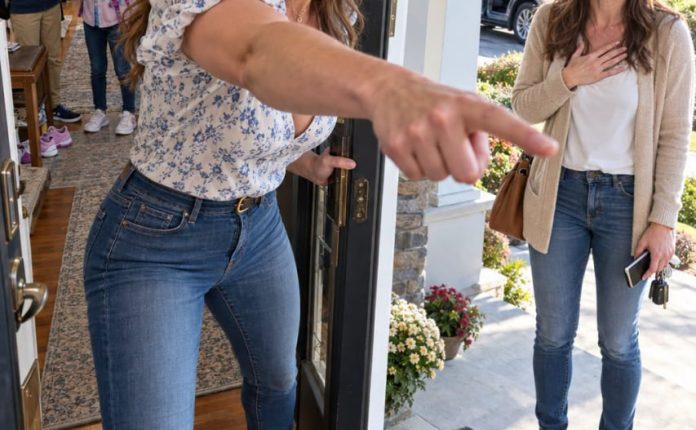
Max appeared in one photograph Louise had taken near the gate.
Arms raised.
Body angled forward.
Leah stood beside him holding the printed pages.
Even frozen in an image, I could see the confidence.
They had not arrived hoping.
They had arrived expecting access.
I called Louise again.
“Did they threaten you?”
“No.”
“Did they try to enter physically?”
“No.”
“Good.”
“I told them they could not pass.”
“Exactly right.”
He hesitated.
“Would you like me to call authorities if they return?”
The question made everything real.
I looked around the villa.
My desk.
The kitchen.
The terrace doors open toward the water.
Until that morning, the place had felt almost removed from the family conflict.
Leah had changed that.
“Yes,” I said.
“If they refuse to leave, do whatever is appropriate.”
“I understand.”
After we hung up, I considered calling Leah.
For maybe five seconds.
I imagined the conversation.
You made fake messages.
No I didn’t.
Louise misunderstood.
Max printed them.
You invited us months ago.
You’re twisting everything.
You embarrassed us.
The argument already existed in my head because we had repeated versions of it for years.
I did not call.
I called my attorney instead.
Not because I wanted to sue anyone.
I did not.
I simply wanted advice about securing the property and documenting attempted unauthorized access.
That conversation was short and practical.
Keep records.
Make access rules explicit.
Update security.
Ensure the caretaker has written authority to deny unapproved visitors.
No drama.
Exactly what I needed.
Then I thought about the larger problem.
Leah had always relied on narrative.
She was louder.
Faster.
More socially connected.
She could turn a refusal into rejection before I had even processed the conversation.
My strategy had always been silence.
For years, silence protected my energy.
But silence also gave other people empty space to fill.
I did not want revenge.
I did not want to post Leah’s fake messages online and invite strangers to attack her.
I did not want a public family trial.
I wanted something more basic.
I wanted ownership of my own story.
That idea stayed with me.
A few days later, I called Alyssa.
She answered almost immediately.
“Blake.”
“Do you have a minute?”
“For you? Sure.”
“I think I have a follow-up.”
She paused.
“What kind?”
“The kind I said I didn’t want to write.”
That got her attention.
We talked for more than an hour.
This time, I told her more.
The vacations.
Mom’s cruise.
Leah’s comments.
The villa request.
The Instagram post.
The way the story had spread.
I told her about my parents asking me to give in.
About Dad saying I had changed.
Then I told her what happened at the gate.
Alyssa went quiet.
“She actually flew there?”
“Yes.”
“After you explicitly told her no?”
“Yes.”
“And she brought messages you did not send?”
“Yes.”
Another silence.
“Blake.”
“I know.”
“Are you sure you want this public?”
The question mattered.
She was not hungry for scandal.
She was warning me.
“If we do a follow-up, it could spread.”
“I know.”
“People will have opinions.”
“They already do.”
“This could make things worse with your family.”
“They’re already worse.”
She sighed.
“What do you want the article to accomplish?”
That question stopped me.
Not what happened?
Not what do you want to say?
What do you want it to accomplish?
I thought about Leah.
Then my parents.
Then the years of photos I was not in.
“I want people to understand what exclusion looks like when it isn’t dramatic.”
Alyssa waited.
“It’s not always someone screaming that you don’t belong.”
I continued.
“Sometimes nobody calls.”
“Sometimes they decide you can’t afford the trip before asking.”
“Sometimes they tell you that you’re boring until you stop showing up.”
“Then when you finally build something they want, suddenly family means access.”
Alyssa was quiet.
“That’s the story,” she said.
Over the next several days, we outlined it.
I sent her old messages.
Not everything.
Enough.
Family group chat screenshots.
The villa request.
The public post.
The gate incident.
I did not want the piece built around humiliating Leah.
I did not send private things unrelated to the story.
I did not want strangers analyzing her marriage or children.
I wanted the pattern visible.
That was all.
While Alyssa worked, I focused on the villa itself.
Louise and I created a formal guest registration system.
He found the idea entertaining.
“You are building a fortress now?”
“No.”
“A moat?”
“Also no.”
“Sharks?”
I laughed.
“A list.”
He looked disappointed.
The system was simple.
Approved guests received a private link.
Basic details.
Arrival dates.
Acknowledgment of property rules.
Confirmation that staff instructions had to be respected.
If a name was not registered, there was no entry.
No exceptions.
No family loophole.
No verbal claims.
I upgraded the security system.
Changed the gate code.
Gave Louise full authority over access.
The villa felt peaceful again almost immediately.
Not because Leah had changed.
Because uncertainty had disappeared.
She could argue with me.
She could post.
She could complain to relatives.
She could not simply walk through the gate.
Then I built a website.
That part was almost therapeutic.
One page at first.
Clean.
Minimal.
The villa needed a name.
I called it Casa Horizonte.
The horizon house.
It fit.
The site showed the property.
Ocean views.
Rooms.
Sustainability work.
The beach.
A section explained that stays were private and available only to approved guests.
No public booking calendar.
No open reservations.
Then I added another section.
The Journey.
I spent two nights writing it.
The essay was called For the Ones They Leave Behind.
I did not mention Leah.
I did not mention Mom or Dad.
I wrote about what happens when people assign you a role and then become angry when you outgrow it.
The quiet sibling.
The failure.
The boring one.
The person everyone assumes will always accept less.
I wrote about rebuilding slowly.
About the strange grief of succeeding without the people whose approval you once wanted.
And about boundaries.
Not as punishment.
Not revenge.
A boundary was simply a door where you controlled the lock.
One line became the center of the piece.
The best revenge isn’t payback. It’s presence.
Living fully.
Refusing to disappear.
When I finished, I sat outside on the terrace and reread it.
For once, the story sounded like mine.
I sent the website privately to a small group.
Friends.
A few colleagues.
Several relatives who had never actively participated in the conflict but had mostly remained distant.
No announcement.
No demand that they take my side.
Just the link.
Then I waited.
Alyssa’s follow-up article was scheduled for Friday morning.
Thursday night, I barely slept.
Not because I regretted it.
Because for the first time, silence was no longer the only thing protecting me.
My own voice was about to exist beside Leah’s.
And I had no idea what would happen once people heard both.
END PART 7