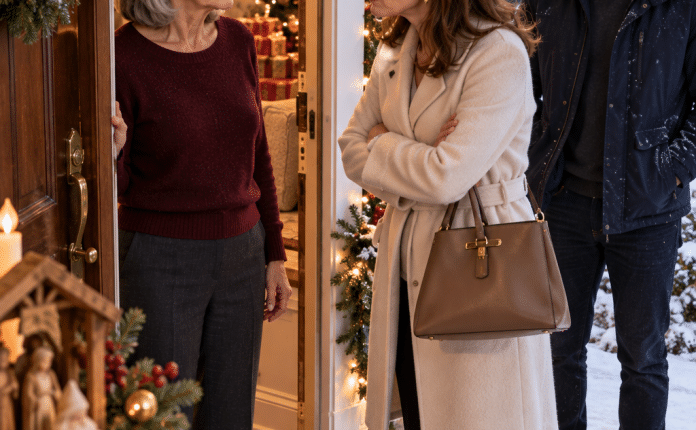
PART 2: Daniel Set a Christmas Table He Would Not Be Sitting At
I handed Daniel the silverware.
Natalie took over the napkins.
For the next twenty minutes, the three of us moved around the dining room with the careful coordination of people who had already said enough.
Nobody discussed the mountain house.
Nobody asked what I planned to do with the food.
Nobody suggested I reconsider.
Daniel placed forks beside plates.
Natalie adjusted glasses.
I checked the serving space twice because Ruth had warned me that seventeen guests would somehow create thirty-seven serving bowls.
At one point, Daniel picked up Tom’s chipped blue serving dish from the sideboard.
He turned it over in his hands.
The chip along one edge had been there for almost twenty years.
“Where does this go?”
“Middle of the sideboard.”
He placed it there carefully.
Then stepped back.
“It looks good.”
“I know.”
The corner of his mouth moved.
Almost a smile.
Tom bought that serving dish during a road trip because he insisted the blue glaze matched my kitchen.
It did not.
Not even slightly.
I complained about it for years, then protected it through three kitchen remodels because losing it would have felt like admitting he was really gone.
Daniel knew that.
Or at least, once, he had.
When the table was finished, Natalie stood by the door with her coat buttoned.
“I really am sorry.”
I nodded.
There was no need to make the moment larger.
She had admitted what she had done.
What mattered next would be whether anything changed.
Daniel hugged me before leaving.
Longer than usual.
“Merry Christmas, Mom.”
“Merry Christmas.”
Natalie kissed my cheek.
“We’ll call tomorrow.”
“If you have time.”
She looked embarrassed.
“We’ll make time.”
I watched their car disappear down the street.
The house stayed quiet for less than a minute.
My back door opened.
Ruth came through carrying three folding chairs under one arm and balancing a pie against her chest.
She was my closest friend and possessed the special talent of entering my home as if doors were merely decorative.
She looked toward the driveway.
“That was them?”
“Yes.”
She put down the chairs.
“How bad?”
“The chef canceled.”
Ruth froze.
Then slowly turned toward me.
“No.”
“Yes.”
Her eyes widened.
“No.”
“Yes, Ruth.”
She placed the pie on the counter.
“And?”
“And nothing.”
“You didn’t go?”
“No.”
“You didn’t send food?”
“No.”
“You didn’t agree to cook fourteen steaks, six side dishes, and some pretentious dessert with a French name?”
“No.”
Ruth pressed both hands together beneath her chin.
“I am so proud of you I could become unbearable.”
“You’re already unbearable.”
“Good.”
She hugged me.
Then stepped back.
“What are they eating?”
“I have absolutely no idea.”
Ruth considered this.
“Character development, apparently.”
I laughed.
Really laughed.
The kind that seems to come from somewhere underneath grief.
For weeks, the entire situation had felt heavy.
Daniel’s embarrassment.
Natalie’s elegant mountain Christmas.
The unspoken message that my food, my traditions, maybe even I myself, belonged to a version of their lives they no longer wanted people to see.
Ruth’s ridiculous expression punctured something.
The chef had canceled.
They were adults.
They would survive.
And I had people coming.
So we went back to work.
Christmas morning began before sunrise.
I woke before the alarm.
By six-thirty, coffee was brewing and the kitchen lights were bright against the dark windows.
The ham went into the oven first.
Then I prepared the chicken.
Fresh rosemary.
Lemon slices.
Garlic.
Butter pushed carefully beneath the skin the way Tom always claimed made the chicken “scientifically superior.”
He never knew what he meant by that.
Neither did I.
The smell alone was enough to make the house feel like Christmas.
Corn pudding waited beside the stove.
Shortbread cooled on wire racks.
Cranberry sauce glowed ruby red in a glass bowl.
Mashed potatoes occupied the largest pot I owned.
At eight, Ruth arrived wearing a red sweater covered with a sequined reindeer.
I stared at her.
“Elegant.”
She spread both arms.
“Very sophisticated crowd.”
I laughed so hard I nearly dropped a potato.
“Please tell me you bought that specifically for today.”
“I have owned this masterpiece for nine years.”
“That is worse.”
“Jealousy is ugly at Christmas.”
She took the peeler from my hand.
“Go check your ham.”
By noon, the house was warm enough that I opened a kitchen window despite the cold outside.
The first guest arrived carrying homemade rolls.
Mrs. Callahan was seventy-six and had taught third grade for thirty-eight years.
Her two sons lived in Australia.
She held out the basket.
“I told you not to bring anything.”
“I ignored you.”
“I see that.”
“This is the first Christmas in forty-six years that neither of my boys is in the country.”
Then she pushed the rolls toward me.
“I decided carbohydrates were an appropriate response.”
I smiled.
“You’ll fit right in.”
Luis and Ana Morales came next.
Ruth knew them through a local community group.
They had moved from Colombia that summer for Luis’s engineering job and had no relatives nearby.
Ana carried a small box.
“My mother makes these at Christmas.”
Inside were delicate cookies covered with powdered sugar.
“You didn’t need to bring anything.”
“I know.”
She smiled.
“I wanted to.”
That sentence caught me.
Wanted to.
Not required.
Not expected.
Not obligated because somebody had cooked for you first.
Wanted.
The distinction kept appearing everywhere once I noticed it.
The college student arrived ten minutes later.
His name was Evan.
Twenty-one.
His parents were overseas with his younger sister, and a snowstorm had canceled the flight he planned to take to visit them.
He stood awkwardly in my doorway holding a bottle of soda.
“You really don’t mind me being here?”
“Take off your coat.”
He did.
Ruth immediately handed him a bowl of mashed potatoes.
“Stir.”
He looked at me.
I shrugged.
“Do what she says. She’s dangerous.”
Within ten minutes, Evan was arguing with Mrs. Callahan over whether gravy could reasonably be considered a beverage.
Then Michael arrived.
Divorced.
His children were in Tennessee with their mother that year.
He carried sparkling cider and admitted, almost sheepishly, that his original Christmas plan involved football and a frozen pizza.
“Not anymore.”
He smiled.
“No.”
The final two guests arrived still wearing hospital badges.
Nurses.
Both had worked a morning shift and expected to eat vending-machine snacks afterward until Ruth heard about them.
One of them, Denise, stepped inside, stopped, and inhaled deeply.
“Oh my God.”
I looked toward her.
“What?”
“Someone cooked.”
That was all.
Someone cooked.
Not:
Who catered?
Not:
Does this match the house?
Not:
Is this sophisticated enough?
Someone cooked.
She hugged me before I had even learned her last name.
By one o’clock, every chair was filled.
I stood near the kitchen doorway counting automatically.
Seventeen guests.
Then Ruth pointed at me.
“You forgot one.”
“What?”
“You.”
I looked at the table again.
Eighteen.
Seventeen people I had invited.
Plus me.
For a moment, I simply stood there.
I had spent so much of my life arranging places for everyone else that I had almost forgotten I needed one too.
END PART 2