PART 12: I Stopped Waiting for Someone Else to Decide Whether I Belonged
Before I left that night, Daniel wrapped one piece of lemon-rosemary chicken and placed it in a small container.
I watched him.
“What is that?”
“For you.”
“I told you I don’t need leftovers.”
“This is different.”
“How?”
“It’s insurance.”
“Against what?”
“You getting hungry.”
“I own food.”
He smiled.
“Take the chicken.”
I did.
Not because he insisted.
Because I wanted breakfast solved.
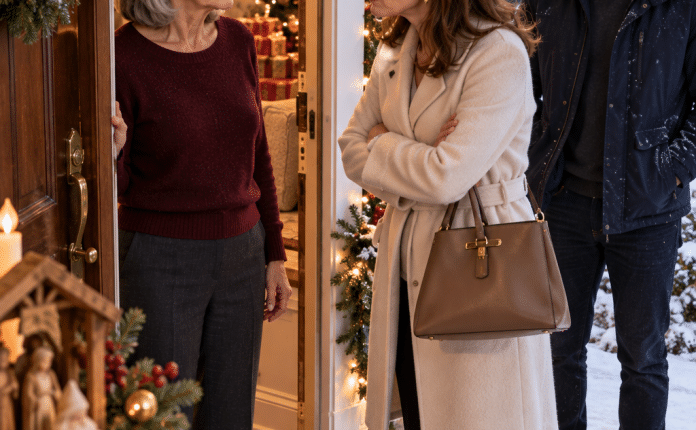
At the front door, Natalie hugged me.
“Merry Christmas.”
“Merry Christmas.”
Daniel carried my coat.
I put it on.
Then he looked toward the kitchen.
The framed grocery list could be seen from where we stood.
Danny home Friday.
Get lemons.
Daniel followed my gaze.
“I think Dad would be pleased.”
“With Christmas?”
“Maybe.”
“With your potatoes?”
“They were Natalie’s.”
“Good save.”
He laughed.
Then became quiet.
“With us.”
I looked at him.
Tom would have been proud of parts.
Annoyed by others.
He would have complained that everyone spent too much money on gifts.
He would have stolen chicken.
He would have told Ruth her sweater was a fire hazard and then asked where she bought it.
Most of all, he would have hated speeches about personal growth.
So I spared his memory one.
“I think he would be glad we ate well.”
Daniel smiled.
“That sounds like him.”
I stepped onto the porch.
Cold air tightened around my face.
“Drive safe,” he said.
“I always do.”
“That is not what Ruth says.”
“Ruth thinks braking is emotional.”
“She may have a point.”
I gave him a look.
“Goodnight, Daniel.”
“Goodnight, Mom.”
I walked toward my car.
This time, I did not leave wondering whether my son was proud of me.
Or embarrassed by me.
Or sufficiently sorry.
Those questions had once felt enormous.
They no longer controlled the shape of my holidays.
Driving home, I thought about the seventeen chairs from the previous Christmas.
Seventeen guests.
Eighteen places once I remembered myself.
Mrs. Callahan with her rolls.
Luis and Ana with cookies from Ana’s mother.
Evan stirring potatoes because Ruth ordered him to.
Michael remembering his grandmother after one bite.
Denise standing in my doorway after a hospital shift and saying, with simple gratitude, “Someone cooked.”
I had invited those people because I thought they needed Christmas.
Some of them did.
What I did not understand until later was how badly I needed that table too.
Daniel had made me feel as though the traditions Tom and I built were something I should hide.
As though love expressed through casseroles, chipped serving dishes, rosemary, lemon, and too much food was unsophisticated.
For a little while, I let his embarrassment reach me.
Then seventeen people arrived and ate everything.
They laughed.
They remembered people they missed.
They took leftovers home.
They asked whether I might invite them again.
Nobody needed the food to represent status.
It represented care.
That was what it had always represented.
Tom knew it.
Long before any mountain house.
Long before a private chef.
Long before Daniel worried about the opinions of people who barely knew where he came from.
Tom wrote five ordinary groceries on a piece of paper.
Milk.
Butter.
Potatoes.
Coffee.
Chicken.
Then he remembered his boy was coming home.
Danny home Friday.
Get lemons.
That was love in our family.
Small enough to fit on a grocery list.
Ordinary enough to be forgotten inside a casserole dish for years.
Strong enough to survive the man who wrote it.
Strong enough to reach his son when nothing else had.
Daniel eventually understood.
Not because the chef canceled.
Not because the tenderloin failed.
Not because his Christmas dinner became inconvenient.
Consequences opened the door.
The grocery list made him look through it.
He finally understood that the food he had been embarrassed by was never about presentation.
It was memory.
It was grief.
It was the first Christmas after Tom died.
It was a mother feeding her son because neither of them had language for how empty the house felt.
And once Daniel understood what he had rejected, he stopped asking me to prove its value.
That mattered.
But his understanding was not the only thing that changed the ending.
Mine did too.
I learned that love was not a chair somebody else had to pull out for me.
I could set one myself.
I could open my door.
Invite people.
Cook what I loved.
Decline invitations that came with conditions.
Accept invitations that sounded like actual invitations.
I could say yes because I wanted to.
No because I meant no.
And neither answer made me less of a mother.
The following weeks returned to ordinary life.
Christmas decorations came down.
The sequined reindeer disappeared back into whatever unfortunate closet Ruth stored it in.
Mrs. Callahan called once to ask for her roll basket because Daniel had accidentally packed it with leftovers.
I laughed for five minutes before telling him.
He drove it to her himself.
Life moved on.
That was part of the resolution too.
Not every repaired relationship needs a final ceremony.
Sometimes people simply begin behaving differently.
Daniel called.
I answered when I could.
Natalie occasionally asked for recipes.
I gave them when I wanted to.
Ruth remained unbearable.
Tom remained gone.
The grocery list remained.
And when the next holiday season eventually approached, I did not feel afraid of the calendar.
That was new.
I did not wonder where I would be allowed to spend Christmas.
I wondered what I wanted.
There is a difference.
One evening, months later, Daniel sent me a photograph.
His kitchen shelf.
Tom’s framed grocery list sat where he had placed it.
Beside it was Daniel’s card.
Make room for whoever is coming home.
His message underneath contained only one line.
Still trying.
I looked at the photograph for a long time.
Then answered.
That’s all anyone can do.
I did not add that Tom would be proud.
I did not know that for certain.
But I knew my husband would recognize the effort.
He always cared more about what people did next than about speeches promising what they planned to do.
That lesson had finally reached both of us.
The year Daniel told me my Christmas cooking was too embarrassing for his guests, I thought the deepest wound was being left out.
It was not.
The deeper wound was allowing someone else’s embarrassment to make me question the value of things built from love.
The seventeen chairs fixed that before Daniel could.
They reminded me that one closed door did not make me unwanted.
One table did not determine whether I belonged.
One person—even my son—did not have the authority to decide whether my traditions were worthy of keeping.
I could set another table.
I did.
And when Daniel eventually learned how to invite me without asking me to leave pieces of myself behind, I could sit at his too.
Not because I needed the place.
Because I chose it.
That was the difference I intended never to forget.
The food had never needed to be elegant.
The table had never needed to be perfect.
Nobody needed a mountain view.
Tom had known what mattered.
A son coming home.
A mother remembering his favorite meal.
Enough lemons.
Enough room.
Care.
That was all.
And it turned out to be more than enough.
Daniel had learned how to ask me to come.
And I had learned that whether my answer was yes or no, I would never again forget how to set a place for myself.