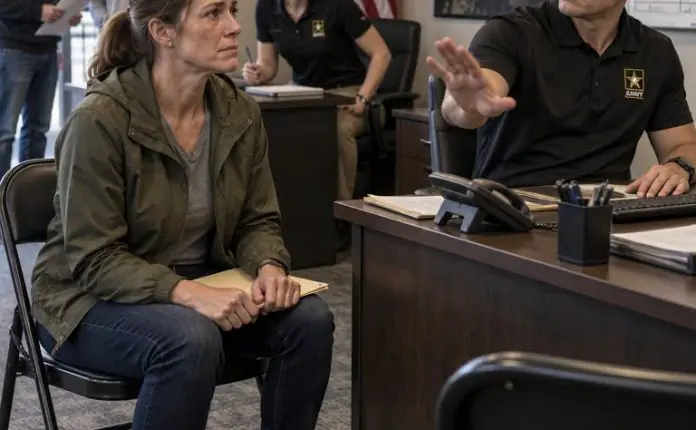
That realization created more pressure than the insult had.
People imagine power feels light.
It does not.
The moment you realize you could humiliate someone publicly is the moment you have to decide whether you actually should.
I could have stood.
I could have pointed to the poster.
I could have named my rank.
I could have forced an apology in front of Alvarez and the young applicants now lingering near the door.
I could have made him very small.
Nobody would have been surprised.
Some people would probably have enjoyed watching it.
I understood that version.
I also understood its cost.
Making someone small in front of people whose respect they need takes something out of a room.
The young people near the door were going to leave for initial training soon.
They would spend months being corrected by people whose job was to turn inexperienced civilians into soldiers.
I did not want one of their last memories of the recruiting station to be a senior soldier using authority to publicly crush a junior one simply because she could.
And then there was Danforth.
There was always going to be Danforth.
For eighteen years, I had carried the apology I never delivered.
Now life had placed a young soldier in front of me who had made essentially the same mistake I had made at twenty-two.
The question was suddenly very simple.
Had I learned anything from regretting it?
Or had I merely learned to resent being on the receiving end?
While Sutter held the phone, I looked at his whiteboard.
Two ship dates filled.
Two more people he was chasing.
Green marks in a year when many stations were struggling.
I thought about what recruiting required.
Twelve-hour days.
Unreturned phone calls.
Parents who distrusted you.
Young people who changed their minds.
Girlfriends.
Boyfriends.
Car payments.
Fear.
He had been casually disrespectful to me for thirty seconds.
He might have spent the rest of the week patiently helping forty other families.
I did not know.
But I knew the job.
That did not excuse what he had said.
Context is not an excuse.
It is simply part of the picture.
And I had spent enough years making decisions about people to know that the whole picture matters.
The pressure was no longer coming from Sutter.
The room was already mine.
The pressure came from the distance between what would feel satisfying and what I believed would be right.
Those two things are not always friends.
I had chosen satisfaction when I was younger.
Sometimes I had walked away feeling tall and woken hours later feeling smaller.
I had also chosen restraint and watched people mistake it for weakness.
That discomfort passes.
Regret tends to stay.
A voice answered on Sutter’s phone.
I made the decision quietly.
“Staff Sergeant.”
He looked at me.
“Put it down.”
He blinked.
“Please. Put the phone down.”
He spoke briefly into the receiver.
“Never mind.”
Then he returned it to the cradle.
His eyes came back to me.
There were several emotions in them.
Fear reached the surface first.
That told me more than he probably intended.
I lifted the folder from my knees and slid it across the desk.
I turned it toward him.
Then I opened it.
“This is a records correction,” I said. “It needs a station stamp and a signature. It may be the most boring piece of paper in this building.”
I moved that page aside.
“And this is a volunteer application. I’m asking to come in on my own time and help you with the pool.”
He looked down.
“That is the entire reason I came here.”
His eyes moved over the volunteer form.
Then they stopped.
Near the bottom was a section for awards and decorations.
I had filled it out because the form asked.
Not because I wanted anyone to read it aloud.
His gaze moved toward the poster.
Back to the form.
“Ma’am… Sergeant First Class…”
“I know you didn’t know.”
He started to speak.
I shook my head.
“That’s the point. You had no way to know because I didn’t tell you.”
He looked at me.
“It shouldn’t have mattered.”
The young applicants by the entrance had stopped pretending they were not listening.
“A woman walked in with a folder and asked you for two minutes. That should have been enough.”
He lowered his eyes toward the paperwork.
“Rank was never supposed to be the admission price for getting looked at.”
I tapped the volunteer form.
“I didn’t come here to be somebody. I came here to help you make your numbers.”
I meant it.
He heard that I meant it.
Something changed in his posture.
Not relief exactly.
The realization that the floor was not about to disappear beneath him.
And that somebody had deliberately chosen not to make it disappear.
People misunderstand authority.
They often imagine authority is the power to make things happen.
Sometimes the most important version of authority is the power to prevent something from happening when everyone expects you to do it.
A new soldier can lose their temper.
It takes longer to learn how to keep one when losing it would be understandable and even applauded.
I kept mine.
Not because what Sutter said was acceptable.
Because the room was full of young people watching what leaders do with mistakes.
I wanted them to see correction without destruction.
Then the back-office door opened.
Master Sergeant Pike stepped out carrying a mug of coffee.
He had been in the Army almost twenty-six years. Gray had started at the edges of his hair, and his reading glasses were pushed onto his forehead.
His expression suggested he expected to sign something ordinary.
Then he saw me.
He stopped.
The coffee did not spill.
He was too experienced for that.
But he stopped the way somebody does when their next step finds the ground in a slightly different place than expected.
His eyes moved from my face to the wall.
Poster.
Me.
Poster.
He completed Alvarez’s calculation in about a second.
“Sergeant First Class Holt.”
I nodded.
“Master Sergeant.”
He set his coffee down.
He did not call the room to attention.
I gave him the smallest shake of my head before he could.
He understood.
“We use your picture to open this place every morning,” he said. “It’s the first thing the pool sees. First thing I see.”
He looked at Sutter.
Then at me.
His jaw tightened.
“Ma’am, I’m going to apologize on behalf of—”
“You are not.”
He stopped.
“Nobody is apologizing on behalf of anybody.”
I kept my tone gentle.
“It’s all right, Master Sergeant.”
He studied me for a second.
I could see every instinct in him telling him to fix the situation loudly.
Senior leaders sometimes struggle with that.
We like fixing.
Especially when fixing lets us discharge our own anger.
But making something right for yourself is not the same thing as making it right for the person standing in front of you.
Pike put that instinct down.
“All right, Sergeant First Class. Your call.”
He looked around the station.
The applicants.
Alvarez.
Sutter.
The poster.
“I’ve been running this station for three years with your face on that wall,” he said. “Maybe I forgot the face belonged to a person who could walk in one morning and need two minutes.”
He glanced at Sutter.
“That’s on me too.”
Nobody moved.
The stillness was not caused by shouting.
Nobody had shouted.
It was the stillness that comes when everybody realizes the loudest possible thing has chosen not to happen.