Part 1
The first thing I noticed was that my apartment door was open.
Not wide open. Maybe three inches.
Just enough for the bright hallway light to cut a thin white stripe across my living room floor.
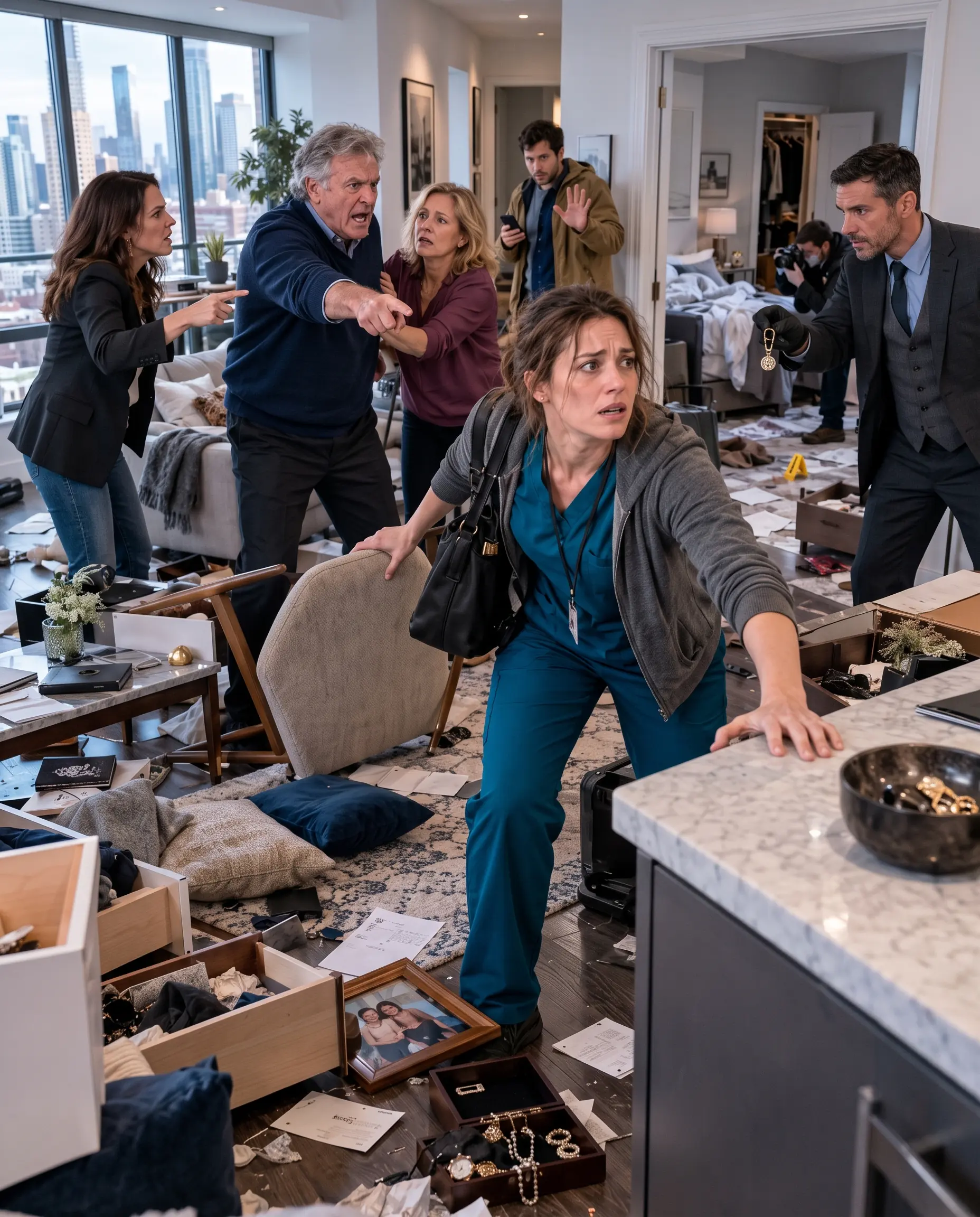
I stood there at seven in the morning with my hospital tote digging into my shoulder, my keys pinched between two fingers, and twelve hours of emergency-room exhaustion sitting behind my eyes.
For a few seconds, I actually wondered if I’d forgotten to close it.
That was easier for my brain to accept.
I’d worked nights at St. Catherine Medical Center for six years. I left my apartment at almost exactly the same time every evening, locked the same deadbolt, pulled the handle once to make sure it caught, then walked down two flights of stairs because the elevator was painfully slow.
I didn’t forget my door.
Still, I whispered, “Maybe I did.”
Then I pushed it open.
My kitchen looked like someone had picked it up and shaken it.
Every drawer had been pulled out.
Forks and spoons covered the floor. Batteries rolled under the refrigerator. Takeout menus were scattered across the linoleum. A ceramic bowl my mother had bought me when I moved into my first apartment was broken beside the trash can.
The living room wasn’t much better.
Couch cushions on the floor.
Desk drawers open.
My laptop gone.
Then I saw my bedroom.
The mattress had been shoved halfway off the frame. Clothes had been ripped from hangers. Shoes lay upside down across the carpet. The contents of my dresser had been dumped in uneven piles.
I didn’t scream.
That’s the strange part.
At work, I’d seen people go into shock after accidents. Sometimes they cried. Sometimes they couldn’t stop talking. Sometimes they became so calm it was almost eerie.
That morning, I became calm.
I placed my bag carefully on the floor.
I backed into the hallway.
Then I called 911.
“My name is Claire Bennett,” I told the dispatcher. “Someone broke into my apartment.”
My voice sounded like someone else’s.
Within fifteen minutes, two officers were walking through the rooms while I sat on the only kitchen chair that hadn’t been overturned.
One officer, Ramirez, asked me not to touch anything.
I nodded.
Then I started making a list.
Laptop.
Cash.
An old tablet.
A small envelope containing gift cards.
Then I thought about the jewelry box.
I stood so quickly the chair legs scraped the floor.
“My bedroom.”
Officer Ramirez turned.
“What?”
“My jewelry box.”
He stopped me before I could cross the doorway.
“Let us look first.”
It wasn’t on the dresser.
It wasn’t under the bed.
It wasn’t in the closet.
The jewelry box itself wasn’t worth anything. It was dark cherrywood, scratched along one corner, with a brass latch that hadn’t closed properly since I was sixteen.
My mother had given it to me when I turned twelve.
After she died, I kept something else inside it.
Her engagement ring.
My mother, Anne, died from a sudden illness when I was twenty-two.
The ring wasn’t impressive by jewelry-store standards.
Small diamond.
Plain gold band.
The underside was slightly worn from decades against her finger.
I had never worn it.
I didn’t even know if it fit.
That wasn’t the point.
Sometimes after difficult shifts, especially around her birthday, I opened the jewelry box just to make sure it was still there.
That sounds ridiculous until you’ve lost somebody.
Then objects become strange things.
A sweater isn’t a sweater.
A handwritten grocery list isn’t paper.
A scratched ring isn’t metal and stone.
It’s proof that somebody once occupied the same physical world you still live in.
Officer Ramirez found the square of faded blue flannel I’d used to wrap the ring.
It was under the bed.
Empty.
That’s when my hands started shaking.
“Anyone else have access to your apartment?” he asked.
“No.”
Then I stopped.
About eighteen months earlier, my older brother, Marcus, had helped me move a sectional into the apartment.
I’d bought it used from a couple across town, and Marcus borrowed his friend’s pickup to help me.
For one afternoon, he was the brother I remembered from childhood.
He complained about the stairs.
I bought Thai food.
He laughed when the couch got stuck in the landing.
At one point, I gave him my spare key because he needed to get back inside while I drove to the hardware store.
I never got it back.
And I’d never asked.
“Actually,” I said slowly, “my brother may still have a key.”
Officer Ramirez’s pen stopped.
“Name?”
“Marcus Bennett.”
“When did you last speak?”
I hated how quickly the answer came.
“Three months ago.”
The conversation had happened on a Sunday afternoon.
Marcus had called while I was folding laundry.
He skipped hello.
“I need eight grand.”
I laughed because I assumed he was kidding.
He wasn’t.
He’d gotten into financial trouble. He was vague about the details, only saying he’d made “a couple stupid decisions” and needed to settle something quickly.
I had nearly twenty-four thousand dollars in savings.
He knew that because my father had once mentioned my house fund at dinner.
But having money saved isn’t the same thing as having money available for somebody else’s crisis.
I’d spent almost three years picking up extra shifts, packing lunches, driving a ten-year-old Honda and telling myself that eventually I’d stop paying rent and own something.
“I can’t give you eight thousand dollars,” I told him.
“You can.”
“No, Marcus.”
“You literally can.”
“It’s my down payment.”
He went quiet.
Then he said, “Dad would help me if he had it.”
That sentence bothered me more than the request.
I said, “Then ask Dad.”
“He doesn’t have it.”
“Neither do I.”
“You just said you do.”
“No. I said I have savings.”
“Same thing.”
“No, it isn’t.”
Another silence.
Then he gave a humorless laugh.
“Okay, Claire. Got it.”
He hung up.
We hadn’t spoken since.
I told Officer Ramirez.
He didn’t react, but he wrote everything down.
Our building manager, Denise Cooper, came upstairs while the officers were finishing.
Denise was in her sixties, always wore bright glasses, and knew everyone’s delivery drivers by name.
Her face changed when she saw my apartment.
“Oh, honey.”
“Does the hallway camera work?” I asked immediately.
“It should.”
“Can you check?”
She nodded.
The security camera near the elevator covered almost my entire hallway.
Denise took the officers downstairs to access the recording.
I stayed upstairs because there was nowhere else to go.
I sat on my crooked mattress holding that piece of blue flannel.
I remembered my mother’s hands.
She used to twist the ring when she was thinking.
Around and around her finger while she balanced the checkbook or waited for water to boil.
A stupid detail.
A tiny one.
Suddenly it was all I could think about.
Twenty minutes later, Officer Ramirez came back.
His expression had changed.
“Ms. Bennett?”
I stood.
“We have footage of a man entering this floor at approximately 4:40 this morning.”
My mouth went dry.
“He didn’t force the door.”
I looked at him.
“He used a key.”
The hallway seemed to tilt.
“Can you see his face?”
“Some of it. We’re pulling clearer frames.”
He hesitated.
“Do you have a recent photograph of your brother?”
I stared at him.
And for the first time that morning, I felt something worse than fear.
Recognition.
I called my father before I could talk myself out of it.
He answered after two rings.
“Claire?”
“Dad, somebody broke into my apartment.”
Silence.
I told him everything.
The drawers.
The laptop.
The missing jewelry box.
The hallway footage.
Marcus still having my spare key.
My father didn’t interrupt.
When I finished, I expected shock.
Anger.
Maybe disbelief.
Instead, he asked, “Are you sure you locked the door?”
I frowned.
“What?”
“You work nights. You’re exhausted. Maybe you forgot.”
“The camera shows somebody using a key.”
“That doesn’t mean it was Marcus.”
“I haven’t even told you what the person looked like yet.”
Another silence.
This one made the hair on my arms rise.
“Dad?”
He cleared his throat.
“I just don’t want you accusing your brother before you understand everything.”
Everything.
I looked down at the empty piece of flannel in my palm.
“What exactly is there to understand?”
And that was when my father said something that told me he already knew far more than he’d admitted.
“Marcus was desperate, Claire.”
I stopped breathing.
“Dad,” I said quietly. “How did you know that had anything to do with this?”
He didn’t answer.
And suddenly the burglary wasn’t the only thing I needed explained.
Part 2
My father tried to walk it back.
“I didn’t say he did anything.”
“You said Marcus was desperate.”
“Because you brought up Marcus.”
“No. I said someone entered with a key.”
“Claire—”
“Did you know he was coming here?”
“No.”
The answer came too quickly.
At work, you learn that sometimes what people don’t say matters more than what they do.
I’d spent years listening to patients hesitate around questions about injuries, drinking, home safety, and whether somebody was hurting them.
My father’s hesitation had a shape.
“Did Marcus tell you he still had my key?”
“I don’t remember.”
“Did he tell you he needed money?”
“He’s been having a hard time.”
“I know. He asked me for eight thousand dollars.”
My father’s tone sharpened.
“And you said no.”
There it was.
Not concern.
Not surprise.
A grievance.