After nine months on deployment, I finally walked back into my own house—only for my mother-in-law to block the doorway. Then she handed me a laminated list of rules for how I was expected to behave while living under my own roof. I looked at the paper. Then I looked at her. And I smiled. Because at exactly 5:00 the next morning, she was going to learn whose house she had been pretending to control.
Part 1: The Rules Waiting in My Own House
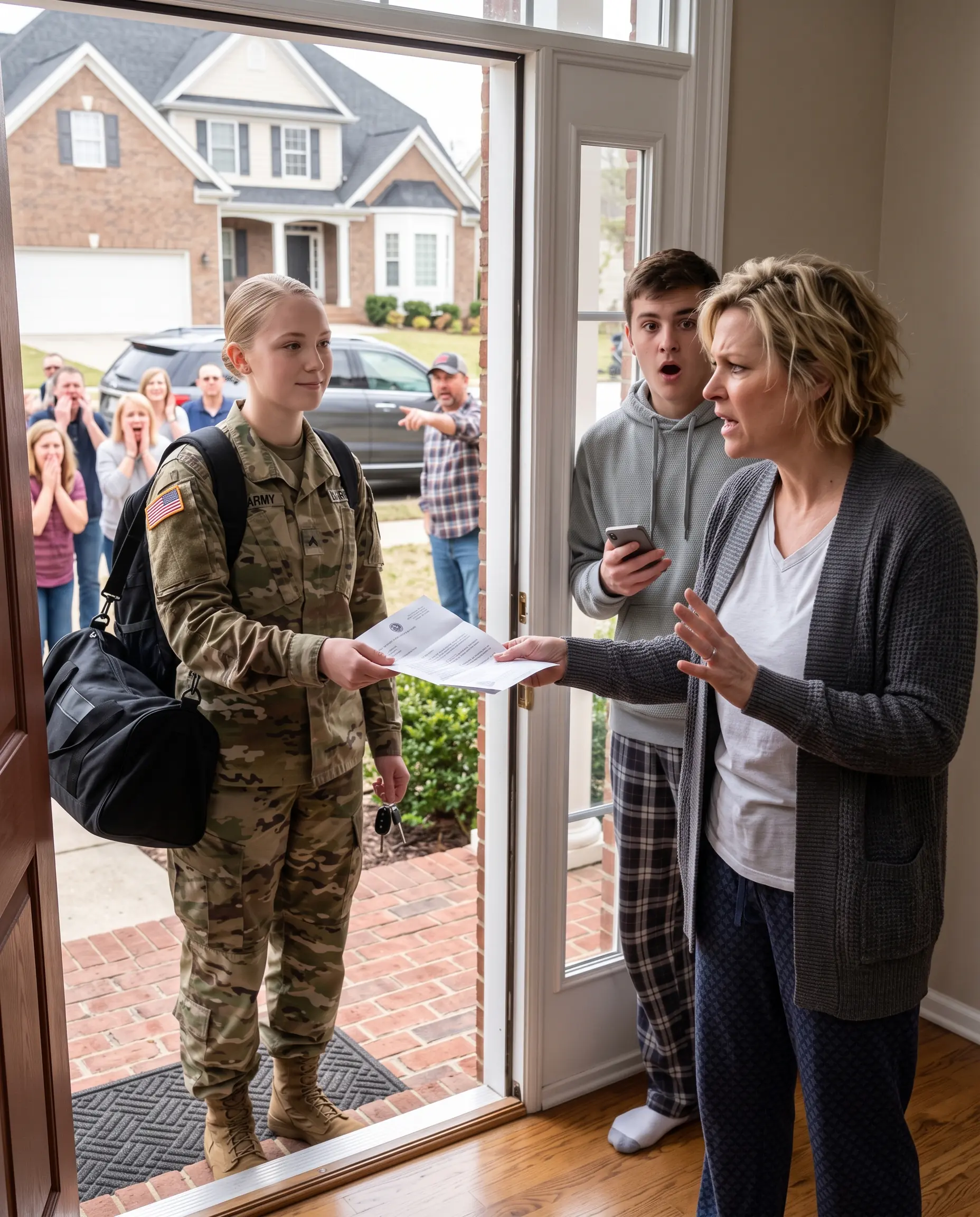
After nine months overseas, I came home dreaming of silence, clean sheets, and my husband opening the door before I reached it.
Instead, I turned my key in the lock and found a pink laminated sign hanging beside my coat closet.
HOUSEHOLD EXPECTATIONS.
For a second, I thought I had walked into the wrong house. Then I saw the scratch on the hardwood floor from the bookcase I had dragged years earlier, and I knew exactly where I was.
My house.
Just not mine anymore.
Two huge boxes blocked the foyer. My white entry bench was buried under flowered cushions. My framed Hill Country photograph had been replaced by a wooden rooster with a gingham bow, and a television was playing from my bedroom.
My bedroom.
“Ethan?” I called.
No answer.
Instead, my mother-in-law, Diane Walker, appeared in the hallway wearing my navy silk robe. Behind her came Ethan’s younger sister, Megan, holding my favorite blue pottery mug.
Neither of them looked surprised.
No gasp.
No hug.
No welcome home.
Diane only adjusted her glasses. “You’re earlier than Ethan said.”
I stared at her. “Why are you wearing my robe?”
“It’s comfortable.”
Megan sipped from my mug. “Mom, are we still doing chicken tonight?”
I felt something cold settle beneath my ribs. “Why are you both living here?”
Diane picked up a clipboard and pressed a laminated sheet against my chest.
“You’ve been gone a long time, Laura. The household has a routine now. It would be easier if you respected it.”
At the top, written in red marker, were four words:
GUIDELINES FOR LAURA.
Dinner at 5:30. Morning laundry. Kitchen cleaning. Bathroom rotation. “Work-related excuses” were disruptive.
Then I reached rule three.
The primary bedroom had been assigned to Diane because of her knees. I was to sleep in the downstairs office.
Rule four was worse.
“$900 monthly household contribution,” I read aloud.
“You’re charging me rent?” I asked.
“It’s not rent. It’s contribution.”
“In my house.”
Before she could answer, the garage door opened. Ethan walked in with groceries, saw me, and froze.
There should have been joy on his face.
Instead, there was fear.
I lifted the laminated sheet.
“What is this?”
Part 2: The Room They Left Me
Ethan set the groceries down slowly.
“Can we talk privately?”
“We can talk right here.”
Diane crossed her arms like she was the one being inconvenienced. Ethan rubbed the back of his neck.
“Mom and Megan had trouble with their apartment.”
“So you moved them into my house.”
“Our house.”
The words escaped before he could stop them.
My eyes narrowed.
“The deed says otherwise.”
He swallowed. “I mean our home. Obviously.”
“How long have they been here?”
“About three weeks.”
That made everything click.
I had video-called him from this house less than a month earlier, and the background had looked normal. Diane had moved in near the end of my deployment, which meant this takeover had been fast and deliberate.
Ethan stepped closer.
“Their landlord sold the building. They needed somewhere temporary.”
“Temporary guests don’t take the primary bedroom.”
Diane scoffed. “I have a knee issue.”
“Then use the downstairs room.”
“That room is tiny.”
I almost smiled.
“So you agree.”
Nobody answered.
Ethan lowered his voice. “You’re exhausted. Please don’t turn this into a war.”
Nine months overseas, and my husband was warning me not to create conflict because I objected to being assigned rent and chores in my own home.
But anger is useful only when you control where it goes.
The Army had taught me one rule I never forgot.
Never react before you understand the terrain.
So I let my shoulders drop.
“You’re right,” I said. “I’m tired.”
Diane looked pleased.
“I knew you’d understand once you settled down.”
I slipped the laminated sheet into my jacket pocket and carried my bags to the downstairs office.
The door barely opened. My desk had been shoved against the wall, a narrow twin bed squeezed inside, and my books were stacked in plastic bins.
A cheap floral comforter covered the mattress.
I closed the door.
Locked it.
Then I sat on the edge of the bed and opened my laptop.
Part 3: The Money Trail
I started with the security system.
Diane had been added as an authorized user.
So had Megan.
Then I checked the thermostat, the streaming account, and grocery delivery. Diane and Megan were everywhere.
Recurring orders had been created for wine, prepared meals, imported coffee, beauty products, furniture, and decorations.
Then I opened the secondary checking account.
That account existed for property taxes, emergency repairs, landscaping, appliances, and legitimate household costs while I was deployed.
Before I left, it held $14,800.
The balance was $1,126.
I stopped breathing.
Transaction after transaction filled the screen: department stores, salons, spas, furniture, jewelry, credit-card payments, and charges with Megan’s name in the notes.
I downloaded everything.
Then I saw a $2,400 transfer made five days earlier.
The memo said only one word:
CONSULTATION.
I almost called Ethan from behind the locked door.
Then I stopped.
Not yet.
For the next hour, I photographed the room, the boxes, my belongings in the garage, the new furniture, and every unfamiliar item in my house.
At dinner, I played along.
Diane served chicken at exactly 5:30 and checked the clock before sitting. Ethan kept glancing at me. Megan talked about a weekend trip she wanted to take once “everything settled.”
I barely spoke.
Diane mistook my silence for surrender.
By eleven, the house was quiet.
I was still awake.
Around midnight, I stepped into the hall for water and heard Diane whispering in the living room.
“It’s easier than we thought.”
A man answered on speaker.
“And you believe she’ll agree?”
Diane laughed softly.
“Ethan can handle her.”
I stood still in the dark.
Then she said, “Once Ethan gets Laura to sign, the rest is simple.”
Sign what?
The man lowered his voice.
“I still recommend she have independent counsel before any property transfer.”
My entire body went cold.
Diane snapped, “She doesn’t need a lawyer for a simple family arrangement.”
Then came the sentence that changed everything.
“Once the deed is moved out of Laura’s name, we’ll refinance, and she won’t be able to throw anybody out.”
Part 4: The Broker
I did not sleep.
At two in the morning, I sat on the narrow bed and built a timeline.
Three weeks earlier, Diane and Megan moved in. Two and a half weeks earlier, the first furniture purchase appeared. Nine days earlier, Ethan transferred $1,500 to Megan’s credit card. Five days earlier, the $2,400 consultation charge appeared.
Three days earlier, Ethan had asked when I expected to arrive home.
I had thought he was excited.
Now I wondered if he had been checking a deadline.
I searched our shared email archives, then checked printer history through the home-office network.
Most people never think about printer logs.
I do.
Six documents had been printed from Ethan’s laptop in the previous week. One title included “Texas deed.” Another contained “refinance.”
At 2:47 a.m., I called Martin Cole, a civilian attorney I trusted.
He answered on the fifth ring.
“Laura? It’s almost three.”
“I need a favor.”
He heard my voice and became alert.
I gave him the short version.
When I mentioned the deed conversation, he interrupted.
“Do not sign anything. Do not argue about ownership tonight. Send me the deed, bank statements, and everything you have.”
By sunrise, I had a plan.
But I did not blast music, throw luggage outside, or lock anyone out. That would have felt satisfying for five minutes and created a legal mess.
Instead, I showered, made coffee, and waited.
When Diane came downstairs at seven, my laminated rules were placed neatly beside my mug.
“You’ll need to clean the downstairs bathroom before breakfast,” she said.
“No.”
She turned slowly.
“What?”
“I said no.”
“We discussed this.”
“No. You handed me instructions. That is not a discussion.”
Her lips tightened.
“I don’t appreciate your tone.”
“And I don’t appreciate strangers assigning chores inside property they don’t own.”
“I am not a stranger.”
“You are not an owner either.”