That assumption came from experience. Our family settled problems through closed conversations, quiet reimbursements, and requests that the least emotional person compromise.
Sloan had watched Mom smooth over previous boutique problems and watched Dad avoid asking what anything cost. She knew Caleb would protect his marriage first. She knew they would ask me to produce peace before they asked her to produce proof.
The planted wallet gave them something tangible to discover. The invented cash gave them a moral reason to reach into my savings.
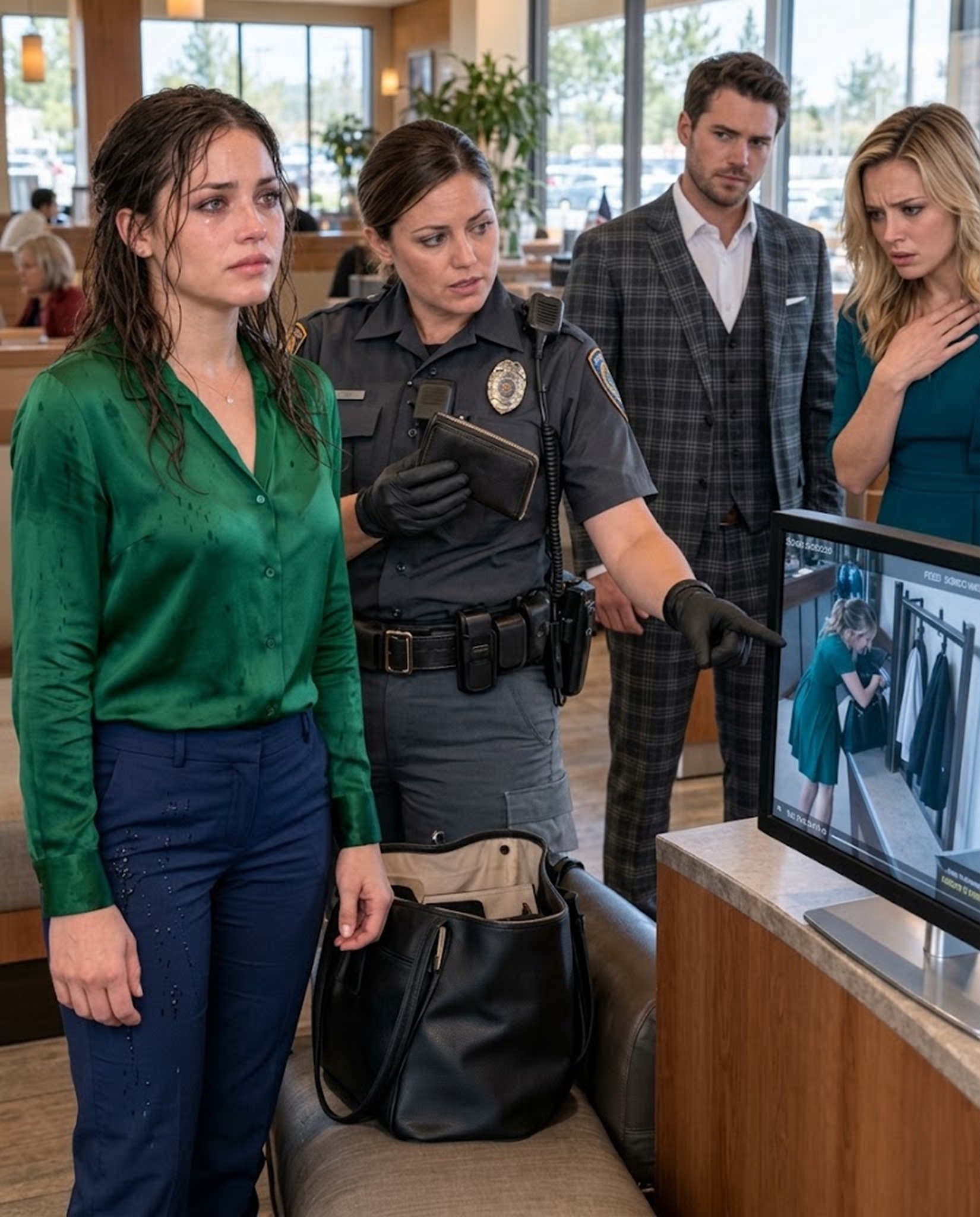
Sloan did not need the story to survive an investigation. She needed it to survive one family dinner and the hours before her supplier deadline.
When I insisted that an accusation of that magnitude should be formal, she panicked. The water was not part of her careful plan. It was what happened when humiliation failed to control me quickly enough.
Even after the footage exposed her, Sloan signed the complaint because she believed tears and a revised story might still compete with evidence.
They did not.
The $13,000 had measured her emergency. She had simply decided my savings should answer it.
My family understood the records a week before they understood what I needed from them.
Mom, Dad, and Caleb came to my apartment without Sloan. I let them in because I wanted one conversation in a place where no one could order me to leave.
Before anyone sat down, I asked them a question.
“What evidence did you have when you made me leave?”
Mom glanced at Caleb. “Sloan said the wallet was gone. You admitted you had argued about money. The wallet wasn’t found until the police came.”
“At the table, you had her accusation and nothing else.”
“She was hysterical.”
“That described her emotion. It did not establish my guilt.”
Mom sat on the edge of my sofa.
“Sloan grew up being moved from one apartment to another. Financial trouble terrifies her. I am not defending what she did, but you need to understand how desperate she was.”
“Her childhood explains why she feared losing the business,” I said. “It does not explain why I had to be framed for a felony.”
“She wasn’t thinking clearly.”
“She brought an empty wallet, put it inside my bag, waited through dinner, named an amount, and demanded payment. Which part wasn’t planned?”
Mom looked down.
“I should not have told you to leave.”
“Why did you?”
Her answer was honest enough to hurt.
“Because you were the one I thought would actually go.”
She had not selected the person who caused the danger. She had selected the person most likely to obey.
Caleb leaned forward. “She deceived me, too.”
“She did. But she didn’t make you tell me to leave.”
His face tightened. “I was trying to keep the situation from exploding.”
“It had already exploded. You chose which woman should absorb it.”
“She was my wife.”
“And I was your sister. Neither relationship required you to declare me guilty.”
“I didn’t declare you guilty.”
“You told me to leave after she threw water in my face because she said I had stolen from her. You do not get to rename that as neutrality now.”
Dad had said almost nothing. Finally, he looked at me.
“I didn’t believe you stole it,” he said.
That hurt more than another excuse would have.
“Then why did you let them throw me out?”
“It was my retirement dinner. People were watching. I thought if you left, we could sort it out afterward.”
“You decided your dinner mattered more than whether your daughter was publicly called a criminal.”
He lowered his head. “Yes.”
Mom began to cry. She asked whether I could tell the prosecutor that I did not want Sloan’s life destroyed.
I told her I would answer every official question truthfully, but I would not suppress evidence or ask anyone to pretend a planned deception was merely a family misunderstanding.
Dad asked what accountability from them would look like.
“The accusation traveled beyond the private room,” I said. “The correction has to travel just as far. Every guest and relative who heard that I stole money needs an unqualified statement that Sloan planted the wallet and that all of you forced me from the dinner without evidence.”
“And then you forgive us?” Mom asked.
“Then the record is corrected. Forgiveness is a different question.”
I looked at each of them.
“Desperation explains why she wanted money. It does not excuse how she tried to get it. And her lie does not excuse what each of you did before the camera saved me.”
I established no contact with Sloan. I told Mom I needed distance until she could apologize for her own decision without placing Sloan’s fear in the same sentence. Dad could contact me individually. Caleb could write to me, but I would decide whether and when to answer.
They left without a group embrace or a promise that everything would return to normal.
Normal was the system that had made Sloan’s plan possible. I did not want it back.
The legal case ended months later through a plea agreement rather than a theatrical trial. Sloan admitted that no $13,000 had been inside the wallet at Northline Grill. Her agreement resolved the false report, attempted deception, and the water incident with probation, community service, required counseling, restitution for my direct losses, and an order preventing her from contacting me.
I read the factual admission twice. It described the wallet, the false cash claim, and the plan to pressure me. The language was plain. No sentence called Sloan evil, and no sentence needed to. The sequence of her choices was enough.
I gave a truthful statement and asked for nothing beyond proportionate accountability. I did not need imprisonment or public humiliation to prove that what happened mattered.
Sloan & Sage closed before the case ended. The supplier terminated its account. The payment hold continued, and the debts were larger than the image Sloan had maintained.
I had not destroyed her business. The business had already been failing when she placed the wallet inside my tote.
Caleb separated from her after reviewing the rest of their finances. He found concealed balances, overdue accounts, and years of partial explanations. Their divorce became final after the plea.
He did not present the divorce as compensation when he wrote to me.
“I disclosed your savings. I believed her because challenging her felt harder than challenging you. I told you to leave when I knew your character better. Those were my decisions.”
It was the first apology from him that did not ask me to understand him before he understood me.
Mom and Dad sent a written correction to every relative and guest who had received the accusation. They stated that Sloan had planted the wallet, that no $13,000 had existed, and that they had forced me from the dinner without evidence.
Dad refused to soften the wording. Mom signed it.
The correction arrived in the same family thread that had filled with explanations on the night of the dinner. An aunt apologized for accepting the story. My cousin admitted that Sloan had allowed guests to leave believing the police had found proof against me.
I read the responses and did not rush to reassure anyone that we were still a family.
The correction restored the facts. It did not restore the family we had been before.
Dad and I began meeting for breakfast once a month. He never again called his silence neutrality.
Mom respected the months when I did not answer her calls. When I eventually resumed limited contact, I met her separately and ended conversations whenever she tried to manage my relationship with Caleb.
I did not return to large family celebrations immediately. No one received access to me simply because a holiday arrived or because an empty chair made them uncomfortable.
For the first time, absence was not a punishment imposed on me. It was a boundary I could choose.
Caleb and I met for coffee after his divorce became final. He looked older than he had at Northline Grill.
“I know ending my marriage doesn’t earn my sister back,” he said.
“No. But taking responsibility gives us somewhere honest to start.”
We did not recover seven years of distance over one cup of coffee. We began with occasional messages and short meetings. I stopped measuring progress by whether our relationship looked normal to anyone else.
Caleb never asked me to meet Sloan, carry messages, or help him process the divorce. That restraint mattered more than a dramatic promise would have. It showed that he was beginning to understand my life was not the place where other people’s consequences should be stored.
Nearly a year after Dad’s dinner, I invited a few people I trusted to eat at my apartment.
There were no assigned family seats and no expectation that anyone tolerate harm merely to protect the evening. I chose the menu myself, cooked only what I wanted, and left one chair unused because the table did not need to be full to prove I was loved.
The quiet before my guests arrived felt peaceful rather than abandoned.
I hung my coat on the hook inside my own doorway. No one touched it without asking.
In the kitchen, I filled a clear pitcher with water. For a moment, I remembered ice striking my collarbone and my mother pressing my belongings against my soaked blouse. The memory remained, but it no longer controlled the object in my hands.
The doorbell rang.
I set glasses around the small table and opened the door to people whose trust did not depend on a camera.
When everyone was seated, I poured the water and placed the pitcher in the center of my table.
That night, I understood something I wish I had learned much earlier: peace is not the absence of conflict when one person is always required to carry it. Peace is the presence of truth, accountability, and the freedom to say no without being punished for it.
The police had cleared my name in less than an hour. Reclaiming my place in my own life took longer. It required me to stop treating endurance as proof of love and to stop mistaking obedience for maturity.
Family can survive an uncomfortable truth. What it cannot survive—not honestly—is a system that protects appearances by sacrificing the person most likely to remain quiet.
I did not get my old family back.
I got something more honest: relationships that had to knock before entering, apologies that did not demand immediate forgiveness, and a table where no one had to surrender dignity just to keep a seat.