He just said he had put it in a clean envelope and would leave it wherever I wanted.
I told him to put it in our mailbox after we were home.
When I found it there, the mitten had been washed.
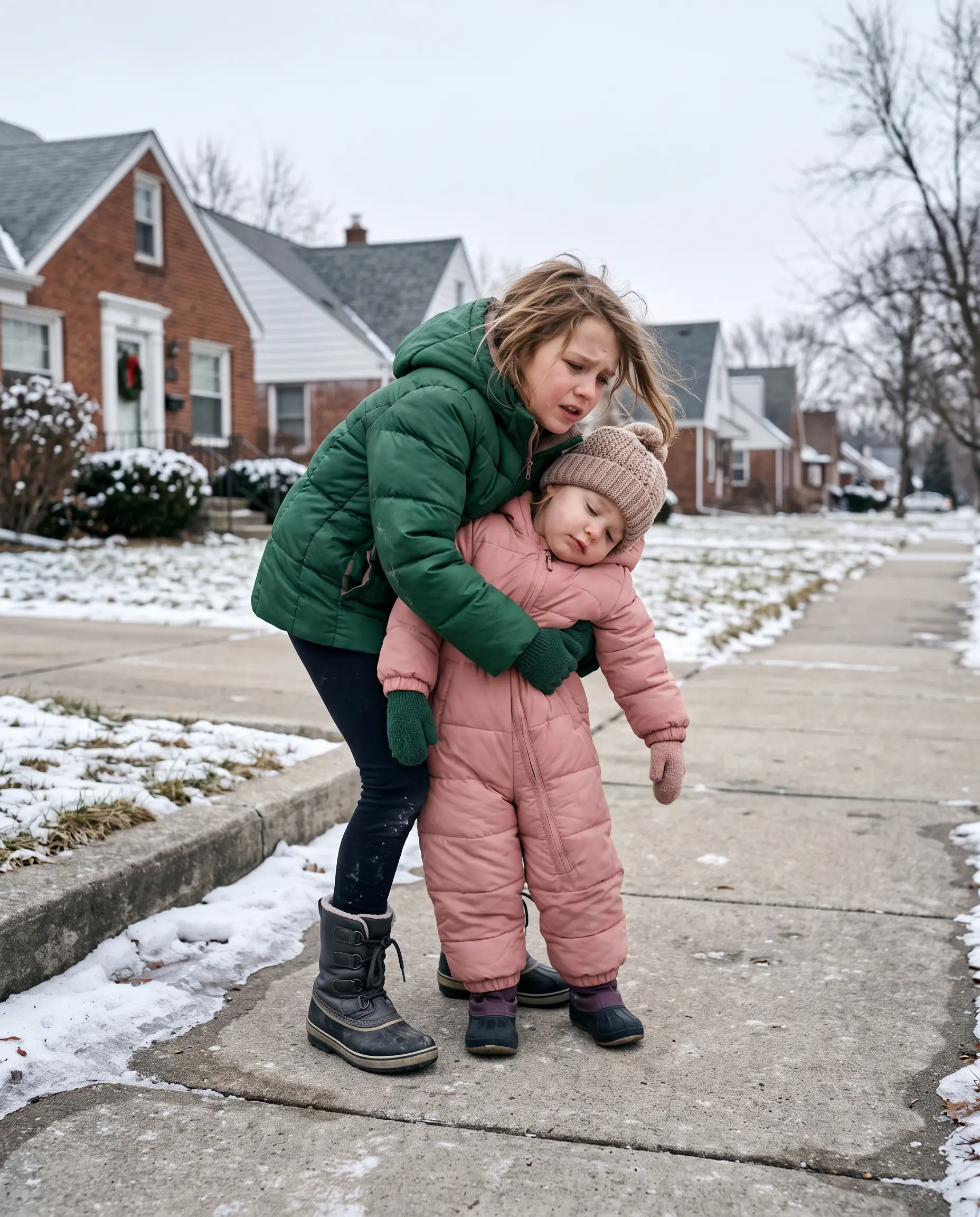
That bothered me more than if it had still been dirty.
The dirt had been part of what happened.
Washing it made me think about how badly adults sometimes want to clean the evidence of a moment they cannot undo.
I didn’t throw it away.
I didn’t give it back to my daughter either.
I put it in a drawer.
My mother sent messages for weeks.
Some were angry.
Some were wounded.
Some sounded almost apologetic until the apology reached the sentence where she explained why I had caused her to react the way she did.
I stopped reading those.
My father sent fewer messages.
His were short.
“I understand.”
“I won’t come by.”
“Tell me if there is anything practical I can do.”
For a long time, I didn’t ask him to do anything.
He had watched my daughters leave once.
I needed him to understand that regret did not erase the choice that came before it.
My husband came home after his doctors were satisfied he could recover there.
The girls became almost comically protective of him.
My three-year-old kept bringing him objects he didn’t need: a plastic spoon, one sock, a stuffed animal, a folded napkin.
My eight-year-old was quieter.
For several nights, she asked where her sister was before she went to sleep, even when they had been in the same room five minutes earlier.
She also started checking whether doors were locked.
That was the part that stayed with me.
Before Christmas, a door had been an ordinary thing to her.
After Christmas, she noticed them.
Open.
Closed.
Locked.
Unlocked.
Who was on which side.
One evening she asked, “Do we have to go to Grandma’s again?”
I was putting groceries away.
I stopped with a carton of milk in my hand.
“No.”
She waited.
“Even if she says sorry?”
“You don’t have to go anywhere just because somebody says sorry.”
She looked toward the living room, where her little sister was sitting on the floor near their dad.
Then she nodded and went back to helping me put cans in the pantry.
Months passed before my father saw them again.
It happened because my older daughter asked whether Grandpa was still sad.
I told her the truth as simply as I could.
“Probably.”
“Do you hate him?”
“No.”
“Do you trust him?”
That answer took longer.
“Not the way I used to.”
She seemed to understand that better than I expected.
When she eventually said she wanted to see him, we arranged it with us present.
No surprises.
No unsupervised visit.
No pretending Christmas had never happened.
My father arrived carrying nothing.
No giant gifts.
No bag of candy.
No attempt to buy back his place in their lives.
He sat down and told my eight-year-old, “I saw you leaving, and I should have stopped you. I didn’t. That was wrong.”
She looked at him for a long time.
Then she asked, “Why?”
He didn’t say Grandma made him.
That mattered.
“Because I was more afraid of arguing with another adult than I was focused on keeping you safe.”
My daughter looked down at her shoes.
“I was scared.”
“I know.”
“You could see us?”
His face folded.
“Yes.”
She moved closer to me.
My father did not reach for her.
He let her decide the distance.
That was the first useful thing he had done with his regret.
My mother refused those conditions.
She said she would not be treated like a dangerous person.
She said family shouldn’t need supervision.
She said children should not be allowed to control adults.
So there was no visit.
There was no dramatic confrontation either.
I didn’t drive to her house.
I didn’t demand that she understand.
I had spent too many years believing every boundary needed a closing argument.
It didn’t.
The following Christmas looked completely different.
My husband was home.
The girls were healthy.
We stayed in our own house.
My older daughter helped her sister put sprinkles on cookies and complained that half of them were ending up on the floor.
My husband burned the first batch because he got distracted fixing something under the sink.
I made coffee and forgot where I set it down.
Nothing about the day was impressive.
That was exactly what I wanted.
In the afternoon, someone knocked.
My eight-year-old froze for half a second and looked at me.
I checked first.
It was a package delivery.
I opened the door, took the box, and thanked the driver.
When I turned around, my three-year-old was trying to drag a grocery bag that was almost as big as she was across the kitchen because she had decided she was helping.
Her sister laughed and grabbed the other handle.
Together they carried it the last few feet.
Then my older daughter went back to the front hall.
She put one hand on the open door and looked outside at the cold air.
For a second, I remembered her standing on another porch, waiting for adults to change their minds.
This time she was inside.
This time her sister was beside her.
This time she was the one holding the door.
She looked back at me and asked if she could close it because the house was getting cold.
I nodded.
She pulled it shut, turned the lock, and ran back to her sister.