The day I arrived with the last of my belongings, we sat on the porch together and drank sparkling cider.
Fireflies flickered across the yard.
For the first time in years, every room around me had been arranged entirely around my own needs.
No one else’s schedule.
No one else’s children.
No one else’s expectations.
Just mine.
It felt peaceful.
Then Naomi found the address.
I don’t know whether she got it from a relative or searched the county property records.
She showed up one Saturday carrying a bottle of wine and saying she had been worried about me.
I let her inside.
She walked through every room.
She opened doors.
Looked into closets.
Commented on the kitchen.
Brent asked questions about the square footage.
Then he asked about the water pressure.
Then the HVAC system.
They were supposed to be visiting their aunt.
But they were inspecting a property.
After they left, I stood on the porch and watched their car disappear down the driveway.
I had a strange feeling.
The kind that comes just before a storm.
The following week, I installed the security cameras.
I changed every entry code.
And I made certain that Naomi never received a key.
Or so I thought.
Now, ten months after that Christmas conversation, I was lying in a guest room nearly two hundred miles away, watching my niece unpack my home through a camera on my phone.
She was placing her family’s belongings inside rooms I had renovated with my retirement in mind.
I could have called her.
I could have demanded an explanation.
I could have listened to her tell me it was an emergency.
That she had nowhere to go.
That family was supposed to help family.
That she assumed I would understand.
And perhaps the old Dolores would have listened.
The woman who had spent eleven years rescuing Naomi might have tried to solve the problem.
But I wasn’t that woman anymore.
I saved the camera footage.
Then I called 911.
“There are people inside my home,” I told the dispatcher.
“I’m out of town, but I can see them moving boxes into the bedrooms.”
“Do you know them?”
“Yes.”
I took a breath.
“The woman is my niece.”
“Did you give her permission to enter?”
“No.”
“Did you give her a key?”
“No. I didn’t give anyone a key.”
The dispatcher confirmed my address and sent a patrol unit.
I watched the driveway camera.
Eleven minutes later, headlights swept across the screen.
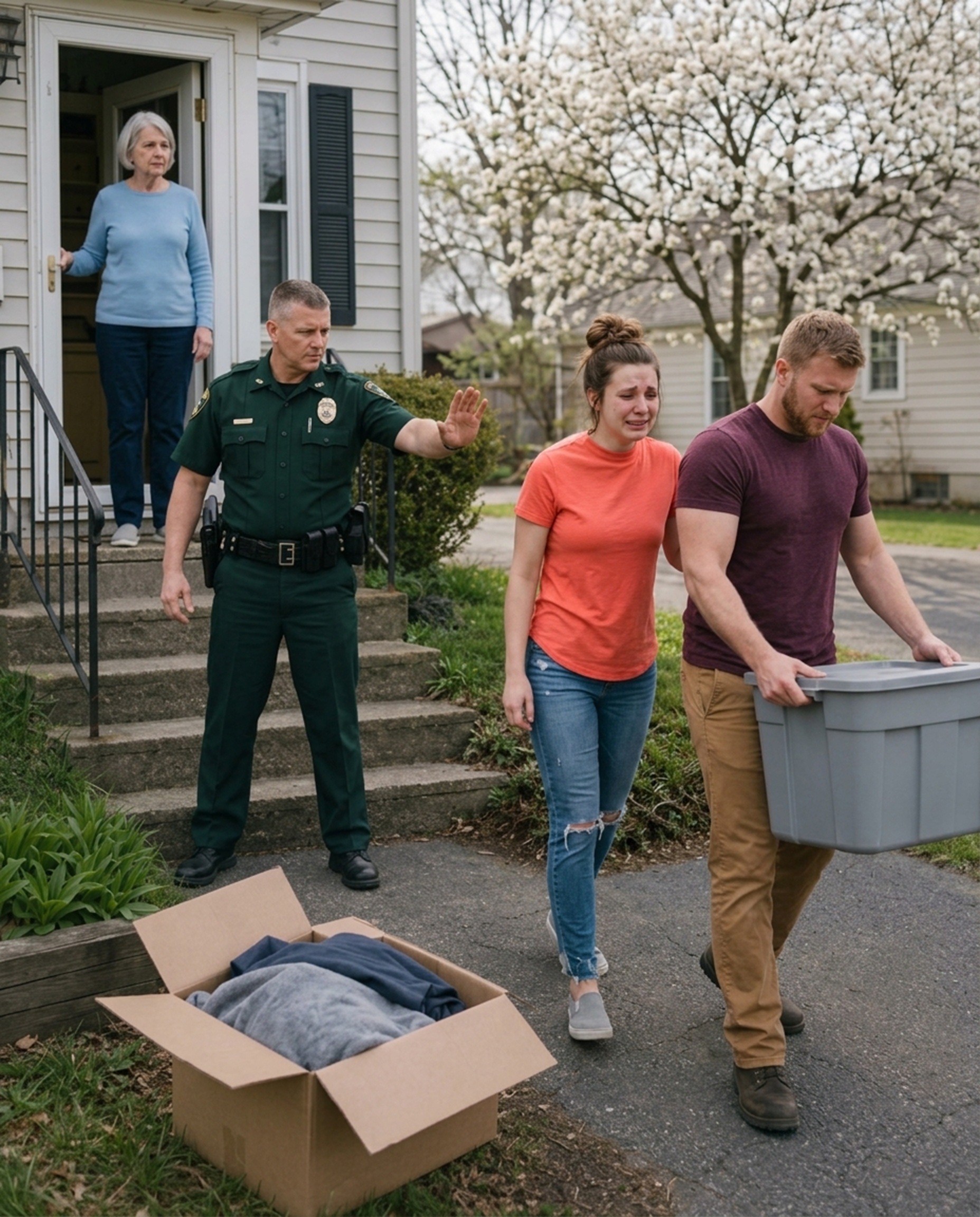
Two officers approached my cottage.
They knocked.
Inside, Naomi stopped talking.
Brent lowered the storage bin.
For a long moment, the two of them looked at each other.
I could almost imagine the silent conversation taking place between them.
Which explanation would work?
What could they say?
How could they make this look like a misunderstanding?
Finally, Brent opened my front door.
He wore the easy smile he used whenever he wanted someone to overlook something he had done.
The officer on the porch didn’t smile back.
“Step outside,” he said.
And that was the beginning of the end.
The Paper Trail
Brent initially tried to explain that they were family guests.
Naomi appeared behind him, phone in hand, talking quickly about a misunderstanding.
But the facts were already becoming clear.
The ownership records showed that I lived there.
My cameras showed them moving boxes into the house.
And I had explicitly told them they were not moving in.
The officers ordered Naomi and Brent to leave.
Their belongings could remain temporarily while arrangements were made for them to retrieve everything.
The next morning, I drove back to Tennessee.
I went directly to the police station to give my formal statement.
Naomi was waiting near the entrance.
She looked exhausted.
“We had nowhere to go,” she said.
“Our lease was ending.”
Then she said the sentence that made something inside me go cold.
“I thought the cottage was just sitting there.”
I looked at her.
“I live there.”
She lowered her eyes.
The officer handling the case placed several documents on the desk.
Then he explained something I hadn’t known.
The missing key had come from my contractor.
After the final walkthrough, the contractor had left a spare key on the kitchen counter.
Naomi had apparently taken it while I was outside checking the gutters.
“That was a mistake,” she insisted.
“I was going to tell her.”
But the officer wasn’t finished.
He placed another document on the desk.
It was a change-of-address request submitted through the United States Postal Service.
Naomi had already arranged for some of her family’s mail to be redirected to my cottage.
I stared at the paper.
Then the officer pulled out another set of records.
School enrollment documents.
Both of Naomi’s children had been registered using my address as their permanent residence.
The dates stopped me cold.