Her faint smile carried more relief than amusement.
Vanessa tried contacting me through messages, relatives, and mutual friends.
Her explanations moved from denial to justification.
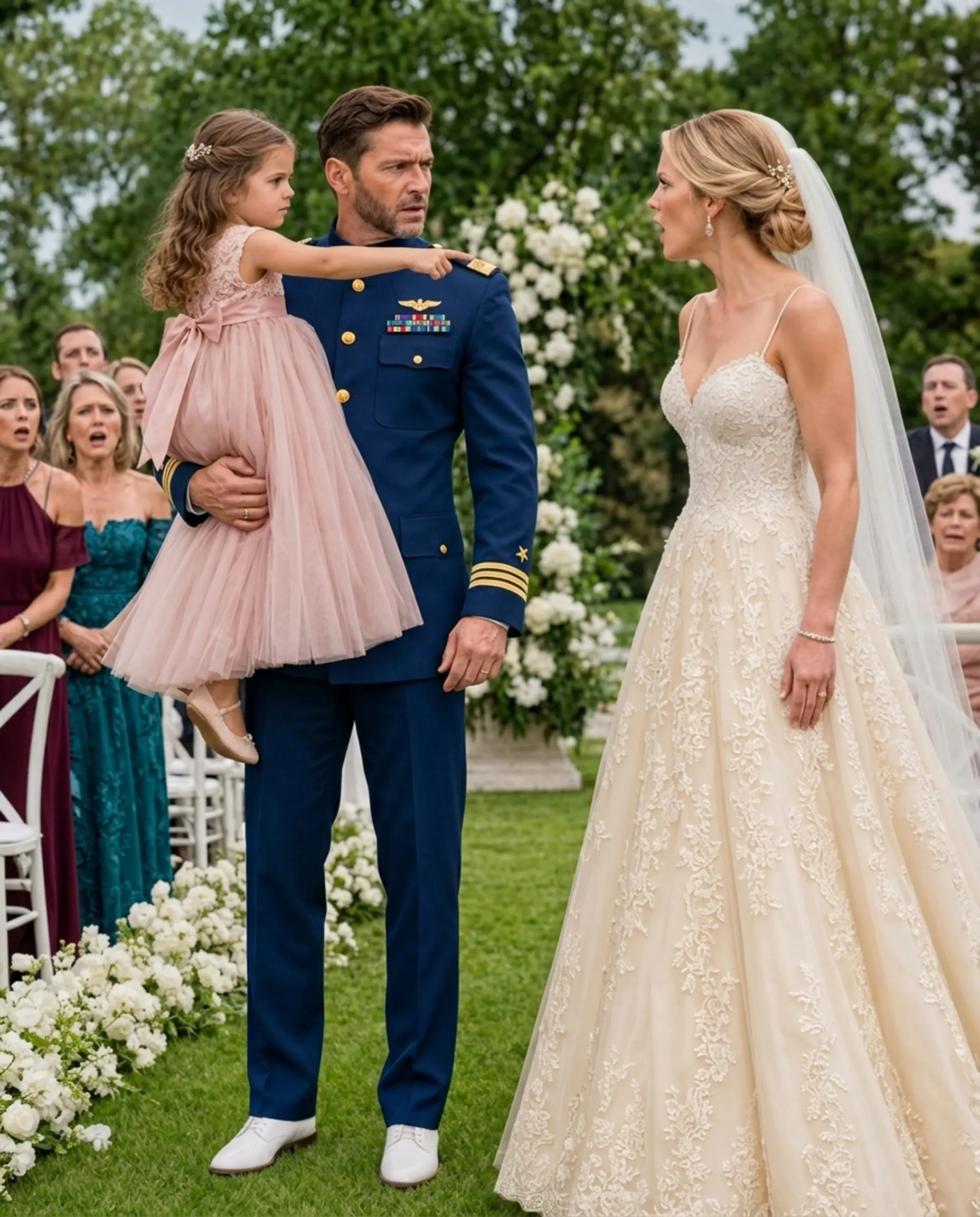
First, Emily had exaggerated.
Then the request had supposedly been temporary.
Finally, Vanessa insisted that every marriage required a wife to become the husband’s primary family relationship.
I responded once through my attorney.
“No adult partnership requires humiliating a child or erasing her deceased parent.”
After that, direct communication ended.
## PART 5: THE UNIFORM COULD NOT MAKE THE DECISION FOR ME
Several colleagues eventually learned about the canceled wedding, although nobody asked intrusive questions while I was in uniform.
The Army had trained me to gather information, assess risk, and protect those under my responsibility.
At home, I had trusted appearances because I wanted the comfort they promised.
That contradiction was difficult to accept.
My commanding officer invited me into his office after hearing an incomplete account from another guest.
“You do not owe me personal details, but I need to know whether your daughter is safe and whether this situation affects your duties.”
“Emily is safe, although I failed to recognize an emotional threat developing inside my home.”
He considered that before responding.
“Command responsibility includes correcting conditions after reliable information appears. It does not require pretending you possessed information nobody gave you.”
The distinction helped, though responsibility remained.
I temporarily reduced unnecessary travel and arranged more consistent care with Laura during training periods.
Emily continued counseling and gradually stopped apologizing whenever she mentioned Caroline.
Together, we returned her mother’s photographs to the living room.
We also created a memory cabinet containing letters, photographs, Caroline’s favorite recipes, and several objects Emily wanted accessible without turning the entire house into a memorial.
The goal was never to remain trapped inside grief.
We needed to carry our history without allowing someone else to erase it.
One evening, Emily asked if I still loved Vanessa.
“Part of me continues loving the person I believed she was, although that person cannot be separated from what she chose to do.”
“Does loving somebody mean you have to forgive everything?”
“Loving someone does not eliminate boundaries, and forgiveness never requires giving an unsafe person another opportunity.”
Emily nodded and returned to her homework.
Her willingness to ask direct questions showed that fear was loosening its grip.
PART 6: THE AISLE WE WALKED TOGETHER
Three months after the canceled wedding, Willow Ridge Lodge offered to return several personal belongings left behind during the confusion.
Among them was Emily’s flower basket.
We drove there together on a clear Saturday morning.
The garden terrace no longer held chairs, lights, or wedding decorations. Pine trees moved gently beyond the empty arbor while sunlight crossed the mountains.
Emily carried the basket toward the beginning of the aisle.
“I practiced this walk for weeks, but I never actually got to do it.”
“Would you like to finish it now?”
She hesitated before handing me several silk petals that had remained inside the basket.
We walked slowly toward the arbor while she scattered them over the empty path.
No guests watched.
No music controlled our pace.
At the end, Emily looked up.
“What happens after we reach this part?”
“We decide where to walk next.”
That answer became the start of a new tradition.
Every year on Caroline’s birthday, Emily and I chose somewhere neither of us had visited.
Sometimes a museum.
Sometimes a mountain trail.
Other years, simply a new restaurant where we ordered dessert first.
It allowed Caroline’s memory to become part of movement rather than only grief.
Vanessa eventually sent Emily a written apology through our attorney.
She admitted that jealousy toward Caroline’s memory had turned into resentment toward a child who could not defend herself.
The counselor reviewed the letter before Emily decided whether to read it.
She placed it unopened in a drawer.
“Maybe I will read it when I am older, but I do not need her explanation right now.”
I respected that choice.
Control over the story belonged to the child who had once been silenced.
PART 7: THE FAMILY THAT WAS ALREADY COMPLETE
One year after the canceled ceremony, Emily participated in a school presentation about family history.
She displayed a photograph of Caroline, one of me in uniform, and another showing herself between Laura and me during a summer picnic.
A classmate asked whether she wished she had a more ordinary family.
Emily answered before looking at me.
“My family is ordinary because people die, plans change, and the people who remain still have to choose each other.”
Her answer reminded me of the child sitting beside a washing machine, twisting a ribbon while wondering whether she represented something shameful.
After the presentation, we went home and made Caroline’s chicken recipe from the memory cabinet.
Emily criticized my seasoning while I reminded her that colonels were not generally trained for culinary precision.
“Maybe the Army should reconsider its priorities,” she replied.
Our house no longer waited for someone to transform it into a legitimate family.
It contained homework, photographs, arguments over laundry, late-night military calls, and enough ordinary affection to remain complete.
I once believed marrying Vanessa would give Emily stability and help us both build a future beyond grief.
That desire made me overlook the possibility that someone could perform tenderness while viewing my daughter as temporary competition.
Canceling the wedding did not feel heroic.
It felt humiliating.
Expensive.
Confusing.
Necessary.
Protection rarely resembles the dramatic certainty people imagine.
Sometimes it means believing a frightened child even when doing so destroys the future an adult carefully planned.
Three minutes before the ceremony, I believed my responsibility was to walk toward Vanessa and make another lifelong promise.
Instead, I found Emily behind a locked door and remembered the promise that already mattered.
Five years earlier, after Caroline died, I told my daughter she would never face the world alone while I was alive.
At Willow Ridge, I nearly broke that promise by trusting the wrong person.
Then Emily told me the truth, and I listened before three minutes became an entire childhood.
There was no wedding that afternoon.
Nevertheless, a family walked away together.
The END.