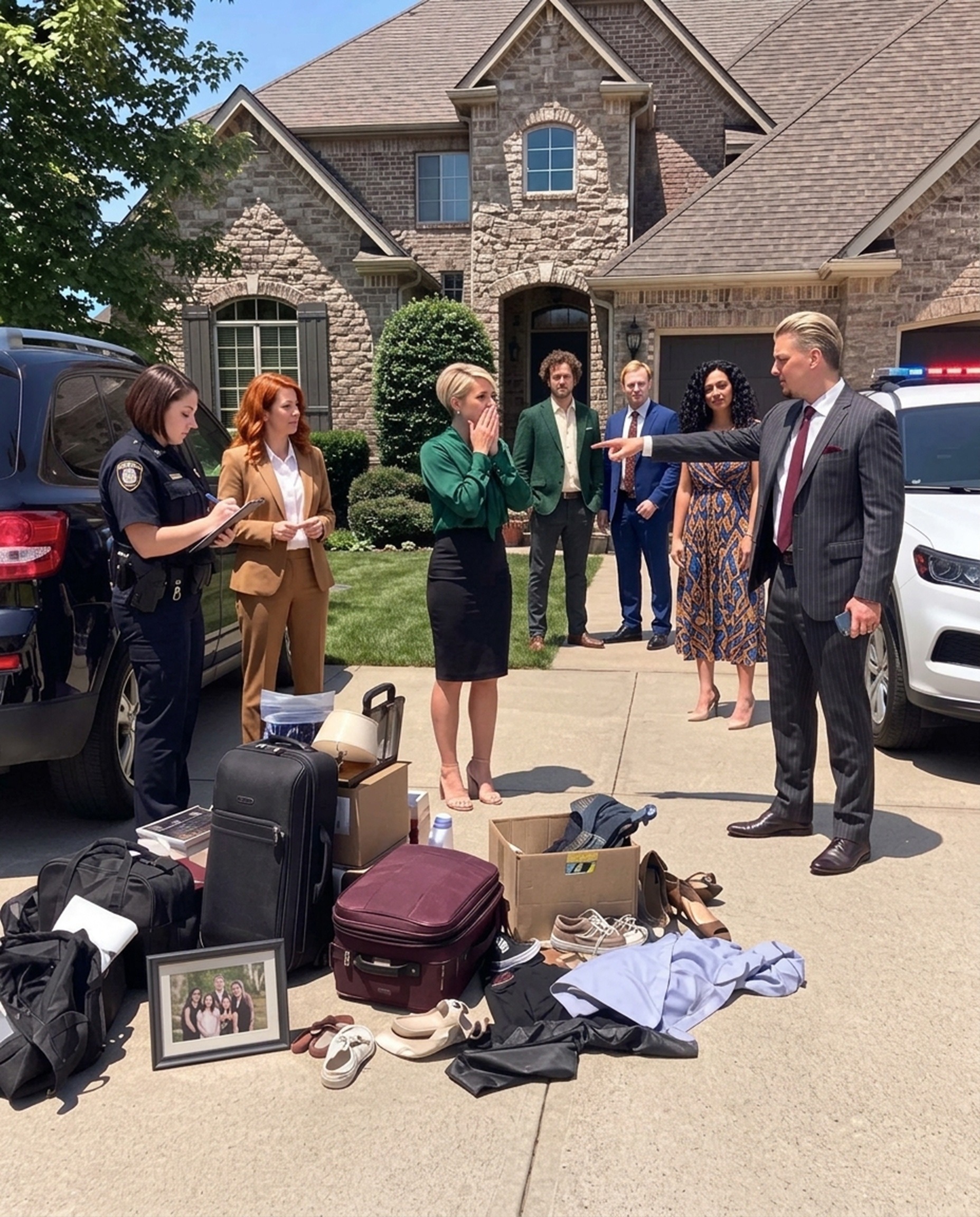
Daniel explained the conditions Patricia had violated, including the home-equity credit line, the unpaid property taxes, the lapse in homeowners insurance, and the resulting damage to the trust’s interests. He then informed her that the court had terminated her life estate and that her legal right to occupy the property had ended.
Patricia’s face lost its color. Grant, however, reacted with anger.
“This is insane! Allison, you can’t do this! This is my family’s house! My mother’s house! You were never anything but…”
“Careful.”
Daniel spoke quietly, but Grant immediately stopped. My attorney reminded him that nothing belonging to the Monroe family had been taken or damaged and that I had merely assumed possession of property that had legally belonged to me since Walter’s death.
“What Walter wanted her to have.”
Patricia stared at Daniel before slowly turning toward me. Her expression changed again when she heard her husband’s name.
“Walter did this?”
“Yes.”
For the first time that afternoon, I chose to speak. I told Patricia that Walter had cared about me, had noticed how she treated me, and had watched Grant repeatedly refuse to defend me.
“Walter decided the person who had shown kindness inside this house would eventually be the person who kept it.”
My voice remained steady as I looked toward the front door that Patricia had spent years reminding me I entered only as a guest.
“You spent eight years telling me I didn’t belong here. It turns out I’m the one who does.”
I could have shown her Walter’s letter and read every sentence aloud in front of the family. But those words had been written for me, and I refused to turn the kindness of the only Monroe who had respected me into a weapon.
Vivian immediately called the family attorney while Uncle Douglas wandered among the carefully wrapped furniture as though he might find some explanation hidden beneath it. Grant simply stood in the driveway staring at me, unable to reconcile the woman he had dismissed that morning with the legal owner of the house his family considered their legacy.
Only hours earlier, Grant’s attorney had finalized a settlement designed to leave me almost empty-handed. I had allowed him, Patricia, and everyone else outside the courthouse to believe they had succeeded because there had been no reason to tell them otherwise.
Then Patricia sat heavily on the arm of her displaced sofa.
“Where am I supposed to go?”
Her voice no longer carried the authority I had heard for eight years. To my surprise, I felt sorry for her, although not enough to reverse what had happened or surrender what Walter had deliberately left to me.
Patricia’s unpaid taxes and lapsed insurance had provided the legal mechanism for ending her life estate, but I understood that the collapse had begun long before that. For years, she had treated the person Walter trusted as an enemy, taught her son that contempt was easier than courage, and behaved as though the house were a throne that guaranteed her authority over everyone inside it.
Daniel answered her question before I could.
“That is no longer my client’s responsibility.”
He instructed Patricia to contact her attorney and the bank regarding the credit line. The sheriff’s deputy then escorted the family away from the property while arrangements were made for the remaining belongings to be collected the following day.
There was no screaming confrontation and no dramatic scene. Everything happened calmly and professionally, exactly as Daniel had planned.
By early evening, the lawn was clear and the house had fallen completely silent. I stood alone in the front hallway holding a new set of keys, realizing that for the first time, nobody could tell me I was merely a guest inside the house on Habersham Road.
I didn’t move in immediately because the property still carried too many financial complications and too many memories. But the following morning, I returned alone, unlocked the front door with my own key, and walked through the empty rooms as early sunlight spread across the floors.
Eventually, I reached Walter’s back porch and sat in the wicker chair he had always used. Beyond the railing, his neglected roses waited in the garden, and that was where the tears I had refused to shed over Grant finally came.
I wasn’t crying for my marriage.
I was crying for Walter, the quiet man who had seen what everyone else ignored and protected me in the only way he knew how.
After a while, I wiped my face and walked toward the garden shed. Walter’s old pruning shears were still inside, and I carried them to the overgrown rose bushes before beginning to cut away years of neglect.
I thought the hardest part was finally over.
It wasn’t.
Because Grant had just learned that the house he expected to inherit belonged to his ex-wife, and the Monroe family had no intention of accepting Walter’s decision without a fight …
Part 5: The House That Was Finally Mine
Grant challenged Walter’s trust almost immediately. His attorney filed motions attempting to undermine the documents, but Walter had used an extremely careful estate lawyer, and Daniel described the trust with one reassuring word: airtight.
The challenges failed. Patricia’s home-equity credit line was eventually treated as her personal responsibility because she had obtained it against property she didn’t own outright, while I handled the overdue taxes, reinstated the homeowners insurance, and rehired the lawn service. Fortunately, Walter had left the house without a mortgage, which made repairing the financial damage possible.
The emotional damage took longer.
For weeks, I couldn’t imagine sleeping beneath the roof where I had spent years being reminded that I was an outsider. Gradually, however, the house stopped feeling like Patricia’s territory and began feeling like the gift Walter had intended it to be.
The following spring, I heard that Grant married Brooke. They moved into a condo in Midtown, and despite everything that had happened between us, I genuinely hoped they could build whatever happiness they were capable of finding together.
I never spoke to Patricia again. She stayed with Vivian for a while, although that arrangement apparently didn’t last, and eventually she moved into a retirement community outside Marietta.
Her world became considerably smaller than the one she had ruled from Habersham Road. I didn’t celebrate that, but I no longer felt responsible for it either.
Patricia had built much of her identity around two beliefs: that the house belonged to her and that I was the intruder. In the end, both assumptions had been wrong.
I eventually moved into the house permanently and returned to work as a paralegal, ironically at Daniel’s firm. With his encouragement, I enrolled in evening classes and began working toward the law degree I had abandoned after marrying into a family that believed wives like me didn’t need careers.
It turned out I was good at law. Perhaps eight years of living inside the fine print of my own marriage had prepared me for it, or perhaps Walter’s trust had taught me how much power could hide inside a carefully written paragraph.
The roses recovered too.
It took two full seasons of pruning, watering, and patience, but eventually Walter’s garden began blooming again. Every June, I cut several roses and arrange them inside the same crystal vases Patricia once used during dinners designed to make me feel inadequate.
Then I sit on the back porch in Walter’s old chair.
Only one Monroe family photograph remains displayed inside the house. It shows Walter standing in his garden wearing an old cardigan, pruning shears in one hand and a shy half-smile on his face.
He never treated the house like a throne. He never raised his voice to prove his importance, and he never made me feel as though I needed permission to belong.
Sometimes I still take out his letter.
Walter had written that a house was simply a house, although it was the most valuable thing he had left to give me. For years, I believed he was right.
Now I think he underestimated his own gift.
The greatest thing Walter left me wasn’t the property on Habersham Road. It was the knowledge that on one of the worst days of my life, while an entire family stood outside a courthouse celebrating my humiliation, I didn’t need to fight for their approval anymore.
I didn’t need to scream, beg, or defend myself. I didn’t need to give Patricia the dramatic reaction she wanted or force Grant to finally acknowledge what he had done.
All I had to do was follow Daniel’s advice.
Keep my expression neutral.
Keep looking forward.
And allow Walter’s final act of kindness to reach me exactly when I needed it.
That morning, the Monroes raised their glasses in Buckhead believing they had finally thrown me away. Grant believed his aggressive settlement had left me nearly empty-handed, while Patricia remained certain that she would return from lunch to the house she had always considered the center of her family’s legacy.
A few hours later, they turned onto Habersham Road and discovered the truth waiting for them.
The lawn was clean. The locks were new. The court order was valid. And the woman they had spent eight years treating like an unwanted guest was standing outside the one thing they had always believed could never belong to her.
Walter had seen what they refused to see. He had prepared for a day none of us knew would come.
And when it finally arrived, I didn’t have to take the house from the Monroe family.
Walter had already given it to me.
All I had to do was unlock the door …