“No,” I stepped forward, grabbing the edge of the suitcase. “I won’t let them. We just need to do the bath, Edith. Just one bath, and I can rip up the transfer papers. Please.”
She looked up at me, her pale eyes glistening in the dim light of the bedside lamp. “I can’t. You don’t understand what it is, Hailey. It’s not just skin.”
“Then tell me,” I pleaded, my voice dropping to a desperate whisper. “Show me. Let me help you carry it. You don’t have to go to that place. Please don’t give up.”
Edith stared at me for a long, agonizing minute. The silence in the room was heavy enough to crush bone. She looked at my tear-stained face, at my hands gripping her cheap suitcase. She saw, finally, that I wanted absolutely nothing from her except her survival.
“Lock the door, Hailey,” she whispered.
My heart hammered against my ribs. I turned and slid the deadbolt home.
Edith stood very straight. Her hands were shaking violently as she reached for the buttons of her blouse. I didn’t offer to help. I understood, instinctively, that she needed to do this herself.
She got the blouse open. She lifted the hem of her undershirt.
And she turned her back to me.
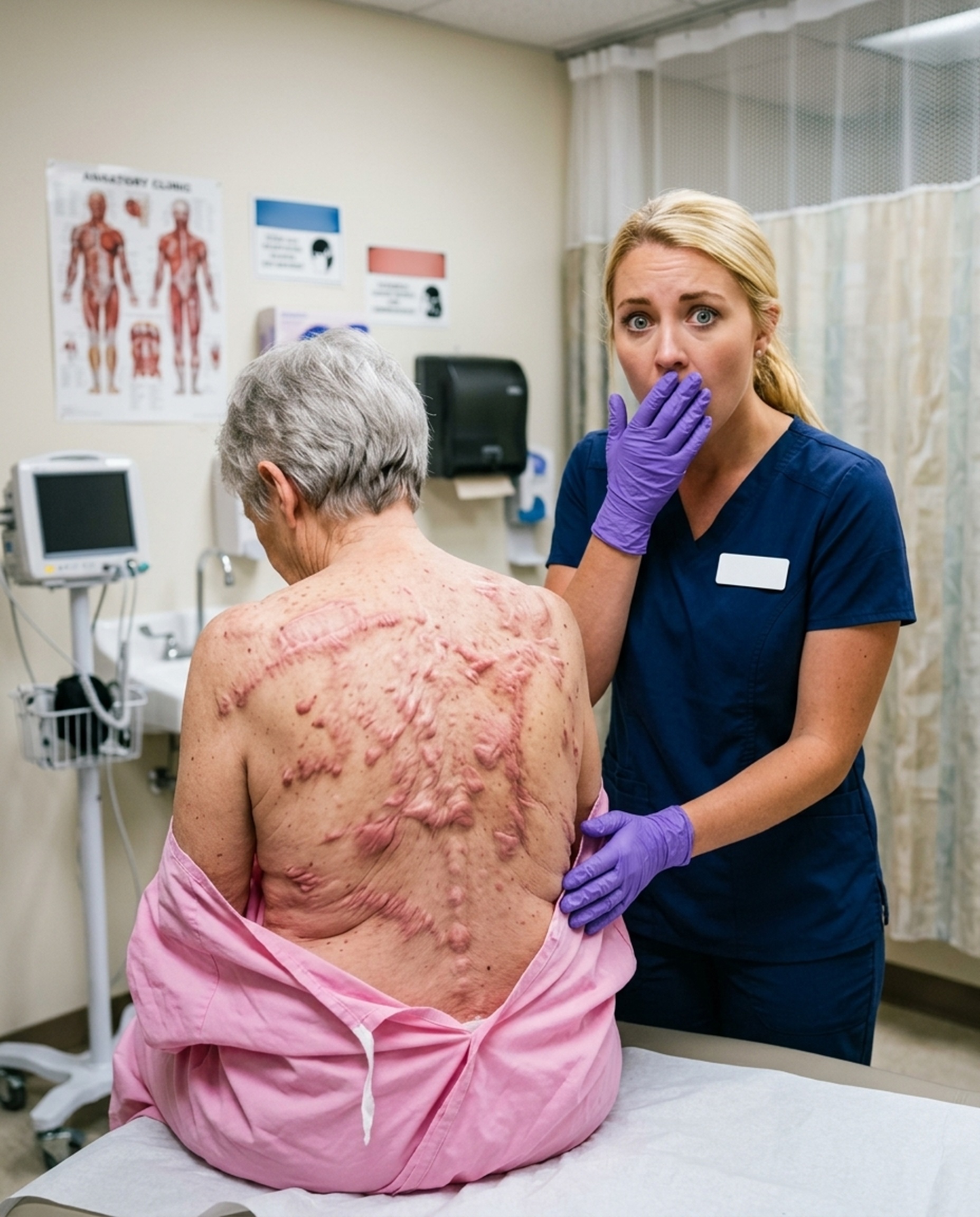
I pressed my hand hard over my mouth to stifle the gasp that tore up my throat, but a ragged sob escaped anyway. Because no textbook, no warning, could have prepared me for what forty years of this woman’s fierce, absolute privacy had been hiding.
Her entire back, from the tops of her shoulder blades down to the dip of her waist, was one vast, catastrophic landscape of ruined tissue. It was thick, mottled, and deeply furrowed, a topographical map of unimaginable agony.
“My God,” I breathed, the words falling out before I could stop them. “Who did this to you?”
Edith stood facing the wall, her arms wrapped tightly across her own chest. She didn’t flinch at my reaction.
“Nobody did this to me,” she said, and a strange, buried dignity rose in her voice. “I chose to walk into the fire.”
I stood paralyzed as Edith Ledbetter, standing in the dim light of Room 7, finally spoke the words she had swallowed for four decades.
“It was the summer of 1986,” she began, her voice distant. “In a little farming township up in northern Indiana. Dust, gravel roads, heat that sat on your chest.”
A young family lived across the dirt road from Edith and her late husband, Richard. They had a three-year-old girl named Nora. One afternoon, while the mother was in town, the house caught fire.
“I was hanging laundry,” Edith said. “I smelled the smoke. I looked over, and the front of the house was a wall of orange. Everyone on the road was screaming at me to wait for the fire department. But I could hear little Nora. Screaming from the back window.”
Edith closed her eyes. “A three-year-old doesn’t know how to wait for a siren, Hailey. I kicked in a side window. The smoke was so thick I had to crawl on my belly. I found her huddled against the baseboard in the back bedroom. I pulled her against my chest. But when I turned to go back… the hallway collapsed. The only way out was forward, through the burning porch.”
I was weeping silently now, picturing this proud woman crawling through a dying house.
“I pinned her face against my stomach,” Edith continued, her voice trembling now. “And I turned my back to the flames. I walked backward.”
“A beam,” she whispered, her hands tightening around her own shoulders. “A heavy, burning roof beam came down. It pinned me against the doorframe.”
My breath hitched. “You were trapped?”
“For ten minutes,” Edith said, turning her head slightly to look at me over her scarred shoulder. “The beam was burning into my flesh, Hailey. I could smell my own skin cooking. But I had Nora trapped beneath me. If I moved, if I dropped her, she would burn. If I screamed, she would inhale the superheated air and incinerate her lungs. So, I bit clean through my own bottom lip, and I held her. For ten minutes, I let the fire take my back so it couldn’t touch her face.”
I fell to my knees on the linoleum, overwhelmed by the sheer, staggering magnitude of the sacrifice.
“Everyone called me a hero,” Edith said bitterly, turning to face me, though she kept her chest covered. “I hated that word. The moment they call you a hero, you stop being a person. I became a monument to them. People wanted to touch the scars. They wanted the story. I just wanted to be a woman who drank coffee and loved her husband. So, I hid it. I hid it from everyone. Even Richard. If he touched me in the dark, I pulled his hands away. For forty years, the hiding became a monster bigger than the fire itself.”
She looked down at me, her eyes filled with a lifetime of exhaustion. “You can wash it now, Hailey. But promise me… don’t look at me with pity.”
I stood up, wiping my face. I brought the basin of warm water. With hands that shook, I took the soft sponge, and I pressed it gently against the ruined landscape of her skin. She flinched, forty years of instinct firing at once, but then, slowly, she exhaled. Her shoulders dropped.
When I was done, I helped her into a clean nightgown. I had saved her from the psychiatric ward. But as I gathered the basin to leave, a new, cold terror gripped me. Carter was still coming tomorrow with the lawyer. The bath didn’t solve the Power of Attorney.
I unlocked the door, stepped out into the hallway with the basin of dirty water, and bumped squarely into a solid figure.
It was Vanessa.
She was holding her clipboard, her eyes wide, staring at me. She had been standing right outside the door.
“I’ve been looking for you,” Vanessa hissed, her face flushed with venom. “Higgins wants you gone tonight. I’m reporting you for being in a locked room with a resident, you little—”
“Vanessa, stop,” I begged, the exhaustion hitting my bones. “You don’t understand what she’s been through. In Indiana, in 1986…”
Vanessa froze. The cruel sneer melted off her face, replaced by a sudden, chalky pallor. The clipboard slipped from her fingers, clattering loudly against the floor.