If I kept this, what kind of man am I teaching my children to be?
The question hung in the quiet room, unanswered, as the midnight hour came and went, the cold wind outside rattling the kitchen window pane.
I stared at the key for what felt like hours, my mind turning over the three hundred dollars we needed and the fifteen thousand dollars sitting in that dark oak drawer.
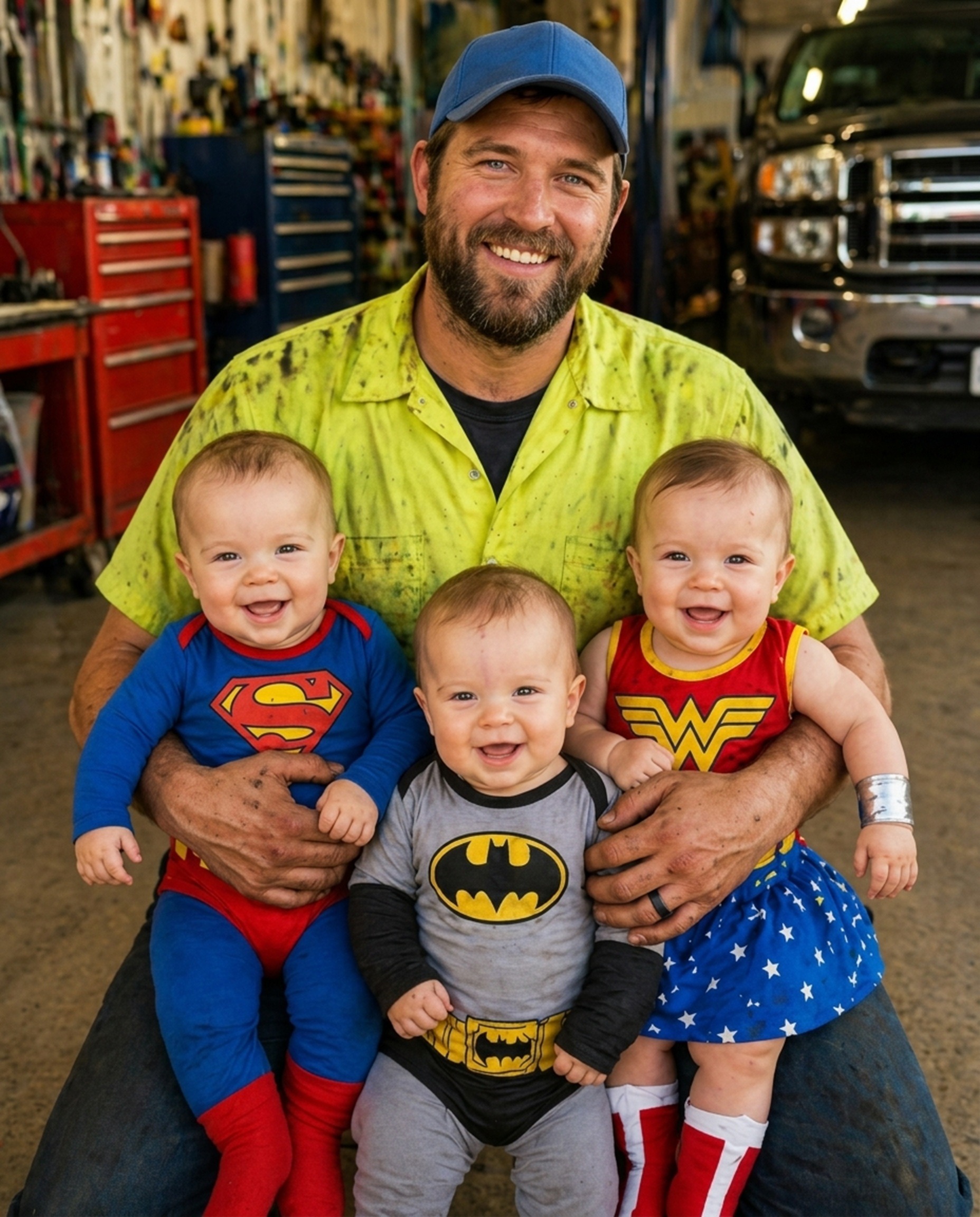
I stood up from the kitchen table, grabbed my truck keys, and walked out into the cold night.
The gravel of the narrow driveway crunched under my boots, each step sounding loud in the midnight quiet of Oak Creek. The streetlights on this block were spaced far apart, leaving the gaps between houses filled with deep, heavy shadows. Harold Lawson lived in a small, green-painted cottage at the end of a dead-end street, where the damp autumn leaves had gathered in thick, wet piles against the concrete foundation. The smell of rotting maple leaves and damp river silt hung in the air, a reminder of the cold winter that was only a few weeks away.
The porch light was not on, but a dim glow from a front window cut through the dark, throwing long, crooked shadows across the overgrown lawn. The green cottage had a small porch with two wicker chairs that had seen better days, their paint peeling in long strips. A single potted geranium sat on the railing, the flowers dead and black from the recent frost. I climbed the three concrete steps, my hand brushing against a rusted iron handrail. A crack ran down the middle of the top step, filled with dry weeds that had gone to seed.
I knocked on the heavy wooden door. The sound was flat and hollow, disappearing into the cold night.
For a long minute, nothing happened. I could hear the hum of a refrigerator through the window, but the house remained dark. I stood there under the overhang, my hands shoved deep into the pockets of my work jacket, the damp October air creeping up my sleeves. I was about to knock a second time when a floorboard creaked inside.
The deadbolt slid back with a heavy metallic click. The door opened a few inches, held by a brass security chain that rattled against the casing.
Harold Lawson peered through the gap, his eyes bloodshot and heavy with the kind of exhaustion that sleep cannot fix. His white hair was messy from lying down, and he wore a faded blue flannel bathrobe that looked too large for his thin shoulders. His face was lined with deep wrinkles, his jaw slightly slack as he tried to place my face in the dark.
“Who is it?” he asked, his voice raspy and sharp with a formal, old-fashioned politeness.
“My name is Evan Carter, Mr. Lawson,” I said, keeping my hands visible where the faint light from the window could reach them. “I run the repair shop down on Elm Street. You brought your old Buick in yesterday for the exhaust manifold.”
Harold squinted at me, his fingers rising to adjust the collar of his bathrobe, smoothing the flannel with a jerky, nervous motion.
“The shop is closed, Mr. Carter,” he said. “Is there something wrong with my car?”
“No, sir,” I said. “The car is fine. But I was sweeping up the floor under the second hydraulic lift about an hour ago, and my boot hit something.”
I reached into my right pocket and pulled out the thick black leather wallet.
I held it up between us, the dark leather catching the pale light from his window.
Harold froze, his hand stopping dead on his collar.
“Where did you find that?” he whispered, his eyes widening.
“Right under the lift, sir,” I said. “You must have dropped it when you climbed out to look at the chassis.”
He quickly shut the door to slide the chain free, the brass clinking against the wood, and then swung the door wide open. He did not invite me in, but he stepped out onto the concrete porch, his slippers scraping against the grit.
He took the wallet from my hand, his knuckles brushing against my palm. They were cold and dry, like old paper. He turned it over twice, his thumb tracing the worn edge where the stitching had started to come undone near the seam.
With clumsy, shaking fingers, Harold flipped the leather open. He did not look at me. He kept his eyes locked on the paper money, his thumb counting the edges of the bills as if he needed to prove to himself that they were real.
A tear escaped his eye, tracking slowly through the deep wrinkles of his cheek before disappearing into his white stubble. He did not try to wipe it away.
“I thought it was gone,” he murmured, his voice barely louder than the breeze in the maples. “I thought I had lost everything.”
“It was tucked right under the frame of the lift,” I said. “I locked it in my desk drawer before I left for the evening, but I could not sleep knowing you were probably looking for it.”
“I looked everywhere,” he said, opening his eyes and looking down at the green paper. “My bedroom, the kitchen counters, the car seats. I went back to the bank parking lot twice in the dark.”
He looked up at me, his eyes wide and wet.
“This is my pension, Mr. Carter. The whole thing. I took it out of the bank on Monday morning.”
I watched him hold the wallet against his ribs, his hands clasping it tightly.
“That is a lot of cash to carry around, Mr. Lawson,” I said, keeping my voice quiet. “The bank is usually safer for that kind of money.”
He adjusted his shirt collar under his bathrobe, his fingers moving with a nervous, jerky rhythm.
“I had to have it,” he said, his voice dropping to a tense whisper that barely carried to the steps. “They said it had to be cash. If I did not have it by Saturday, they said they would take the house.”
“Who said that?” I asked.
Harold shook his head quickly, his mouth tightening into a thin line. He looked over my shoulder at the empty street, as if he expected someone to be standing by the mailboxes.
“It does not matter,” he said, his voice trembling. “The important thing is that it is here. You brought it back.”
“Is there someone threatening you, Mr. Lawson?” I asked, stepping a half-step closer.
He pulled the robe tighter around himself, his fingers knotting the belt.
“No,” he said, though his eyes darted away. “No, it is just a business matter. A contract.”
He flipped the wallet open again and began sliding bills out from the middle of the stack. The crisp paper made a sharp, clean sound as his fingers worked.
“Here,” Harold said, pushing three hundred-dollar bills toward my chest. “You must take this. For your trouble. For your honesty. I cannot let you leave empty-handed after what you did.”
I looked down at the three green bills in his hand.
Three hundred dollars.
It was the exact amount of the utility shut-off notice sitting on my kitchen counter. If I took it, the lights would stay on past November fifteenth, and I would not have to worry about the kids sitting in a cold, dark duplex. I thought of Emma’s worn sneakers, of Noah’s quiet sighs when I told him we could not go to the diner for pancakes, of Liam’s green toy dinosaur that was missing its tail.
My hand twitched in my pocket, my fingers brushing against my own truck keys. The temptation was a physical weight in my chest, a dull ache that made it hard to breathe.
“No, sir,” I said, taking a step back toward the first stair. “I cannot take that.”
“Please,” Harold said, his voice rising, a sudden sharp desperation in his eyes. “Please, you do not understand what you have just saved for me.”
“Mr. Lawson, I just did what anyone would do,” I said. “You do not owe me anything for bringing back what belongs to you.”
“That is not true,” Harold said, his white hair catching the cold breeze. “Most people would have kept it. Fifteen thousand dollars is a fortune to a working man. I know what a mechanic makes in this town. You have those three little ones. I saw them in your truck when you drove past the post office last week.”
“They are five,” I said. “Triplets. Emma, Noah, and Liam.”
“Then take it for them,” Harold pleaded, his hand still extended in the cold air, the bills fluttering like dry leaves. “Buy them some winter coats. Buy them some toys. You earned this.”
“If I took your pension money, I would not be able to look them in the eye tomorrow morning,” I said, keeping my voice flat and practical. “I want them to know their father is an honest man, even if we are tight.”
Harold looked at me, his hand slowly sinking back to his side. The three bills remained clutched in his fingers, a stark contrast to his worn bathrobe.
“You are a rare man, Evan Carter,” he said, his voice dropping to a quiet, formal tone. “Your parents raised you well.”
“They did their best, sir,” I said. “But you should go back inside now. It is too cold to be standing out here.”
He nodded slowly, but he did not move toward the door.
“Thank you,” he said. “Thank you.”
I turned and walked down the three concrete steps, my boots crunching on the gravel driveway once more. The cold night air felt clean in my lungs, clearing out the lingering smell of burnt chicory coffee from my duplex.
I reached my old Ford truck, opened the heavy metal door, and climbed into the worn vinyl seat.
The engine coughed twice when I turned the key, then settled into a low, steady rumble that vibrated through the floorboards.
I sat there for a minute, waiting for the heater to blow something warmer than the freezing October draft.
My pockets were empty, save for my own keys and a few loose pennies, but the heavy knot of tension that had been winding up in my chest all evening was gone.
I looked through the dirty windshield, past the hood of my truck, toward the front of the green cottage.
Harold Lawson was still standing on the porch.
He was holding the black leather wallet tight against his chest with both hands, his white hair catching the light.
He looked very old and very small under the single bulb.
I shifted the truck into drive, the transmission clunking as I pulled away from the curb.
Through the rearview mirror, I watched the small green house recede into the darkness.
Harold did not move, his quiet figure remaining perfectly still under the single yellow bulb.
The frying pan hummed on the small burner, the butter turning brown before I could drop the bread in.
The milk carton sat on the gray laminate counter, showing the price of four dollars and ten cents stamped in blue ink on the cardboard rim.
Noah sat on the floor by the refrigerator, carefully lining up six blue plastic blocks in a straight line that pointed toward the pantry.
His brother Liam sat next to him, clutching his green plastic dinosaur so tightly the tail pressed into his thumb.
“You went outside,” Emma said, twirling a strand of her brown hair around her index finger.
She stood by my knee, looking up at the stove with her chin resting on the edge of the counter.
“I had to do a small chore,” I said, flipping the bread with a metal spatula.
“It was dark,” she said. “The moon was still up by the pine tree.”
“Sometimes people need things fixed even when it is late,” I said.
Noah placed another block, keeping his head down, but I saw his shoulders tighten.
The boys always knew when my voice had that thin, stretch to it, the kind that came when the envelope on the fridge got closer to its date.
The electric bill sat under a magnet, three hundred dollars due by the fifteenth of November.
“Is the green car broken?” Emma asked, her voice rising at the end.
“No, the green car is fine,” I said, sliding the toast onto three paper plates.
“Did you see the big white dog by the corner?” she asked, barely taking a breath between her words. “Did the dog bark at you in the dark?”
“No dog, Emma,” I said, setting the plate in front of her. “Eat your toast before it gets cold.”
Liam set his dinosaur on the chair next to him, his small face pinched as he watched me open the butter tub.
“We have to go to preschool today,” he whispered.
“I know, buddy,” I said. “We will leave in twenty minutes.”
A sudden, heavy knock shook the wooden frame of the front door.
It was not the soft tap of the mail carrier or the neighbor kids looking for a ball.
This was three solid strikes that made the windowpane in the living room rattle.
Noah stopped his hand mid-air, holding a red block.
I set the spatula on the cold burner and wiped my hands on a shop rag from the pack of twelve I bought on Tuesday.
“Stay at the table,” I told them, keeping my voice low.
When I pulled the front door open, the morning air hit my face, smelling of damp oak leaves and wet pavement.
Officer Roger Cole stood on the concrete step, his gray uniform shirt pressed sharp enough to cut paper.
He did not look like he had just started his shift.
His leather utility belt creaked slightly as he shifted his weight, his fingers tapping the black holster.