He kissed the top of my head and walked toward the stairs, his footsteps heavy on the wooden treads as he went up to our bedroom.
I stayed in the kitchen for a long time, watching the water drip from the faucet into the drain. The pink roses sat in the center of the table, their sweet scent filling the small room, but the quiet of the house felt heavy again.
I waited until the house was completely dark before I went upstairs. The clock on our dresser showed five minutes past ten.
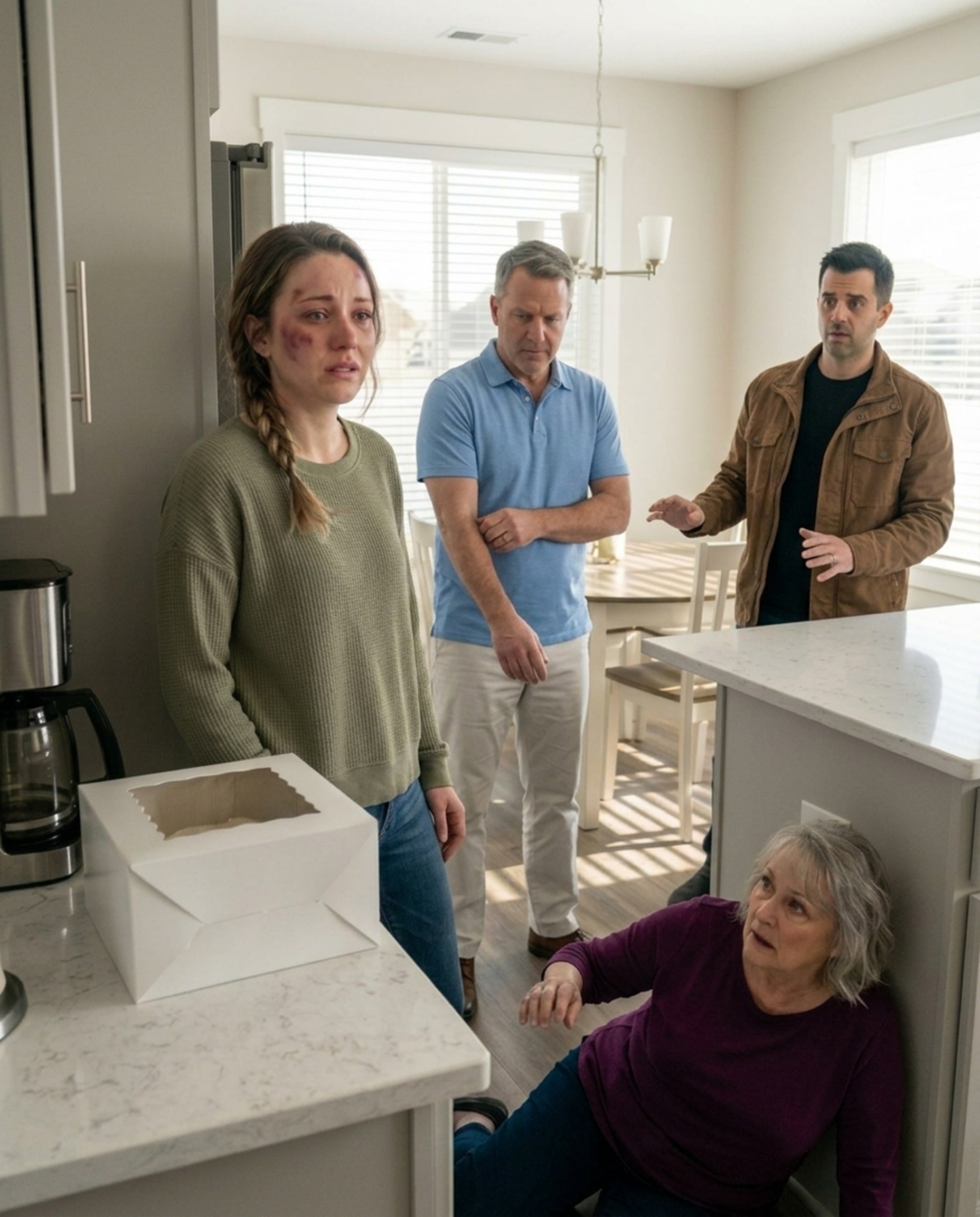
Derek was already asleep, his face turned toward the wall, his breathing slow and even. I did not turn on the overhead light.
I sat down at the small writing desk in the corner of our bedroom and turned on the brass desk lamp, keeping the shade tilted down so the light would not reach the bed.
I pulled my old gray leather organizer out of the bottom drawer and laid it next to the sheet of paper Derek had given me. My actual savings passbook, which I had kept in that organizer for three years, had the account number ending in five-eight-two-two.
I picked up the new statement and held it close to the light of the lamp.
The black ink of the Oak Creek Bank logo looked slightly blurry at the edges, as if the printer ink had smeared before it dried.
I ran my index finger over the paper. The texture was rough and thick, like the cheap paper we bought in bulk for our home computer, not the smooth, thin stock the bank always used for official correspondence.
The word Statement was spelled with a slightly larger letter T in the middle, and the letters did not line up perfectly on the horizontal line.
I compared the two account numbers again, looking at the old passbook and then at the paper.
The document Derek had handed me was a complete fabrication.
I sat very still, listening to the soft, rhythmic sound of Derek breathing in the dark behind me.
I turned the paper over, looking for any mark or watermark on the back, but there was nothing but blank white space.
I laid the paper back down on the dark wood, staring at the crooked font on the printed bank logo under the desk lamp.
By one o’clock the next afternoon, I was sitting on the carpeted floor of Linda’s living room, surrounded by cardboard boxes of artificial pine garlands and plastic pumpkins. Linda, my mother-in-law, stood near the window, carefully wrapping a ceramic nativity scene in yellowed newspaper. The room smelled of lemon polish and old upholstery.
“We need to get these stowed away before the damp gets into the basement,” Linda said, her voice carrying its usual brisk efficiency. “If you don’t keep after the holiday things, they mold, and then you have to throw them all out.”
I reached into a small cardboard shipping box to pull out a tangled mess of silver tinsel. My fingers brushed against a small, crumpled piece of yellow thermal paper trapped under the bottom flap. I pulled it free, intending to toss it into the wastebasket by the door.
It was a cash register receipt from the Oak Creek Pharmacy.
I smoothed the crease with my thumb. The transaction was dated October twelfth, at three in the afternoon. Three days before my thirty-second birthday. Three days before the night Derek had lost his temper in our kitchen.
Two items were printed on the thermal paper. The first was a box of heavy-duty adhesive bandages. The second was a tube of maximum-coverage foundation cream in pale ivory. The total came to thirty-four dollars and twelve cents.
I looked at the brand name of the foundation cream. It was the exact same tube I had found in my bathroom drawer, the one I had never bought for myself.
Linda adjusted her gold necklace, her fingers hovering over the clasp for a second before she smoothed her blouse. She kept her eyes fixed on the ceramic figures she was packing.
“Linda,” I said, holding the paper by its edge. “Did you go to the pharmacy on the Tuesday before my birthday?”
She did not look up from her wrapping. “I go there most Tuesdays for my heart medicine, Emily. You know that.”
“This receipt is for the cover-up cream,” I said, my voice barely louder than a whisper. “The one that was waiting in my bathroom.”
Linda stopped wrapping. Her hands remained flat on the newspaper-covered table, her shoulders stiffening under her green cardigan. The silence stretched between us until the refrigerator in the kitchen kicked on with a low hum.
“You always did look better with a little color on your cheeks, Emily,” she said.
She picked up the box of ceramic figures and walked straight into the kitchen, her slippers dragging slightly on the linoleum. I stood up and followed her, the receipt still held between my fingers.
The kitchen was bright and smelled of dish soap. Linda set the box on the counter and turned on the faucet, letting the hot water run over a blue sponge. She began to wipe down the clean laminate surface with tight, circular motions.
“Why did you buy it three days before he did it?” I asked, standing near the doorway.
“Derek was under a massive amount of pressure,” she said, her back turned to me. “He had those credit card bills from his old business venture. He told me he was going to take care of it, but he was losing sleep. When he doesn’t sleep, he gets highly strung.”
“He took eight thousand dollars from my personal savings account,” I said.
“He had to pay those debts, Emily,” she said, squeezing the sponge until her knuckles turned white. “He couldn’t let his father’s old partners find out he was short of cash. A man’s reputation in this town is all he has. You don’t understand how hard it is for him to carry that name.”
“So you bought the makeup because you knew he would hurt me,” I said.
“I know how he gets when he is cornered,” she whispered, finally turning to face me. “His father was the exact same way. You learn to prepare. You don’t make a scene, and you don’t go showing your business to the neighbors.”
She took the sponge and rinsed it under the tap, her movements quick and practiced.
“A good wife doesn’t let her husband’s business become public gossip,” she said, her voice settling back into its firm, familiar rhythm. “Now put that paper away. We still have the dining room boxes to finish before Derek gets home from the office.”
I did not answer her. I walked down the short hallway, retrieved my car keys from the hook by the entryway, and went out to my vehicle.
I sat in the driver’s seat of my gray Buick, my hands gripping the cold plastic steering wheel. I did not turn the key. I simply stared at the brick facade of Linda’s house, watching the dry oak leaves drift across her manicured lawn.
The pieces finally fit together.
Linda had not been surprised when she saw my face on my birthday morning because she had already spent thirty-four dollars to prepare for it.
This was not a sudden crisis or a single bad night. It was a routine they had perfected over years, perhaps even before Derek and I had met.
The eight thousand dollars was not a banking error, and it was not a temporary loan. Derek had taken it to hide his failure from his mother, and Linda had helped him manage the physical evidence of his rage.
I looked down at the receipt in my lap. The yellow paper looked completely ordinary, like any other slip you would find at the bottom of a purse.
I turned the key in the ignition. The Buick started with its familiar heavy rumble, the dashboard clock showing exactly two o’clock as I pulled away from the curb.
The drive back to Maple Street took ten minutes. I parked the car at the curb instead of pulling into the driveway.
Derek’s car was parked near the side of the house. He was already home.
I let myself in through the utility door, my boots clicking softly on the tile floor.
Derek was sitting at the kitchen table, a glass of water in front of him. He was scrolling through his phone, his face completely relaxed in the afternoon light.
“You’re back early,” he said, not looking up. “Did you finish helping my mother?”
“We finished most of it,” I said, keeping my distance near the refrigerator.
“She called me,” he said, rolling his shoulders backward as he set his phone on the wood table. “Said you seemed a little quiet today. Said you left your coat on her hanger.”
“I forgot it,” I said, pulling the cuffs of my gray sweater down over my wrists.
“We have that dinner with the county commissioner on Friday night,” he said, taking a slow sip of his water. “Make sure you wear something nice. And use that cream Linda gave you. Your jaw still looks a little yellow in the light.”
I reached into my pocket and felt the thin paper receipt.
“I will,” I said.
He picked up his phone again, his thumb sliding across the screen, completely unaware that I was no longer waiting for things to get better.
I stood by the kitchen counter, the paper receipt trembling in my hand as I tucked it deep into my pocket.
The dampness of the grass soaked through the canvas of my sneakers before I even reached the driver-side door of my car. I had my hand on the cold chrome handle when a shadow fell across the hood, blocking the pale morning sun that was just starting to rise over the treeline.
Derek stood there with a blue tri-fold brochure in his hand, the paper creased and dirtied at the corners. He tapped the folded edge against his palm, his eyes fixed on my face with a stillness that made me freeze.
“I went looking for the tire pressure gauge in your glove box, Emily,” he said, his voice carrying that slow, mocking drawl.
He stepped closer, his boots crunching on the gravel of the driveway. He rolled his shoulders backward, a deliberate movement that tightened the leather of his jacket across his chest.
“I did not know you were interested in legal aid clinics in the city,” he said.