Part 1: The Confession in Room 614
In 31 years of nursing, I heard more deathbed confessions than I can count. People told me about affairs, stolen money, abandoned children, secret addictions, and regrets they had carried longer than some marriages lasted. Most confessions faded by morning. The one from room 614 never did, because his secret did not die with him.
His name was Thomas Hale, though everyone called him Tom. He was 72, with advanced heart failure and the weary kindness of a man who knew the end was close. His wife, Eleanor, had rarely left the hospital during his final week. She sat in the waiting room with their grandchildren, knitting a blue blanket she hoped would keep him warm.
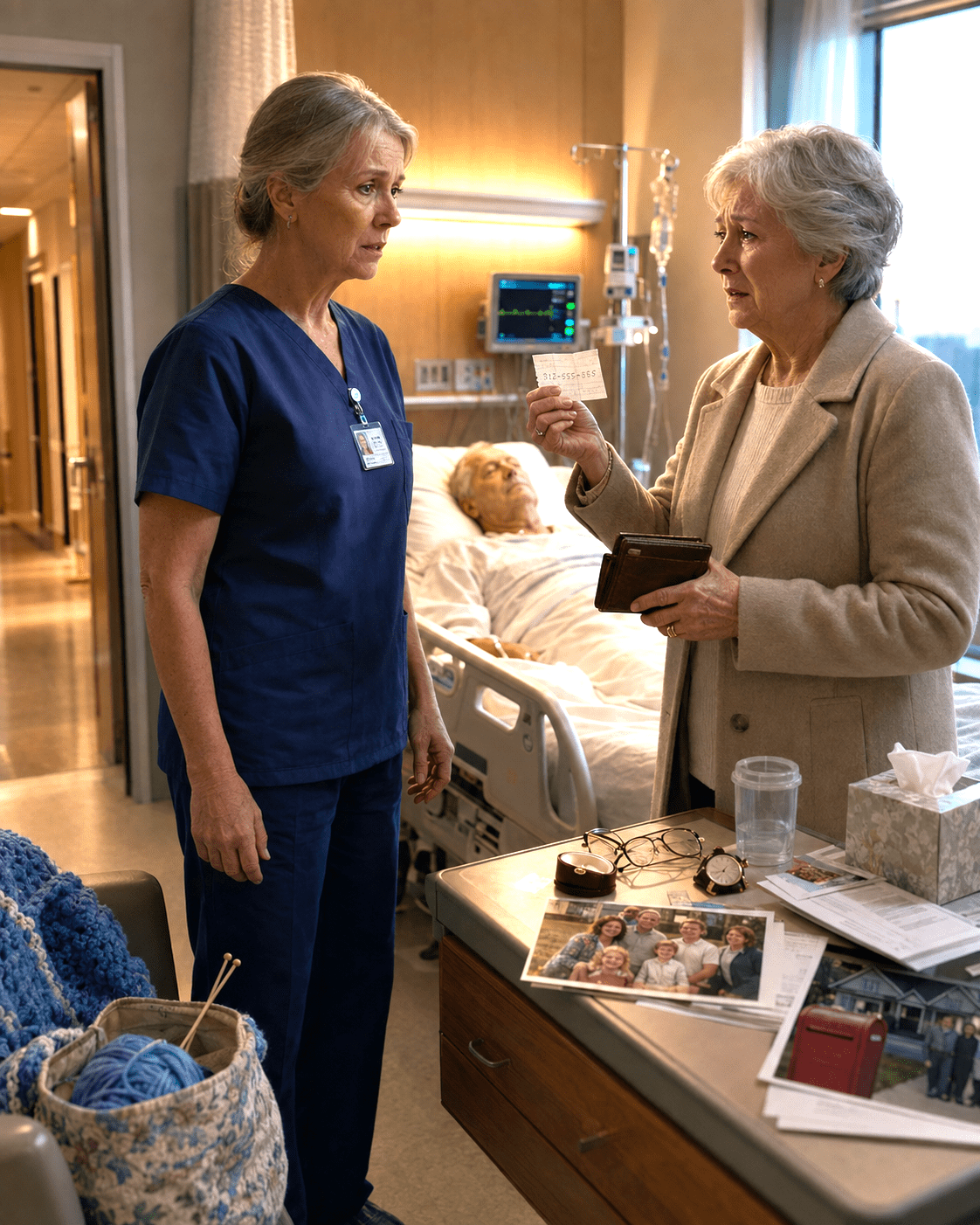
Tom watched her through the glass whenever the door opened.
That night, just after midnight, he asked me to close the door.
I had been checking his medication when he caught my wrist gently.
“Please,” he whispered. “I need to tell someone.”
There is a particular look people have when they know time has become smaller than truth. I had seen it before. I pulled a chair beside his bed and sat.
He stared at the ceiling for several seconds.
“I have another family.” At first, I thought the medication had confused him.
Then he said, “Kentucky. A woman named Rose. Two children. A little house with a red mailbox.”
My hand stopped over the chart.
“How long?” I asked. “17 years together,” he said. “Longer if you count the years before I admitted what it was.”
I felt the air change.
His wife was less than 30 feet away, knitting a blanket for the man who had apparently built another home in another state.
Tom began crying quietly. He told me Rose knew about Eleanor. Eventually, anyway. The children in Kentucky were adults now. He had helped raise them, paid bills, attended school events when he could, and invented business trips whenever one life required him to disappear from the other.
“I loved them,” he whispered.
I did not answer. “And I loved Eleanor.”
That sentence angered me more than I expected.
I had spent decades watching spouses sleep in hospital chairs, clean wounds, sign consent forms, and whisper promises over bodies failing them. Love was not an excuse I enjoyed hearing from people who had turned devotion into deception.
Tom seemed to read my face.
“I know what I did.”
“Does Eleanor know?” I asked.
He looked toward the closed door.
“No. Not everything.” Then he gave me a phone number.
I did not write it down. I did not need to. He repeated it twice, slowly, as if making sure it would survive him.
“Please promise me you won’t tell her.”
I looked at him. As his nurse, I understood confidentiality. As a woman, I thought of Eleanor outside, counting stitches and asking me every hour whether her husband was comfortable.
“I can’t make promises about what happens after you die,” I said carefully.
His eyes filled with fear.
“Please.” I held his hand, but I said nothing.
Tom died at 3:07 that morning.
Eleanor came into the room at dawn.
She kissed his forehead, folded the blanket she never finished, and began packing his things.
Then she opened his wallet.
A tiny square of paper slipped onto the floor.
She unfolded it. I saw the number immediately.
Eleanor looked directly at me.
“Do you know who this belongs to?”
And in that moment, the secret Tom had begged me to protect was no longer safely his.
It had landed between us, demanding answers neither of us was ready to hear.
Part 2: The Number in His Wallet
I had faced grieving families before, but Eleanor’s question was different because I knew the answer, and Tom had asked me to carry it into silence.
I looked at the number in her hand.
Every nursing instinct told me to protect his confidence. Every human instinct wanted to spare her another wound.
But the paper was already hers, and she was asking about her own life.
I swallowed. “I don’t know the person personally,” I said carefully, “but your husband mentioned that number to me last night.”
Eleanor did not move. “He did?”
“Yes.” Her fingers tightened around the tiny square of paper.
“What did he say?” I chose every word as if I were stepping across broken glass.
“He asked me not to tell anyone what he shared.”
Her face changed slowly. “So there was someone.”
I could not give her the whole confession. I also could not look into her eyes and pretend the number meant nothing.
I nodded once. “I’m sorry.”
Eleanor stared at Tom’s empty wallet.
I expected tears. Anger. Questions. Maybe an accusation that I had known something and withheld it while she sat outside knitting.
Instead, she carefully refolded the paper.
“Thank you for being honest.”
That was all. She placed the number inside her coat pocket and finished packing his belongings.
The blue blanket lay across the chair, unfinished. Eleanor had spent 3 weeks knitting it while doctors adjusted medications and whispered about comfort care. She picked it up, held it against her chest, then placed it in her bag without unfolding it.
At the doorway, she turned toward me.
“Was he frightened?” “Yes.” “Was he in pain?”
“No. We kept him comfortable.”
She nodded. Then she left.
For the rest of my shift, I replayed the conversation.
Had I betrayed him or protected her? I could not decide.
Still, I worried. For the first time in years, I wished nursing came with instructions for the moments when professional duty and human decency seemed to point in opposite directions.
For several nights, I imagined Eleanor calling the number and discovering a mistress who had no idea Tom was married. I imagined screaming, accusations, adult children learning their father was someone different from the man they buried.
Then, as hospital life always does, the days moved on.
New patients filled room 614.
New families waited beside elevators.
Three weeks later, I arrived for my shift and found a cream envelope taped to my locker.
My name was written neatly across the front.
Inside was a handwritten card.
“Would you meet me for coffee? I think you deserve to know the rest.”
It was signed, Eleanor Hale.
I read the sentence twice.
Part of me wanted to decline. Nurses are taught boundaries for good reasons, and whatever happened after Tom’s death belonged to his family.
But another part of me needed to know whether the truth I had partially released had caused damage I could never repair.
I called the number Eleanor had written beneath her name.
We agreed to meet Saturday morning at a quiet café across town.
When I arrived, she was already seated beside the window.
She looked tired, but not destroyed.
In front of her were 2 photographs.
I sat down. Eleanor pushed the first one toward me.
It showed Tom beside a red mailbox, smiling with a woman and 2 young children.
Then she slid forward the second.
It showed Tom years later beside Eleanor and their grandchildren.
“They were both real families,” she said.
I stared at her. “You knew?”
Eleanor smiled sadly. “I found out 18 years ago.”