Part 1: The Balance That Broke My World
My father had been dead for 2 years when grief found a new way to destroy me. I walked into my bank expecting reassurance, and within minutes I was staring at a balance so impossible that every memory of my family began to feel like evidence.
Dad had left me $430,000. He had always treated money as protection, something you saved so the people you loved would never feel trapped.
I placed the inheritance in savings and promised myself I would not touch it for at least 2 years. I kept working, paid my own bills, drove the same car, and let the account sit untouched.
Then, on a Tuesday morning, I stopped at the bank before work.
There was no emergency. I had realized I had not checked the balance in months. I almost left because I was running late. Sometimes I wonder how long the lie would have survived if I had driven away.
A teller greeted me, verified my identification, and typed for seconds.
“Your available balance is $12,418.”
I laughed because screaming felt less reasonable.
“I’m sorry. What?” She checked again.
“$12,418.” My fingertips turned cold. “That’s impossible. I haven’t withdrawn anything.”
The teller called the branch manager, Daniel. He opened my history, stared at the screen, then turned the monitor toward me.
The withdrawals formed a pattern.
$8,000. $8,000. $8,000. Every 2 weeks for 2 years.
My inheritance had been disappearing while I slept, worked, celebrated birthdays, paid rent, and mourned my father.
“Who authorized these?” I whispered.
“They were made in person,” Daniel said.
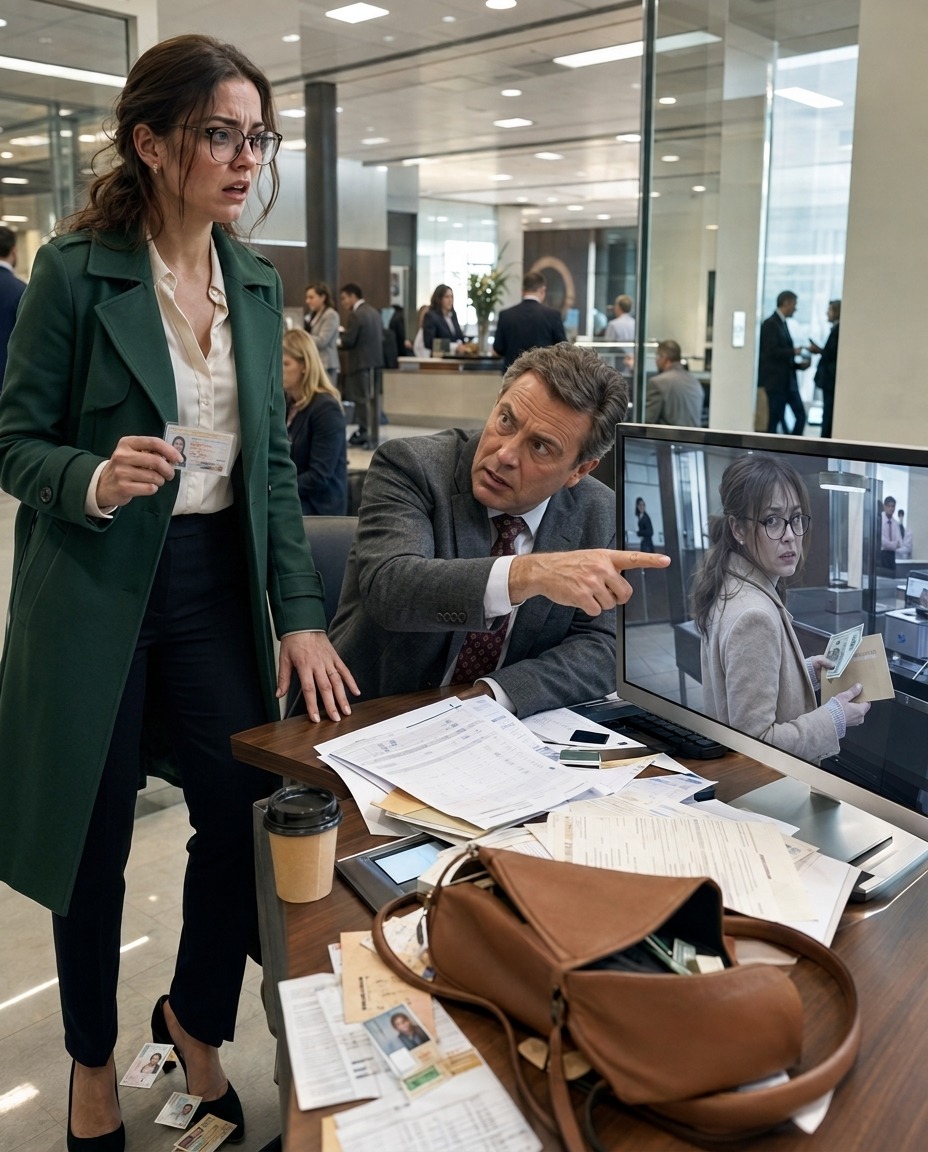
“With my ID?” “Yes.” I pulled my driver’s license from my wallet so quickly that cards fell to the floor. Daniel compared it with the scanned identification attached to transactions.
Same name. Same photograph. Same birthday.
Different address. “That isn’t where I live.”
“I know.” Daniel requested security footage from the withdrawal. We waited inside his glass office while my heartbeat pounded against my ribs.
The recording appeared. A woman in a beige coat entered the bank.
She had my haircut. She wore glasses identical to mine.
She even walked with the same slight limp I had developed after an ankle injury years earlier.
She approached the counter, signed my name, collected $8,000, and placed it inside her bag.
Then she turned toward the security camera.
The room tilted. I knew the tiny scar beside her eyebrow. I knew the angle of her head. I knew the mouth that used to steal frosting from birthday cakes before our mother noticed.
Daniel watched my face. “Do you know her?”
For several seconds, I could not speak.
Finally, I whispered, “She’s my sister.”
Claire had died 11 years earlier in a car accident three states away. There had been a death certificate, a closed casket, white lilies, and a granite grave I visited every Christmas.
I had spent 11 years apologizing to someone I believed was buried beneath that stone.
But Claire was alive. And she had been entering my bank, wearing my identity, taking my father’s money.
Nothing in that room felt solid beneath my feet anymore.
I reached for my phone with shaking hands and called the person who could tell me whether I was losing my mind.
My mother answered on the third ring.
“Hello?” “Mom,” I said. “I need the truth about Claire.”
Silence. Then her breathing changed.
“She’s alive,” I said. The pause lasted too long.
Finally, my mother whispered, “Where are you?”
“At the bank.” Another silence.
Then came the sentence that broke my heart twice. “Then you know.”
Part 2: The Funeral That Never Made Sense
I closed my eyes. “You knew?”
My mother began crying. “How long?”
“Since the funeral.” “Since the funeral?”
“She didn’t die, sweetheart. She disappeared.”
“You buried an empty casket and let me believe my sister was dead.”
“She was in trouble.” “What kind of trouble?”
My mother would not answer.
I asked again, louder. “What kind of trouble, Mom?”
“I can’t explain this on the phone.”
“You had 11 years to explain it.”
“I was trying to protect you.”
“From Claire?” “From what was around her.”
Then she added, “Your father knew.”
Dad had stood beside me at Claire’s grave. He had watched me leave flowers. He had held me when I cried over our final argument. He had known every year that my sister was alive somewhere, yet he never told me.
I hung up. The bank contacted police. By afternoon, Sergeant Morales sat across from me, reviewing transaction records while I repeated the impossible story.
A dead sister. A fake identity.
About $418,000 moved without permission.
Investigators soon found a deeper pattern.
Every $8,000 withdrawal happened 2 days before a payment connected to the same company.
Northbridge Recovery Services. The name meant nothing to me.
It meant something to Morales.
“I’ve seen Northbridge before.” “Where?”
“An interstate fraud investigation.” He explained that Northbridge had surfaced around debt schemes, shell companies, and stolen funds.
Then he asked whether Dad had ever mentioned Claire owing anyone money.
“No.” “Did he ever make payments you couldn’t explain?”
I thought about his locked filing cabinet, private phone calls, and occasional envelopes he refused to discuss. Old habits suddenly looked like evidence.
Morales requested older financial records.
By late afternoon, he had found something worse.
Before Claire supposedly died, Dad had begun making regular payments linked to Northbridge.
Those payments continued for years.
Dad had not only known Claire was alive.
He had been paying to keep something away from us.
I had been 24 when Mom called and said Claire had died in a car accident three states away. The funeral home recommended a closed casket.
She borrowed money, disappeared for weeks, and lied about where she lived.
The last thing I told her was, “Call me when you decide to stop destroying everything.”
For 11 years, I believed those were the final words she carried into death.
At the funeral, white lilies covered the casket. Dad barely spoke. Mom looked hollow. There was a death certificate and a grave.
I visited that grave on birthdays.
I apologized every Christmas. Now, I understood I had been grieving an empty box.
Morales returned with an address.
The counterfeit driver’s license used at my bank had been traced to a rental house across town.
“We’re sending officers,” he said.
“I’m coming.” “You don’t have to.”
“Yes, I do.” I imagined Claire running. I imagined discovering that my mother’s confession was somehow another lie.
The house was narrow and plain, wedged between a laundromat and tired brick apartments.
Morales asked if I wanted to remain outside.
I shook my head. When I entered, the first thing I saw was a chipped blue mug on a kitchen table.
Then I saw the woman holding it.
She looked older, exhausted, and frighteningly familiar.
Her fingers picked at one thumbnail exactly as they had when we were children.
I had dreamed about seeing Claire again for years, but in every dream she returned smiling. None of those dreams prepared me for the terror of seeing her alive and afraid.
Claire lifted her eyes to mine.
Then my dead sister spoke.
“I knew you’d find me eventually.”