He came back to the altar, slipped the folded note into my hand, enclosed my fingers in his, and turned toward the room as if he wanted every person there to hear what came next.
A few minutes earlier, I had not known whether he would come back to me at all.
That uncertainty was the part no one in the room could see.
They could see his mother standing near the front row. They could see the officiant waiting. They could see 180 guests sitting unusually still while a wedding ceremony stopped being a wedding ceremony and became something none of us had planned.
What they could not see was the question I had carried all the way down the aisle.
Was I about to marry a man who would stand beside me when doing so cost him something?
Four hours before the ceremony, I had walked into the dressing room expecting nerves, hairspray, coffee, and the usual last-minute chaos.
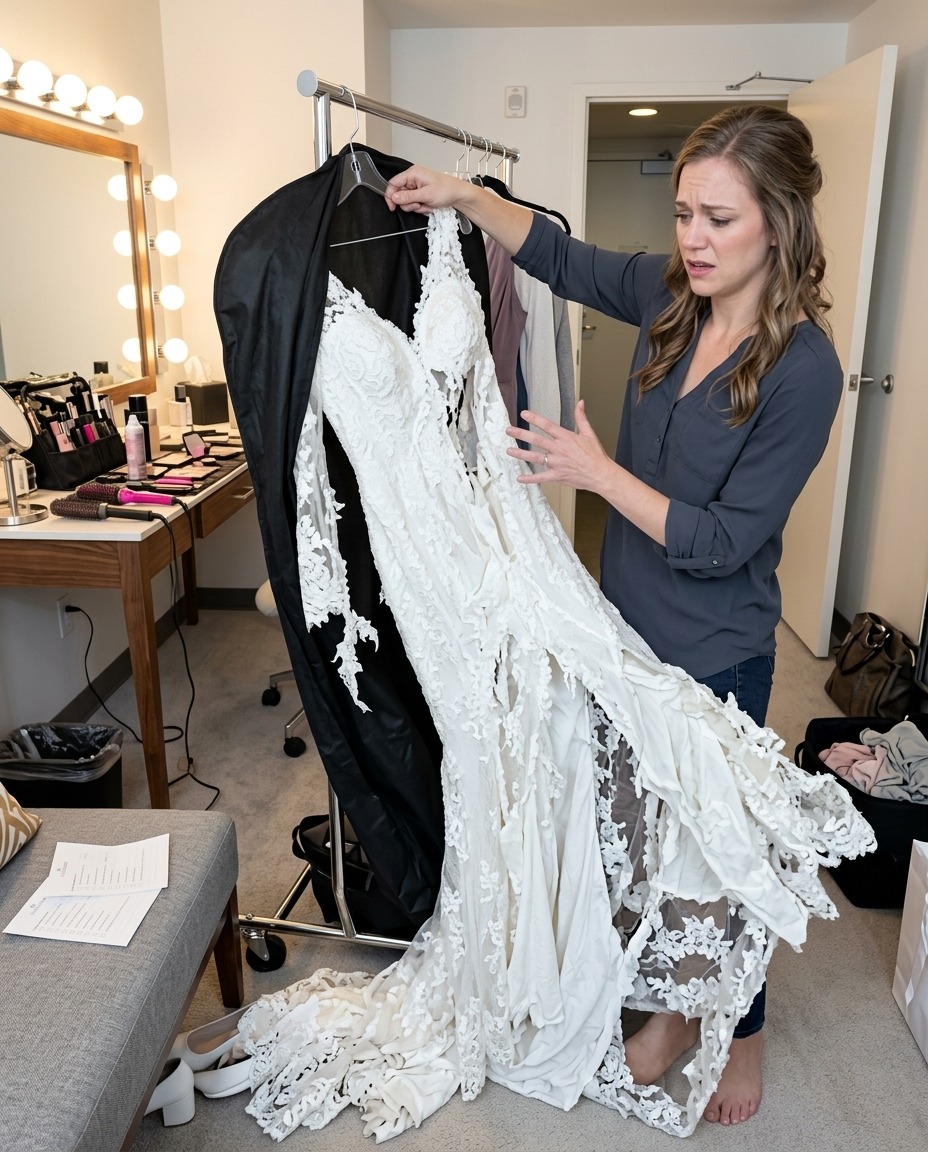
Instead, I found my wedding gown ruined.
The damage was not subtle. It was not the kind of snag someone could hide with a pin or the kind of stain a bridesmaid might attack with club soda and optimism.
The fabric had been damaged badly enough that I knew almost immediately there would be no pretending everything was fine.
For a few seconds, I simply stood there.
The room still smelled like hairspray. A cup of coffee had been left nearby long enough to lose its steam. Everything around me looked like the ordinary preparation for a wedding day, which somehow made the dress feel even more unreal.
Then I saw the note.
It had been placed neatly on top of the ruined gown.
Three words.
“Remember your place.”
I read them once.
Then again.
There are insults that sound childish when repeated later. There are cruel comments that can be softened by tone, context, or an apology someone insists you misunderstood.
This was not one of them.
The note did not say she was upset about the wedding.
It did not say she thought I was wrong for her son.
It told me there was a place assigned to me, and whoever had written those words believed I needed to be reminded of it.
I already knew who had written them.
My future mother-in-law had never made much effort to hide what she thought of me.
For months, I had tried to give her the benefit of every possible doubt.
Maybe she was having trouble adjusting to her son getting married.
Maybe she was used to being the most important woman in his life.
Maybe the comments about how I dressed, how we spent our weekends, or how often he called her were only the awkward growing pains of a family changing shape.
I had told myself versions of that story more times than I could count.
I had also watched my fiancé handle her the way he always had.
He avoided arguments.
He changed subjects.
He sometimes let a rude comment slide because correcting her would turn ten uncomfortable seconds into a thirty-minute confrontation.
I understood why.
At least I thought I did.
There is a kind of family peace that is not really peace. It is simply the arrangement everyone learns to maintain because challenging the person who creates the tension is more exhausting than absorbing it.
Until that morning, I had wondered whether his mother merely disliked me.
The dress answered that question.
What it did not answer was the only question that mattered.
What would her son do when avoiding the problem was no longer possible?
I did not call her.
I did not call him.
And I did not cancel the wedding.
Not yet.
Instead, I folded the note carefully and kept it.
That decision surprised even me.
Part of me wanted to march through the building, find her, and demand an explanation before another guest arrived.
Another part wanted to call my fiancé immediately and force him to choose a side while both of us were angry.
But I knew something important.
If I confronted his mother first, the entire argument could become about me and her.
She could call me dramatic.
She could say I misunderstood.
She could cry.
She could accuse me of ruining the wedding.
Most importantly, he could step into the middle and try to calm everyone down without ever answering the real question.
I did not need him to referee.
I needed him to choose what kind of marriage he intended to have.
So I changed clothes.
I had packed a simple white dress for the following morning. It was never supposed to be part of the ceremony. It was plain compared with the gown that had taken months to choose and prepare.
That suddenly did not matter.
I fixed my hair as best I could.
I checked my face.
Then I walked out.
People noticed.
Of course they noticed.
Some guests looked at my dress and quickly looked away, the way people do when they realize something is wrong but do not know whether acknowledging it will make things worse.
Others whispered to the person beside them.
I did not explain.
I kept moving toward the front.
My future mother-in-law was sitting in the first row.
She looked completely composed.
That may have been the moment the last part of my doubt disappeared.
She did not look surprised to see me without the gown.
She did not ask what had happened.
As I passed her seat, she leaned slightly toward the aisle.
“At least this looks more appropriate.”
I kept walking.
Those words confirmed what the note had already told me.
The ruined dress had not been an impulsive act followed by regret.
She believed she had corrected something.
She believed she had put me where I belonged.
At the front, my fiancé smiled when he saw me.
Then the smile changed.