My nine-year-old patient’s stepfather dragged him into the ER by the wrist, demanded antibiotics, and said, “He’s not worth missing a shift over.”
Then I touched the boy’s swollen face—and something beneath his skin pushed back against my glove.
The man stopped breathing.
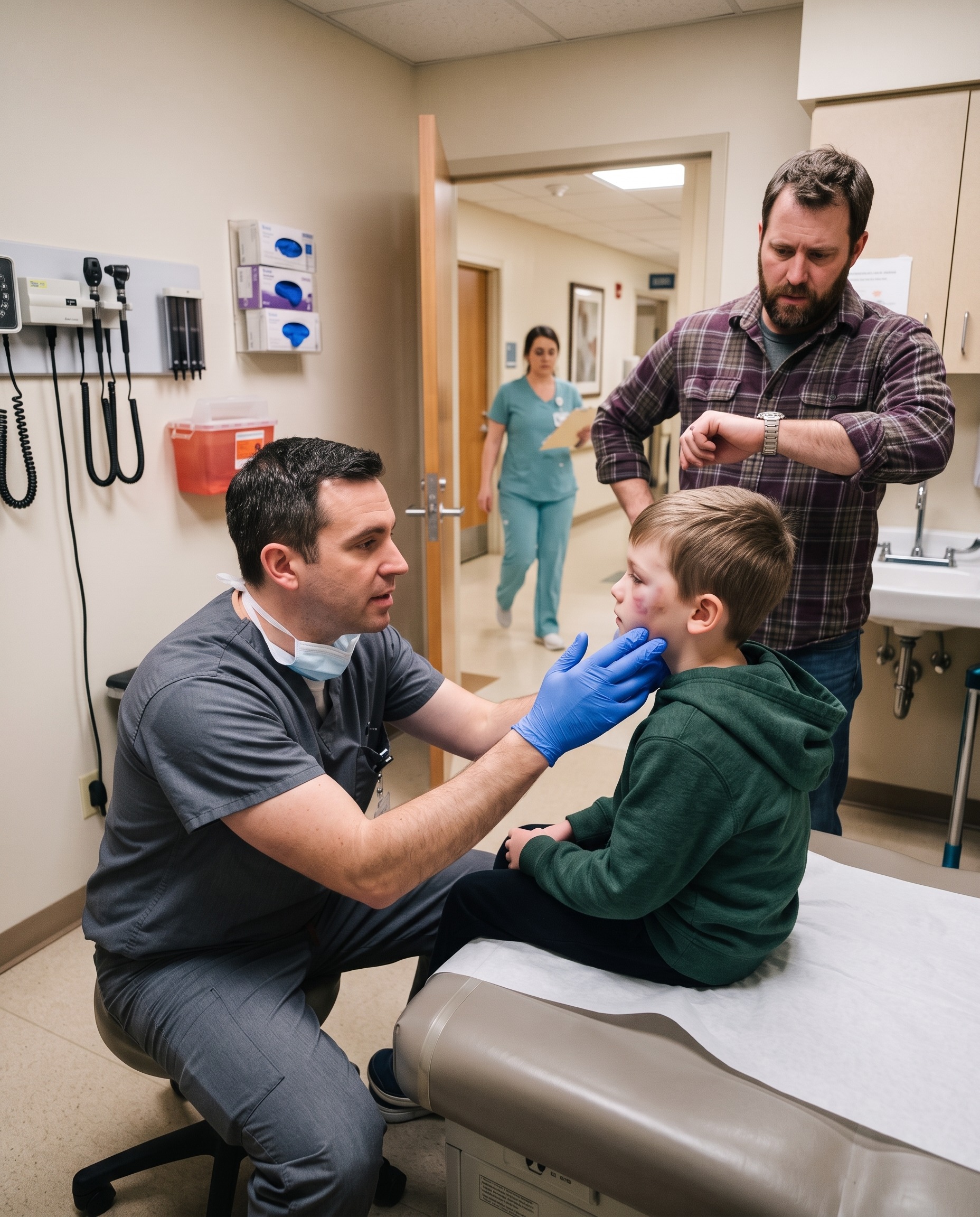
So did I.
It was 3:14 in the morning, the hour when an emergency department can feel both completely awake and strangely separate from the rest of the world.
Rain tapped against the ambulance doors outside our coastal Oregon hospital, steady enough that every person who came through the entrance carried some part of the weather in with them.
Wet footprints crossed the waiting room tile.
A crooked stack of magazines sagged beside triage.
Someone had abandoned a paper coffee cup on a side table, and whatever had been inside it was long past warm.
That was when Greg came through the doors with Leo.
I noticed the grip before I noticed the swelling.
Greg had one hand wrapped around the boy’s wrist, not exactly carrying him and not exactly guiding him. He was pulling him forward with the impatient force of someone trying to finish an errand.
Leo stumbled once but caught himself without complaining.
Greg barely looked down.
“Spider bite,” he said. “Give him a Z-Pak. I work in three hours.”
No hello.
No question about whether the child was all right.
No fear in his voice.
Just a diagnosis he had already chosen and a prescription he expected us to provide.
The boy’s name was Leo.
He was nine years old.
When the registration questions reached his date of birth, Greg stared at the form longer than he should have.
He couldn’t remember it.
“My wife handles that paperwork garbage.”
He said it like Leo’s birthday belonged in the same category as utility bills and junk mail.
His hand tightened around the boy’s wrist.
Leo immediately turned his body sideways.
He didn’t pull away.
He didn’t complain.
He simply adjusted himself around the pressure.
Children tell you things before they speak.
Sometimes they tell you by crying.
Sometimes by clinging to a parent.
Sometimes by refusing to sit still.
And sometimes they tell you by becoming very, very good at making themselves smaller.
I stepped between Greg and the boy.
“I’m Dr. Thomas. I’ll examine him in Room 4.”
Greg followed us.
Leo walked ahead of him.
Inside the exam room, Leo climbed onto the paper-covered bed and sat near the edge with both hands hidden inside the front pocket of his gray hoodie.
Rainwater dripped from his shoes onto the floor.
His clothes looked ordinary enough for a child brought in during bad weather, but his posture didn’t.
He kept his knees close together.
His elbows stayed tucked in.
His chin remained slightly lowered.
Greg stayed standing.
“Sit straight,” he ordered.
Leo’s shoulders snapped back before the sentence was completely finished.
It was automatic.
Sarah, my nurse, stood in the doorway holding the chart.
She caught my eye and tapped it twice with one finger.
That tiny gesture carried most of what I already knew.
Greg had told triage a spider was responsible.
He couldn’t say when the swelling had started.
He didn’t know whether Leo had been feverish.
He didn’t know when the boy had last eaten.
And whenever anyone asked Leo a question, Greg answered first.
“Looks dental,” Sarah whispered when Greg turned toward the counter.
It was possible.
The right side of Leo’s face was visibly swollen even beneath the hood, and an untreated tooth infection could absolutely produce facial swelling in a child.
But possible was not the same as convincing.
I rolled my stool closer to the bed, then stopped before I entered Leo’s immediate space.
I wanted him to see that I wasn’t going to grab him.
“Can I lower your hood?” I asked.
Leo did not look at me first.
He looked at Greg.
Only after that did he nod.
I gently moved the fabric away from the right side of his face.
The swelling ran from his cheekbone down toward his jaw.
Purple bruising showed beneath skin that looked stretched and hot.