My son slapped me because I asked my daughter-in-law not to smoke indoors.
Fifteen minutes later, I picked up my phone—and changed the entire course of my life.
The sound of his palm against my cheek cut through the spotless kitchen, sharp and flat enough that for a second I heard nothing else.
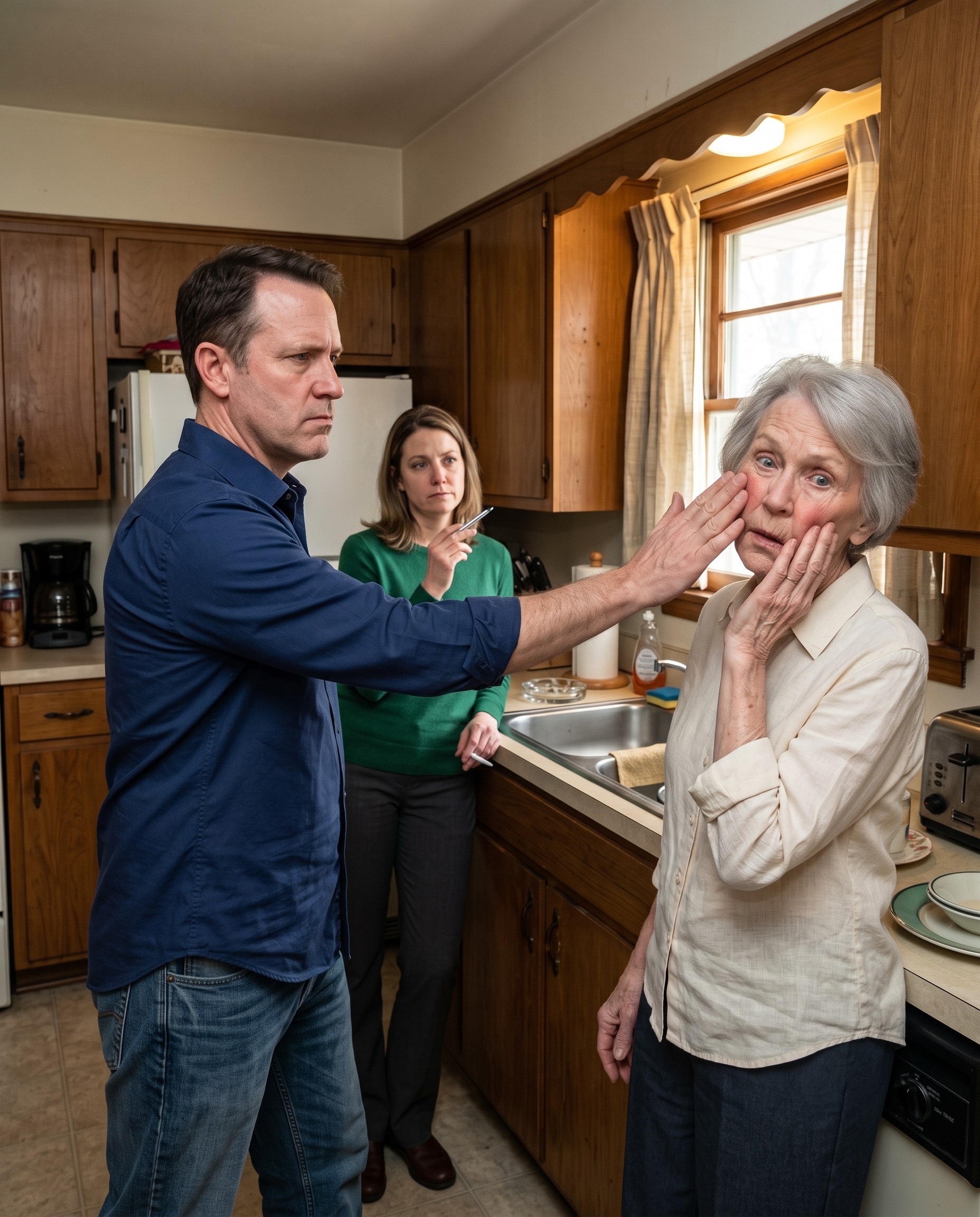
Then the refrigerator hummed back into my awareness.
Thin blue smoke curled above the white counter.
The room smelled like lemon cleaner, stale cigarettes, and the bitter burn that always warned me my lungs were about to punish me.
My cheek went hot beneath my fingers.
My only child had just hit me.
I was seventy-three years old, and all I had said was, “Sloan, please don’t smoke in the kitchen. My lungs can’t take it.”
Sloan stood beside the sink in expensive leggings, holding a cigarette between two polished fingers as if my request had been nothing more than an annoying interruption.
Her ash dish sat beside the sponge I had used that morning.
My son stood close enough that I could see the pulse jumping in his jaw.
What frightened me most was not the slap.
It was his face afterward.
There was no shock in it.
No immediate regret.
No stunned realization that he had crossed a line a son should never cross with his mother.
“Maybe now you’ll stop talking,” he said.
Then he turned to Sloan, kissed her forehead, and asked whether she wanted to go out for dinner as casually as if he had brushed a fly from the counter.
Sloan smiled and tapped ash into the dish.
“I could eat.”
Fifteen minutes later, they left through the garage arm in arm.
Their car started outside, and the garage door rolled shut behind them.
I stayed in the kitchen with one hand against my face, listening to my breathing catch at the edge of the smoke.
My doctor had warned me years earlier that factory dust had damaged my lungs.
I still kept his note folded inside my purse because my son had once demanded proof, as if the wheezing he heard through the walls at night were something I invented to inconvenience him and his wife.
I had shown them the note.
I had explained what smoke did to me.
Then I had asked again.
Eventually, I had begged.
One boundary.
That was all I had tried to keep.
Six months earlier, I had moved into their house telling myself I was lucky.
They called my room the guest room, and after a while I understood that they meant the word literally.
A guest does not complain.
A guest does not take up space.
A guest stays grateful.
There was a stiff bedspread, one narrow closet, and a nightstand holding the only framed photograph I had brought with me.
It showed my son at his high school graduation, my arm around him, both of us smiling after years of burst pipes, canned-soup dinners, and rent checks that sometimes went in two days late.
I had looked at that picture whenever his adult voice became cold enough to make me wonder where the boy in the photograph had gone.
For six months, I had swallowed one small humiliation after another.
Keep your things out of sight.
Use the little washroom downstairs when company comes.
Send what money you can because groceries are expensive.
And above all, be grateful, because “not every son would take his mother in.”
Standing in the kitchen with my cheek swelling, I finally understood how much work I had been doing to excuse him.
I had called control concern.
I had called humiliation stress.
I had called cruelty a bad mood.
The slap made those excuses impossible to hold together anymore.
So I picked up my phone.
I skipped the cousins who called only at Christmas.
I skipped the relatives who would ask what I had said to make him angry.
I skipped everyone who might tell me that family problems should stay inside the family.
Then I found three names I had not dialed in years.
The first belonged to a young man I once let sleep on my couch when he was eighteen and had nowhere else to go.
He was an attorney now with a small downtown office.
The second belonged to a girl whose mother I had cared for after surgery so she could stay in college.
She had become a journalist and still mailed me a Christmas card every year.
The third belonged to a former college kid who had eaten at my kitchen table four nights a week because he was always broke and too proud to admit he was hungry.
He was now a financial investigator who could read a bank statement the way most people read a grocery receipt.
The attorney answered first.
“Loretta? Are you alright?”
The answer rose automatically to my lips.
I’m fine.
I had said those two words through funerals, unpaid bills, surgeries, loneliness, and years when I did not know how I would make everything stretch until Friday.
But I looked at my reflection in the dark microwave door and saw color beginning to form beneath one eye.
I looked at the smoke still hanging in the hallway.
Then I looked at the graduation photograph of the boy I had once known.
“No,” I said. “I’m not fine. I need help.”
By the third call, my hands had stopped shaking.
No one gave me a grand speech.
No one told me to get revenge.
They asked me practical questions.
What happened?
When?
Was I safe right now?
What records did I have?
Had I saved the messages about money?
Could I document the condition of the house and my face without putting myself in more danger?
Their questions changed something inside me because they treated what happened as real.
Not family drama.
Not an old woman being difficult.
Real.
I photographed my cheek with 7:42 a.m. visible on my lock screen.
I photographed the ash in the sink and Sloan’s dish sitting beside the sponge.
I photographed the broken latch on the window in my room.
I unfolded my doctor’s note about my lungs and photographed that too.
Then I opened my banking app and saved screenshots of the monthly transfers I had been sending into my son’s account.
I went through my messages and saved every reminder from Sloan about grocery costs and every version of the same sentence she liked to use whenever I hesitated.
“Family helps family.”
On my phone, all those separate moments looked different together.
They no longer looked like little complaints I should be embarrassed to mention.
They looked like a pattern.
That night, my son and Sloan came home laughing and smelling like steak and wine.
I heard the garage door rise, then Sloan’s heels crossing the floor, then my son opening and closing cabinets in the kitchen.
I stayed under the stiff quilt in the guest room.
Neither of them came upstairs to check on me.
Neither asked whether my face hurt.
Neither mentioned the slap.