The rotting smell in Trauma Room 2 was unbearable, but when I finally cut off the 8-year-old boy’s filthy, neglected cast, what fell out onto the sterile floor made every seasoned ER nurse scream and step back in pure horror.
The smell reached the hallway before the stretcher cleared the ER doors.
It was sweet, metallic, and thick enough to cling to the back of my throat. Fluorescent lights buzzed above the nurses’ station, bleach burned faintly in the floor seams, and beneath that clean hospital smell came something wet and rotten.
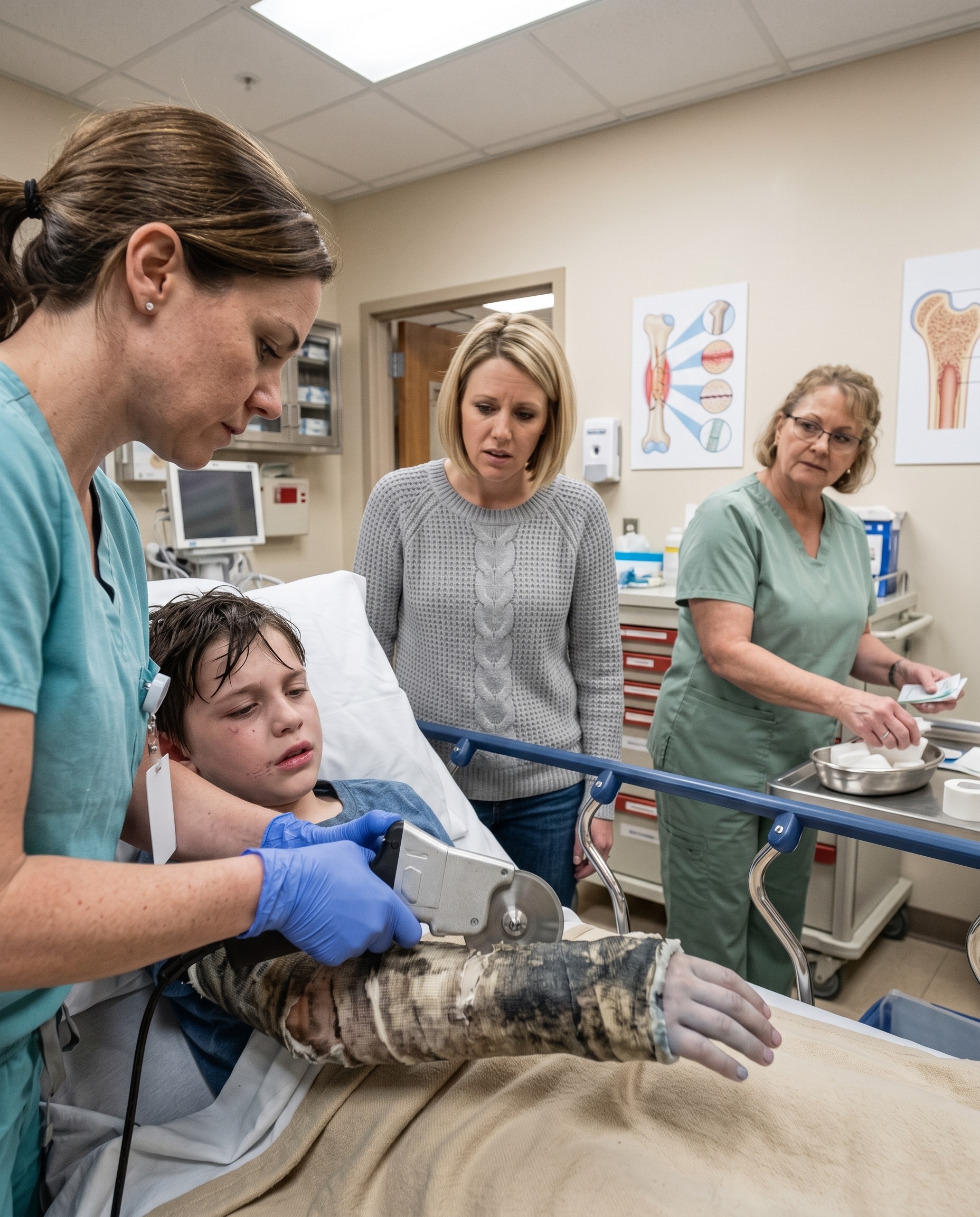
I’m Dr. Sarah Jenkins. In eight years of emergency medicine, I had treated mangled hands, infected wounds, and children whose parents waited far too long before asking for help.
But the boy in Trauma Room 2 stopped our entire unit cold.
“Dr. Jenkins, now,” Marcus said, jogging toward me with one hand pressed over his mask. His face had gone gray. “Eight years old. Mom says mild flu. Heart rate 140, temperature 103.8, blood pressure dropping. He’s barely responding.”
Then he lowered his voice.
“It’s his arm.”
The sliding door opened, and the air hit me like a hand against my chest.
The boy on the bed was so small he looked closer to five than eight. His lips were cracked, and his skin had the thin, waxy look of a child who had been sick much longer than anyone wanted to admit. His eyes were open, but they drifted past the ceiling lights as though he were disappearing somewhere we could not follow.
His right arm was sealed from his knuckles to above his elbow in a fiberglass cast.
It was not the clean blue kind covered in classmates’ signatures.
It was blackened with dirt, stained in dark rings, and frayed around the edges. The material had cut into swollen purple skin. His fingertips were blue, and when I pressed one, the color did not return.
“How long has this cast been on?” I asked.
His mother stood in the corner holding a paper Starbucks cup.
Martha Harris looked untouched by the emergency around her. Cream sweater. Pearl necklace. Smooth blonde bob. Perfect nails. She gave me a thin smile, as though good manners could make the smell disappear.
“Oh, about a month,” she said. “He’s clumsy. Always falling out of trees in the backyard. We’re only here because he felt warm this morning. Probably a seasonal bug.”
A month did not look like that.
A month did not smell like that.
“Mrs. Harris, your son is in septic shock,” I said. “That cast has to come off immediately. He may lose his hand. He may lose his life.”
Her smile tightened.
“No. His orthopedic surgeon said two more weeks. Give him antibiotics, and we’ll leave.”
Clara, our veteran nurse, had already double-masked and dabbed peppermint oil beneath her nose. Even so, her hands shook as she wrapped the blood pressure cuff around the boy’s arm.
Marcus opened the pediatric IV kit beside the crash cart. Labels were lined up. The sepsis protocol sheet was clipped to the rail. Every object in that room seemed to understand the emergency before Martha did.
Neglect does not always enter a hospital looking monstrous. Sometimes it arrives brushed and scented, carrying expensive coffee, asking everyone to pretend the smell is not coming from the child.
I looked at the boy’s blue fingers, and a three-year-old memory flashed behind my ribs—another child, another polished explanation, another warning I had failed to push hard enough.
Some mistakes become ghosts. Some ghosts become rules.
“Clara,” I said, “call security. Then bring me the cast saw.”
Martha lunged toward the bed.
“You can’t touch him!” she screamed. “I’ll sue this hospital!”
Clara stepped between us. “Back up, ma’am.”
Two security guards rushed through the doorway and moved Martha against the wall. She clawed at the front of her cream sweater, fighting them until she saw Clara place the cast saw beside her son’s arm.
Then her entire voice changed.
“Don’t open it,” she whispered. “Please. Don’t open it.”
I had expected anger.
I had expected denial.
I had not expected fear.
Clara looked at me, then at Martha, and lowered her voice. “Doctor… she knows something.”
The cast saw was already in my hand, but the question in that room had changed.
It was no longer only about what was trapped inside that cast.
It was about why a mother who claimed she wanted her son healed was begging us not to save him.
I turned on the machine.
And the first cut into that filthy cast revealed a truth nobody in Trauma Room 2 was ready for.
Part 2:
The first thing we saw when the cast separated was not what anyone expected.
Clara grabbed the edge of the bed as a wave of heat and odor escaped from the opening. The boy flinched weakly, and I immediately stopped cutting long enough to check his face.
“Stay with me,” I whispered.
His eyes moved toward mine for the first time.
Not toward his mother.
Toward me.
Inside the cast was evidence of a much longer problem than a simple untreated injury. The swelling, the damage to his skin, and the condition of his arm told us this had been ignored far beyond a few days.
Martha started crying.
But not the way a mother cries when she sees her child hurting.
She cried like someone watching a secret fall apart.
“You don’t understand,” she said. “I was trying to protect him.”
Nobody answered.
Because the room had already heard that sentence before.
People who hurt others often use the word protection when they mean control.
But then she said something that made me stop.
“I didn’t put that cast on him.”
The room went quiet.
Clara looked at me.
Marcus stopped preparing medication.
Martha stared at her son’s exposed arm and finally admitted there was someone else who had been making decisions about his care.
The person she had been afraid to name was the reason she kept insisting we wait.
And when I heard who had told her to leave the cast alone for two more weeks, I realized this emergency had started long before that hospital door opened.
Part 3:
Martha had admitted someone else controlled her son’s care, but we still didn’t know how much she had chosen to hide.
The first thing we saw when the cast separated was not what anyone expected.
Clara grabbed the edge of the bed as a wave of heat and odor escaped from the opening. The boy flinched weakly, and I immediately stopped cutting long enough to check his face.
“Stay with me,” I whispered.
His eyes moved toward mine for the first time.
Not toward his mother.
Toward me.
Inside the cast was evidence of a much longer problem than a simple untreated injury. The swelling, the damage to his skin, and the condition of his arm told us this had been ignored far beyond a few days.
Martha started crying.
But not the way a mother cries when she sees her child hurting.
She cried like someone watching a secret fall apart.
“You don’t understand,” she said. “I was trying to protect him.”
Nobody answered.
Because the room had already heard that sentence before.
People who hurt others often use the word protection when they mean control.
But then she said something that made me stop.
“I didn’t put that cast on him.”
The room went quiet.
Clara looked at me.
Marcus stopped preparing medication.
Martha stared at her son’s exposed arm and finally admitted there was someone else who had been making decisions about his care.
The person she had been afraid to name was the reason she kept insisting we wait.
And when I heard who had told her to leave the cast alone for two more weeks, I realized this emergency had started long before that hospital door opened.
“My husband,” Martha said. “Michael. His father.”
I kept my hands on the boy instead of looking at her, because his blood pressure was still falling and whatever explanation Martha had brought into Trauma Room 2 could wait behind the one fact that could not: her son was critically sick.
Clara adjusted the IV line while Marcus brought another tray beside me, and I continued opening the cast in short, careful sections.
The next piece of fiberglass lifted away with a strip of soaked padding stuck beneath it.
Then the padding dropped onto the sterile sheet, and several pale larvae spilled onto the floor with it.
Clara recoiled so hard her shoulder struck the supply cart.
Marcus swore under his breath and backed away before catching himself.
One of the nurses outside the doorway cried out, and suddenly the scream promised by that smell finally had a shape.
I had seen infected tissue before.
What shook the room was not simply what had been living under the cast; it was the realization that an eight-year-old child had been carrying that hidden deterioration around while the adults responsible for him kept saying he was fine.
I covered the exposed area with clean dressings and told the team to keep moving.
Fluids, antibiotics, monitoring, surgical evaluation—everything that mattered now was about keeping the infection from taking more than it already had.
Martha tried to come closer.
Clara stopped her with one arm.
“Please,” Martha said. “I need to be with him.”
I looked up then.