
Part 1 – A Funeral in the Rain
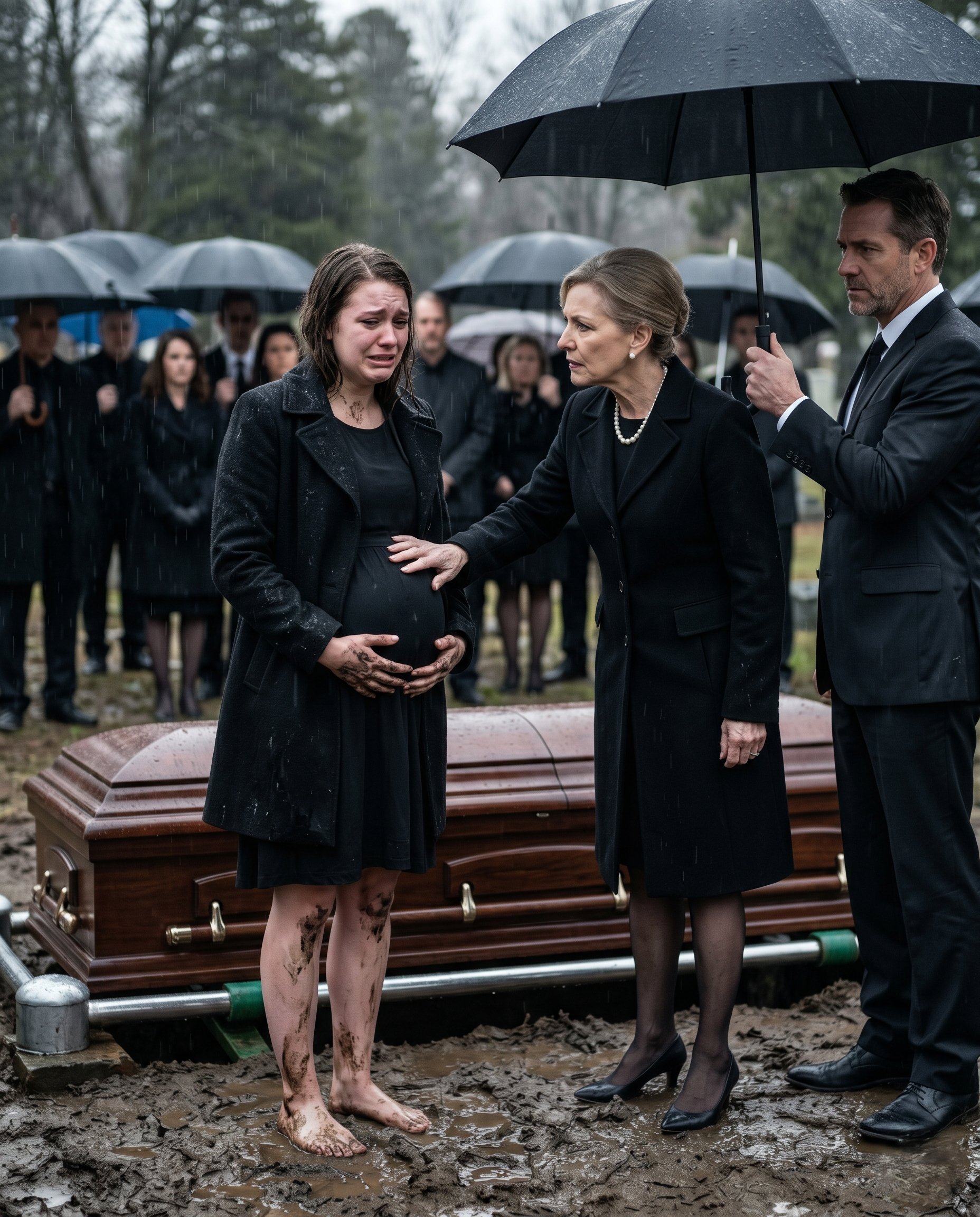
My husband’s funeral took place beneath a sky so heavy with rain that the grass at Oakwood Memorial Park had turned into a soft, muddy sponge. By the time the mahogany casket carrying Thomas Miller was lowered toward its final resting place, my shoes were already sinking into the earth.
I stood close enough to touch the cold brass handle, one hand pressed tightly against my nine-month-pregnant belly, completely numb beneath the crushing weight of grief.
Thomas was only thirty-four when his heart suddenly stopped.
He left behind a half-painted nursery, a hospital bag waiting by the bedroom door, and a wife who still woke up every morning expecting to hear him whistling in the kitchen.
I loved the ordinary things about him most. The way he folded towels with absolutely no system but always tried anyway. The way he filled my gas tank before early appointments. The way he taped our ultrasound pictures to the refrigerator like they belonged in an art gallery.
Across the open grave stood his mother, Margaret.
She wore tailored black wool, expensive pearls, and the same practiced expression she used whenever she wanted people to admire her composure. Even in grief, she somehow managed to remind everyone present that she still controlled the room—and the story being told inside it.
Beside her stood Philip, Thomas’s younger brother. His hands never stopped moving, and his attention never stayed in one place for long. He kept checking an incredibly expensive watch—the same watch Thomas had once bought him after Philip swore his gambling addiction would never hurt the family again.
Some families mistake silence for dignity.
But in this family, silence usually meant everyone already knew the ugly truth and had quietly agreed to protect the wrong person—as long as that person carried the family name.
I already knew they tolerated me more than they accepted me. To Margaret, I was never polished enough. To Philip, I was never important enough—except when Thomas needed someone dependable beside him.
Still, I came to the funeral hoping grief might soften them.
I believed losing Thomas—and the arrival of the baby—might finally make us cling to one another instead of pushing each other away.
I was wrong.
The minister’s voice blurred beneath the steady drumming rain. Umbrellas tilted against the gray sky while expensive shoes slowly disappeared into the soaked earth. Thomas’s coworkers stood in stiff rows, pretending not to notice the icy distance between me and my late husband’s family.
Then the first contraction hit.
A deep pressure tightened through my body, followed by a sharp burst of pain that forced me to bend forward despite myself. I grabbed the metal rail beneath the tent and tried to breathe quietly through the agony.
The second contraction came much faster.
A sudden rush of warmth soaked through my tights and filled my shoes.
For one stunned second, I stared at the wet grass below me as though my own body had betrayed the carefully planned timing of everything.
My water had broken at my husband’s grave.
And for one heartbreaking moment, I instinctively searched for Thomas across the casket—because he was the one who had read every page of the childbirth books.
I took three shaky steps toward Margaret and reached for her sleeve, accidentally smearing rainwater and cemetery mud across the expensive wool.
“Margaret,” I whispered, my voice smaller than I intended. “Please, I need your help, my water just broke, you have to call for an ambulance right now.”
Margaret looked down at my muddy hand first.
Then she slowly lifted her eyes to mine.
There was no panic. No concern. Not even ordinary politeness.
“We are here to grieve Thomas, Blair,” she said coldly. “This is my son’s final moment of dignity, so do not dare make a scene here. If you need a ride, call a taxi yourself.”
Pain can empty a room instantly.
Cruelty empties it even faster.
I turned toward Philip, hoping for at least a fragment of decency, but he barely looked at me. He just tapped the crystal face of his watch and shifted impatiently.
“Not tonight, Blair,” he muttered. “I have estate lawyers waiting for me in the city, so just get an Uber and leave, you will be fine on your own.”
For one brief second, I imagined screaming loud enough for the entire cemetery to hear exactly what kind of family stood beside Thomas’s grave.
But I didn’t scream.
Something colder—and stronger—settled inside me instead.
I released Margaret’s sleeve, straightened my spine as much as labor allowed, and walked away from the funeral completely alone.
Part 2 – Alone at the Hospital
A cemetery groundskeeper eventually found me gripping the edge of the office counter and called emergency services around three in the afternoon.
The ambulance doors slammed shut behind me while the funeral reception was still beginning somewhere else—filled with people probably praising the importance of family loyalty.
At the hospital intake desk, the registrar asked who should be contacted in case of complications.
I stared at the clipboard for several seconds. Rainwater dripped from my shoes onto the floor beneath the chair.
Then I gave the only honest answer I had left.
“No one.”
The nurse paused and looked at me carefully, as if she understood much more than I said aloud. But she didn’t offer pity or meaningless comfort.
She simply removed my soaked tights, wrapped me in a warmed blanket, and fastened an identification bracelet around my wrist.
At 11:46 that night, my son was born.
He was tiny, furious, and beautifully alive.
One small fist rested beside his cheek, and he had Thomas’s mouth in perfect miniature.
That was when I finally cried.
Silently.
I tied Thomas’s wedding ring to the drawstring of my hospital bag and held my son skin to skin until his breathing settled peacefully against my chest.
No flowers arrived from Margaret.
No phone calls came from Philip.
Not a single member of the family appeared on the visitor log, even though my room number was available to anyone who cared enough to ask.
The next morning, the birth certificate worksheet sat beside my hospital bed.
With trembling fingers, I wrote Thomas’s name on the father line.
Then I left the emergency contact section completely blank.
The baby needed feeding every two hours. I needed stitches checked, paperwork signed, and someone to drive me home.
Eventually, one of the nurses walked me to the curb carrying a thick folder filled with discharge papers.
That first night home, I slept upright in the nursery chair Thomas had assembled himself.
The blue painter’s tape he had used still clung to the baseboards where he promised he would finish trimming the room on his next day off.
Love is not always dramatic.
Sometimes love is simply a crooked strip of tape left behind by a man who believed he still had years ahead of him—and a woman too exhausted to remove it.
Part 3 – Thomas’s Final Protection
Five days later, Thomas’s attorney called me.
His voice sounded extremely careful, like someone trying to carry both legal instructions and devastating news at the same time without dropping either.
“There is something Thomas left specifically for you,” he explained. “It is a heavy lockbox, and he was very clear that only you were to be the one to open it.”
I almost refused to go.
By then, exhaustion had turned every task into something impossible.
Still, I drove to the attorney’s office and signed the probate receipt.
The lockbox was silver, heavy, and colder than I expected against my hands.
Inside were documents Thomas had prepared long before his death.
Corporate account controls.
Audit correspondence.
Insurance instructions.
And a handwritten letter I read twice while sitting alone in the parking lot.
Thomas knew Philip’s gambling problem had returned.
He knew Margaret would always protect Philip first and apologize later—if apologizing ever became useful.
So Thomas quietly moved authority where neither of them could reach it.
For twelve days, I heard absolutely nothing from the family.
I learned the exhausting rhythm of caring for a newborn entirely alone: warming bottles in darkness, balancing laundry with one hand, collecting mail while carrying a sleeping baby.
My phone remained silent.
Margaret never asked whether her grandchild had arrived safely.
Philip never bothered asking whether I had even made it to the hospital.
Neither question benefited them.
Then suddenly, the business accounts froze.
Federal auditors placed hard holds on multiple corporate accounts—including payroll, vendor payments, and private withdrawals.
Thomas had anticipated everything perfectly.
The documents inside my lockbox named me as the only authorized signer for specific releases until the audit cleared.
And that was the exact moment Margaret remembered she had a grandchild.
Part 4 – The Visit
On the twelfth afternoon, the doorbell rang.
I checked the security monitor while my son slept peacefully in the bassinet behind me.
Margaret stood on the porch wearing her pearls again, though this time she looked noticeably softer than she had at the funeral.
Philip stood behind her holding a stuffed bear with the price tag still attached.
Their black SUV idled loudly beside my mailbox.
I looked from the monitor to the open lockbox resting on the hall table, then toward the soft blue blanket Thomas had picked before he died.
The people who leave you drowning in the rain often return the moment they realize they need the umbrella.
I opened the door but kept myself firmly blocking the entrance.
“Blair, darling,” Margaret said warmly, reaching for affection she had never earned. “We are so terribly sorry that we have not been by to see you sooner, but I just had to come see my new grandchild.”
Philip leaned sideways, trying to see inside the house.
“We really need to discuss the status of the estate accounts, Blair.”
I looked at the cheap stuffed bear.
Then at Margaret’s rehearsed smile.
And suddenly I could smell the cemetery mud all over again.
“Which grandchild are you referring to?” I asked calmly. “Are you talking about the one you told to call a taxi before he was even born, or the one you are suddenly interested in because Thomas made me the only person who can sign the checks?”
The porch fell completely silent.
Margaret’s expression cracked instantly.
The grandmother act disappeared, revealing something much closer to fear.
Philip stepped toward the doorway, but I lifted the folder before his expensive shoe crossed the threshold.
“Do not even think about coming into my house,” I said quietly.
Philip gave a sharp laugh and informed me I had no idea what I was holding.
I replied that the attorney understood enough for both of us.
Right then, the attorney’s car pulled into the driveway.
I had called him before opening the door.
Grief had already taught me one practical lesson:
Never meet desperate people alone.
The attorney approached carrying a thick file and calmly informed Margaret and Philip that all future communication regarding the accounts would go through his office.
Philip demanded immediate access.
Margaret argued about family rights.
Meanwhile, I stood in the doorway with one hand on the frame and the other resting near my son’s bassinet.
The attorney opened the file and read Thomas’s signed instructions aloud.
Limited releases could be approved for payroll, taxes, and verified operating expenses.
But personal withdrawals required full review.
That was the part Philip could not tolerate.
Margaret slowly turned toward him and quietly asked what exactly he had done.
Philip said nothing.
And his silence answered everything.
Part 5 – Choosing My Family
I did not feel victorious.
I was far too exhausted for triumph.
What I felt instead was a quiet line forming inside me—a boundary separating the family Thomas loved from the family I now had to survive.
Over the following weeks, the attorney handled the audit process.
Legitimate business expenses were paid.
Employees were protected.
Philip’s private requests were denied, documented, and forwarded through proper legal channels.
Margaret sent message after message.
At first they sounded demanding.
Later they became apologetic once she realized I would never reopen the accounts—or the nursery door—just to ease her guilt.
I saved every message.
The hospital bracelet.
The intake papers.
The cemetery office timestamp.
The lockbox receipt.
Everything stayed organized in one folder because the truth deserved better than fading memory.
One day my son would ask about the day he was born.
And when he did, I wanted the answer to be precise, dated, and impossible for anyone with money or pearls to rewrite.
Months later, I finally peeled the blue tape from the nursery baseboards while my son kicked happily on a blanket nearby in the morning sunlight.
Thomas’s wedding ring stayed in a small box above the dresser.
The porch door stayed locked whenever Margaret arrived unexpectedly.
And my peace remained protected because I chose carefully who could come near it.
When my son grows old enough to ask about his father, I will tell him the truths that matter most.
Thomas loved him.
Thomas planned for him.
Thomas protected him long before he ever had the chance to hold him.
And when I think back to that rainy cemetery now, I no longer remember only the cruelty.
I remember something far more important.
I remember walking away from that grave entirely alone—and still bringing my child safely into this world.
That was the real beginning.
Not the funeral.
Not the betrayal.
But the moment I stopped begging people to become family and finally started protecting the family Thomas left behind in my arms.