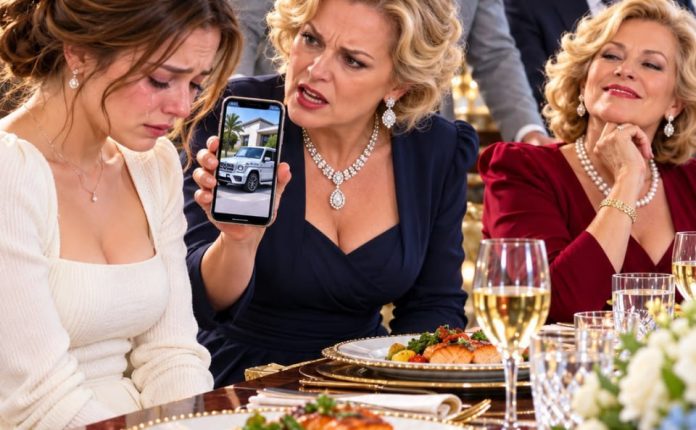
My mother had already decided my brother would take my car. She came to my apartment two weeks before Aunt Clara’s birthday to explain why I should be grateful for the chance to help.
“Jason’s transmission is finished,” she said, setting a plastic container on my kitchen counter. “He’ll need your crossover until he gets himself sorted out.”
“No.”
She blinked, as though I had interrupted before she reached the question.
“I haven’t told you the whole situation.”
“You told me enough. I need my car.”
In the living room, my seven-year-old daughter, Lucy, was helping her younger brother build a cardboard parking garage. Every few seconds, Ben made a reversing noise that ended in a laugh.
Mom lowered her voice.
“Your brother has two children depending on him.”
I looked toward the living room.
“So do I.”
“Don’t make this unpleasant, Emily.”
She had brought chicken soup. In our family, something warm in a plastic container often arrived just before a request I was not supposed to refuse.
I pushed it gently back across the counter.
“I work nights. The sitter needs me home on time. Lucy has school. Ben has preschool. I’m not giving Jason the car.”
“Lending.”
“For how long?”
“Until things improve.”
I had heard that deadline before.
My name is Emily Carter. I was twenty-nine, divorced, and working as a pediatric nurse at a hospital in Ohio. I shared custody with my former husband, Daniel, who lived forty minutes away and reliably took our children on his scheduled weekends.
Our marriage had ended without a spectacular betrayal. We had become unhappy in ways neither of us knew how to repair. We were learning to speak politely at school pickups and divide expenses without turning every conversation into another argument.
My parents considered the divorce a personal failure of mine.
Jason’s troubles were circumstances.
At thirty-four, my brother had closed a lawn-care business and an appliance delivery business. Both had left debts. He was working irregular warehouse shifts while looking for something he believed would suit him better.
Our mother called him ambitious.
When I picked up overtime, she asked why I could not manage on my regular wages.
The car was the first substantial thing anyone had given me without attaching a job to it.
Three months earlier, Aunt Clara called while I was waiting at a bus station after a night shift. A loudspeaker announced a delayed connection before I could move somewhere quieter.
“Where are you?”
“On my way home.”
“That wasn’t what I asked.”
Clara was my mother’s older sister. She had worked in purchasing for a manufacturing company for thirty-seven years and could hear an evasive answer through a bad phone connection.
I admitted that my old sedan had failed its inspection and needed repairs worth more than the car. I had sold it for parts.
“How long have you been taking the bus?”
“Seven weeks.”
“Emily.”
“I’ve worked out the connections.”
There was a pause.
“Have the connections worked you out?”
That was when I began crying.
I had slept four hours the previous day. Ben had needed antibiotics. My sitter, Mrs. Alvarez, had kindly stayed late twice, but kindness did not cancel the extra hours I owed her.
Clara listened without offering a speech about resilience.
A week later, she asked me to meet her at a dealership.
The silver crossover was five years old. It had sensible mileage, clean upholstery, and a scrape near the rear bumper that Clara pointed out before the salesman could.
“I’m buying transportation,” she told him. “You don’t have to sell me a dream.”
She had paid for an independent inspection. There were maintenance records in the glove compartment and two working keys.
At the desk, she made certain the title and registration went into my name.
“This is yours,” she said. “You don’t owe me monthly installments or explanations.”
I sat in the driver’s seat afterward with my hands on the wheel.
For a few minutes, neither of us spoke.
Then Clara touched the folded bus schedule sticking out of my bag.
“You can retire that.”
I kept it anyway.
For three months, my mornings became ordinary. I drove home. I made breakfast before the children woke up. I could buy a full week of groceries without deciding what I could carry between transfers.
Lucy called the crossover the moon car because of its color.
Ben liked the cup holder beside his booster seat.
I liked arriving places without apologizing.
Then Mom brought the soup.
We argued for twenty minutes. She suggested coworkers, Daniel, buses, and adjusting my shifts. Every solution involved rearranging my life so Jason would not have to rearrange his.
When she left, she did not take the soup.
I carried it downstairs after her.
Three days later, I came out of the hospital after my shift and checked my phone.
There was a message from Jason.
Got the car. Mom said she talked to you. Appreciate it.
I read it standing beside a concrete pillar in the parking garage.
For a moment, I thought he meant another vehicle.
Then I called home.
Mrs. Alvarez said Jason had arrived shortly after seven. He told her I knew he was collecting the crossover. He had a key.
She had watched him drive away from my apartment parking space.
My spare key had hung beside the refrigerator. Mom had been in my kitchen the previous Sunday while the children showed her their school pictures.
I called Jason.
“Turn around.”
“Morning to you too.”
“I said no. Bring my car back.”
“Mom told me you two worked it out.”
“You’re speaking to me now. We didn’t.”
He exhaled loudly.
“I’m already halfway across town.”
“That means you can be back in half an hour.”
“I have to get the boys.”
“Then arrange a ride.”
There was a long silence.
“You really want to do this over a car?”
I looked at the hospital clock. Mrs. Alvarez had another job at ten.
“I want you to return something that belongs to me.”
He ended the call after promising we would discuss it later.
Maya found me outside the employee entrance.
She was still wearing her hospital badge and carrying a travel mug with a broken lid.
“You look like somebody canceled oxygen.”
“My brother took my car.”
She waited.
“Without permission.”
“Get in.”
She drove me home.
On the way, my father called.
“Your mother says you’re making threats.”
“I told Jason to return my car.”
“He needs it.”
“I need it.”
“You’re single. Jason has a family.”
I stared at Maya’s dashboard.
“Would you like to say that to Lucy and Ben?”
“Don’t twist my words.”
I ended the call before I said something I would later be expected to apologize for.
At home, both children came running to the door. Ben wanted to know whether the moon car was at the doctor.
“Uncle Jason has it,” I said.
“Can we have it back after lunch?”
I bent to untie my shoes so he would not see my face.
“I’m working on that.”
For the first day, I kept expecting an engine outside.
For the second, I sent practical messages. I needed the vehicle for work. Jason did not have permission. He needed to give me a time and place.
By the third, my mother was telling me that my tone was upsetting everyone.
Nobody offered a return date.
I took photographs of the purchase documents and saved them somewhere my family could not access. I exported the messages rather than trusting myself to remember what had been said.
At work, I was careful with medication records. At home, I had spent years accepting whatever version of an argument my parents preferred.
I began applying the same standard to both places.
Dates. Words. What I knew directly.
I called my insurance company. I explained that a relative had taken the vehicle without permission and asked what information they required.
Then I contacted the police.
The officer who took my report asked specific questions. Did Jason have a key? How had he obtained it? Had I ever allowed him to use the crossover? Had I explicitly asked for its return?
I answered each one.
I did not ask anyone to frighten my brother into obedience. I wanted the unauthorized removal recorded accurately, and I wanted my car back.
There was a report number. There would be follow-up.
Family relationships did not make the situation simple. They also did not erase it.
I sent Jason one more message.
You do not have permission to keep or drive my vehicle. Return it today. I have documented that it was taken without my consent.
He read it.
He did not answer.
My mother did.
You will regret involving strangers in family business.
I put the phone in a drawer and made the children scrambled eggs.
During those eleven days, ordinary tasks became negotiations again.
Maya drove me twice. Daniel collected the children from my apartment instead of the usual meeting place. I took buses on my workdays and paid Mrs. Alvarez for the extra time.
Lucy missed a library activity because the connection would have taken too long.
She said it was fine.
I hated hearing my own practiced voice in hers.
Clara’s birthday dinner fell on a Saturday when the children were with Daniel.
I considered staying home.
Mom called that morning to remind me to bring Clara’s present.
“And please don’t arrive looking for an argument.”
“I’m not the one with someone else’s car.”
“Emily, I’m asking for one pleasant evening.”
I had bought Clara a warm blue scarf. I wrapped it in paper left over from Christmas, keeping the patterned side inward.
Maya dropped me at my parents’ house after our shift.
“Text if you need collecting,” she said.
“I can take the bus.”
“You can also text.”
The house smelled of roast chicken and lemon cake.
Clara was in the dining room with our aunt Ruth and Ruth’s husband, Martin. Dad was opening wine. Mom was directing everybody away from the kitchen as though the evening depended on a flawless arrangement of serving dishes.
Jason’s place was empty.
“Work ran late,” Mom said.
I put my coat over the banister and helped carry plates.
Clara kissed my cheek.
“You look tired.”
“I’ve had a week.”
“So I hear from your face.”
I smiled because she was trying to make it easy for me.
I should have told her then.
Instead, I asked whether she had opened my present.
We sat down. Ruth talked about a leaking conservatory roof. Martin asked Dad about the furnace. Mom kept offering me potatoes.
I thought we might make it through.
Then Clara glanced toward the front window.
“Who dropped you off?”
“My friend Maya.”
“Something wrong with the crossover?”
I opened my mouth.
Mom answered first.
“Jason needed it more.”
She was passing the bread when she said it.
Not apologetically. Not as an admission. The words had the easy tone of someone explaining why she had moved a chair.
Ruth stopped reaching for the butter.
Clara set her fork on the plate.
“Emily agreed?”
Mom gave a small smile.
“You know what she’s like about asking for help. We sorted it out.”
“No,” I said.
The word was quiet, but everyone heard it.
Clara turned fully toward me.
“You didn’t agree?”
“I told them no. Jason took it while I was at work.”
Mom’s fingers tightened around the breadbasket.
“Please don’t say took.”
“What should I say?”
“He borrowed it.”
“Borrowing requires an answer you didn’t get.”
Dad leaned forward.
“Your aunt doesn’t need the whole performance.”
Clara looked at him.
“I asked the question, Robert.”
She asked how Jason had obtained the key.
My mother began explaining the transmission, his boys, his unreliable hours.
Clara let her finish.
“The key, Diane.”
“Mom took my spare,” I said.
“That was sitting out in the kitchen,” Mom replied.
I could feel tears collecting, infuriating and familiar. Once I cried, the discussion would become about how emotional I was.
I pressed my thumbnail against my finger beneath the table.
Clara saw.
“Emily, look at me.”
I did.
“Did you give your mother permission to take the spare?”
“No.”
“Did you give Jason permission to drive away?”
“No.”
Mom laughed sharply.
“We’re her parents.”
Clara’s fork struck the plate as she pushed it away.
“You are not her owners.”
Nobody moved.
Then she took out her phone.
Jason answered on the fourth ring.
“Happy birthday, Aunt Clara. I’m nearly—”
“Bring Emily’s crossover to this house. Within thirty minutes.”
“What?”
“And bring every key you have.”
Mom reached across the table.
“Let me explain to him.”
Clara moved the phone out of reach and switched on the speaker.
Jason made a short, disbelieving sound.
“Emily’s really got everybody worked up?”
“Twenty-nine minutes,” Clara said.
“Fine. Fine, I’m coming.”
She ended the call.
“It’s your birthday,” Mom said. “Must we spoil it?”
Clara glanced at the cake waiting on the sideboard.
“I’m having a useful evening.”
Dad pushed back his chair.
“I won’t sit here while you act as though we’re criminals.”
“Then stand,” Clara said. “But let Emily finish.”
I told them about the buses, the unanswered requests, the insurance call, and the police report.
At that, my father went very still.
“You reported your own brother?”
“I reported what happened.”
Ruth took her hand off her wineglass.
“You told us she’d lent it to him,” she said to Mom.
Mom looked annoyed rather than ashamed.
“She was upset at first. She would have come around.”
That was the first time I understood how much of my supposed consent had consisted of other people waiting for me to become too tired to resist.
Clara rested her phone beside her plate.
“When you moved last winter,” she asked me, “did your mother give you anything?”
I thought she meant furniture.
“Some towels.”
“Money, Emily.”
“No.”
Mom started gathering serving spoons.
“We should put these away before everything dries.”
Clara did not look at the food.
“Find the messages from when you signed your lease.”
My stomach tightened.
I searched back through months of reminders and requests. There was the photograph of the lease. The question about whether Dad could help carry a dresser. My message asking to borrow eight hundred dollars until payday.
Mom’s answer sat underneath it.
We cannot keep rescuing you, Emily.
I remembered exactly where I had read it: outside the pharmacy, with Ben’s prescription in my hand and a deposit deadline approaching.
I had paid the deposit myself. Part came from savings. The rest went on a credit card.
Clara read the screen when I turned it toward her.
“Was I mentioned?”
“No.”
My father stood.
“You know how she gets about money,” he told me. “Don’t feed it.”
I looked at him.
For years, I would have tried to soften whatever came next.
This time I waited.
Clara took a blue envelope from her handbag.
“I brought this because I wanted to ask your mother about something after dinner,” she said. “I thought there might have been a misunderstanding.”
Mom looked at Dad.
It was such a quick glance that I might once have pretended not to notice it.
Clara laid the envelope beside her reading glasses.
“I’d rather hear from you directly.”
Jason texted.
Tell her I’m coming. This is humiliating.
I turned the screen toward my aunt.
She read it without comment.
“If you start counting every little thing,” Mom said, “you’ll tear this family apart.”
I looked from the blue envelope to the message she had sent me last winter.
“I don’t think I know what I’m counting yet.”
Clara opened the flap.
Before she could take anything out, headlights moved across the curtains.
A car braked outside.
My mother stood.
So did I.
I reached the front door before she could tell my brother what to say.
END PART 1