My sister called me the free help at 3:42 on a Wednesday afternoon.
“Thirty-seven minutes, Mara. They waited thirty-seven minutes because you couldn’t manage one thing.”
Lauren stood at the curb outside Maple Ridge Elementary, holding Ellie’s wrist while my niece tried to wipe her nose with a damp sleeve. Owen had moved beside the assistant principal. His backpack was still on, although he had been waiting long enough for the straps to leave red marks on his shoulders.
“I didn’t know dismissal had changed,” I said.
“Of course you didn’t.”
A car rolled slowly past us. The driver looked over, then looked away too late to pretend she hadn’t.
The children had been dismissed at 2:25 because of teacher conferences. I had arrived at 3:02, three minutes before the usual bell, thinking I was early.
The conference schedule had gone to Lauren through the parent portal and in the children’s school folders. She handled school correspondence. I handled the afternoons she built around it.
Until that day, I hadn’t understood how thoroughly those two things had become confused.
Mrs. Alvarez had come outside when she saw my car. Ellie was holding her hand. Owen walked behind them, dragging the toe of one shoe.
“I’m so sorry,” I had said.
I apologized to the secretary, to the assistant principal, and then to the children. Being unaware of the schedule didn’t change how long they had waited.
Ellie climbed into my arms before I finished speaking.
“I thought you were in an accident.”
“No, sweetheart. I’m here. I’m all right.”
Her face was hot against my neck. I could smell the apple shampoo Lauren bought in large bottles from the warehouse club.
Owen didn’t hug me immediately.
“Mom said you knew,” he said.
I looked at him.
“She said Aunt Mara knows the school times.”
“I know the usual time. I didn’t know today was different.”
He considered that with the solemn concentration he brought to complicated Lego instructions.
Then he took my hand.
We were still outside when Lauren arrived.
Tara Whitcomb had called her earlier after noticing the children waiting. Tara remained beside her pearl-white SUV, car door open, one foot on the running board. Her daughter sat inside watching something on a tablet.
Lauren came toward us without closing her own car door.
She didn’t ask whether the children were all right.
She asked what was wrong with me.
“I’ve apologized,” I said. “I’m sorry they were frightened. But you didn’t send me the notice.”
“Don’t try to make this my fault.”
“I’m explaining what happened.”
“You had one job.”
The assistant principal stepped closer.
“Ms. Bennett, perhaps we could—”
Lauren lifted her hand without looking at him.
“No. She needs to understand.”
That was when she called me the free help.
Owen let go of my hand.
I remember noticing a loose thread at his cuff because looking at something small was easier than looking at his face.
Lauren took Ellie from me. My niece protested, reaching over her mother’s shoulder, and Lauren’s voice rose again.
“Enough.”
I stopped speaking.
There were children between us. Whatever I said next would belong to them too.
For four years, I had collected those children almost every school afternoon. Owen had been five when we began. Ellie was three, still attending the preschool program in the same building.
At first, Lauren needed help for six weeks.
Her sales territory had expanded. Her former sitter had moved. She was parenting two young children without another parent sharing the daily routine, and I had a job with unusually early hours.
Six weeks had become the rest of that school year.
Then summer programs.
Then another September.
Nobody sat down and renewed the arrangement. September simply came with new classroom assignments, larger shoes, and the assumption that my car would be at the curb.
I worked at a wholesale flower warehouse outside Livonia. Most mornings, I clocked in before dawn. By afternoon, the cold from the storage rooms had settled into my fingers.
I could finish early enough to make pickup if I started early enough to lose most evenings.
I had once liked that schedule.
There was satisfaction in collecting children who came running when they saw you. Ellie brought me acorns, bent paper crowns, and drawings in which everyone had fingers coming directly out of their arms.
Owen saved questions for the car.
Why did bridges have seams?
Could somebody own a cloud?
If astronauts cried, where did the tears go?
I knew which speed bump made Ellie laugh and which intersection made Owen carsick when he read. I carried allergy-safe crackers in the glove compartment and a clean pair of socks behind the passenger seat.
Those things had never felt like keeping score.
At the curb that Wednesday, Lauren made them feel like a job I had performed badly.
In the confusion, Ellie’s backpack had already gone into my car. Its front pocket held the emergency injector Lauren sent with her outside school. Another remained with the school according to Ellie’s care plan.
When Lauren drove away with the children, I followed to return the bag.
I didn’t call first. I had entered her mudroom nearly every weekday for years.
There was a hook for Ellie’s backpack beside Owen’s baseball cap. Below it sat a basket of unmatched mittens I had sorted the previous February.
I stepped through the open door carrying the bag.
Lauren turned.
“What are you doing?”
“Her medicine.”
I lifted the backpack.
Ellie was halfway up the staircase. She slid down two steps and reached toward me.
“Can Aunt Mara—”
“Not with my children!”
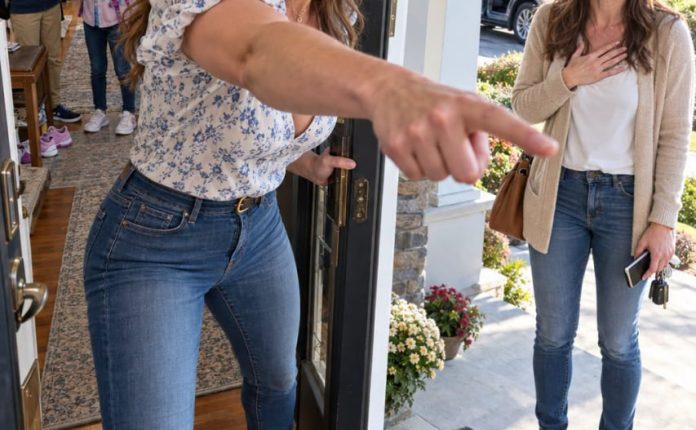
Lauren caught my shoulders with both hands and shoved.
It wasn’t a dramatic fall. I stumbled backward, caught the doorframe, and struck my heel against the raised threshold.
That made it worse somehow. There was no confusion about whether she had meant it. She had simply put me outside.
“You don’t come in here,” she said. “You don’t touch them. You don’t pick them up. Take those seats out of your car.”
Owen stood beside the coat cupboard, staring down.
Ellie covered both ears.
I lowered the backpack onto the porch.
“All right.”
Lauren looked almost angrier at the quiet answer.
“I mean it, Mara.”
“I heard you.”
I walked to my car with my shoulders pulled so tight that breathing hurt.
My phone rang before I opened the door.
Mom.
“Your sister was terrified,” she said.
There was no hello.
“She told you already?”
“She called because she was upset.”
“So am I.”
“You know what I mean.”
I watched a brown leaf scrape across Lauren’s driveway.
Our mother had spent years treating Lauren’s emotions as emergencies and mine as matters of interpretation.
Lauren was under pressure.
Lauren had children.
Lauren didn’t mean things the way they sounded.
I was supposed to understand because I was the easier daughter.
“She shoved me out of her house,” I said.
“Oh, Mara.”
Not disbelief. Weariness.
As if I had made the conversation unnecessarily difficult by introducing something concrete.
“The children saw it.”
“Then don’t drag this out in front of them.”
I looked back at the house. The curtains moved upstairs.
“I left.”
“Good. Give her time.”
I ended the call before agreeing to anything else.
Then I wrote Lauren a message.
Understood. I will not pick up Ellie or Owen beginning tomorrow. Please confirm you have other arrangements.
I read it twice before sending it. No accusation. No explanation she could argue with. Just the practical consequence of what she had said.
Her reply came almost immediately.
Do not come near my kids again.
I took a screenshot because I knew how quickly my family could turn a clear sentence into something nobody had really meant.
That evening, I unbuckled the booster seats.
Owen’s black seat had a cracked cup holder. Ellie’s purple one wore a peeling fox sticker she had chosen during a rainy stop for gas.
Underneath them were a green crayon, three cereal loops, and a receipt from a pharmacy visit I barely remembered.
I vacuumed the seat slowly.
Then I drove the boosters to Lauren’s house, placed them beneath the porch light, and sent one final message telling her they were there.
She didn’t answer.
At home, I made toast for dinner.
I had bought ingredients for the children’s favorite pasta because Wednesday usually ran late for Lauren.
The unopened carton of cream sat beside a package of mushrooms.
I put both in the refrigerator and ate standing up.
The next morning, Denise looked at the clock when I signed in.
“You’ll need to leave early for pickup?”
“No.”
She waited.
“The arrangement changed.”
“All right.”
That was all.
By two fifteen, I had packed a hotel order, checked a delivery sheet, and started stripping leaves from white roses. My hands were moving before I noticed I had missed the moment when I ordinarily reached for my coat.
At three, I glanced at my phone.
Nothing.
At three thirty, still nothing.
I finished the order.
On Friday, Denise offered overtime.
I nearly said no out of habit.
Then I said yes.
The money wasn’t enormous. It was enough to replace the two tires I had been nursing toward winter.
That evening, I went to a tire shop and sat in the waiting room with a cup of terrible coffee.
A little boy across from me dropped a toy truck.
I picked it up.
For a moment, the ordinary act of handing it back nearly undid me.
I missed the children with a physical sharpness I hadn’t expected. I missed Ellie’s running account of who had shared crayons. I missed Owen’s silence before he trusted me with something that had happened at recess.
There was no way to explain that missing them did not mean I could pretend Wednesday hadn’t happened.
Over the weekend, Mom called again.
“Your sister has a lot on her plate.”
“I know.”
“Could you at least be the bigger person?”
“What would that involve?”
A pause.
“Calling her.”
“And saying what?”
“That you love those children.”
“She knows I do.”
Mom sighed into the receiver.
I could picture her rubbing the place between her eyebrows.
“You’re both stubborn.”
One of us had issued an order. The other had followed it.
But saying that felt like stepping onto a treadmill I already knew would go nowhere.
“I asked her to confirm another pickup arrangement,” I said. “Has she?”
“She’s managing.”
“Good.”
Mom didn’t seem pleased that I meant it.
On Monday, I stopped at a grocery store at three fifteen.
For years, that hour had belonged to the school parking lot. The store felt strangely available, as if I had wandered into a room that had always been locked.
I bought pears.
I went home.
I sat at my kitchen table and ate one without checking the time.
Then I cried so abruptly that I had to put it down.
Freedom wasn’t the first thing I felt.
It was absence.
By the fifth school day, I had stopped checking my phone every ten minutes. By the seventh, I had made an appointment for a haircut without asking whether it might interfere with anybody’s meeting.
Mom sent a message about how children could misunderstand adult disagreements.
I replied that Lauren was welcome to arrange a call.
There was no call.
On the ninth school day, Tara messaged me.
Hope you’re feeling better. Let me know if you need anything.
I stood beside the apples in the supermarket and read it twice.
Better from what?
The typing dots appeared, disappeared, and returned.
Lauren said you were overwhelmed and needed a break.
I could hear the carefulness in that sentence.
For a few seconds, I studied the stacked fruit as though the right answer might be printed on a label.
Had the kids been getting home safely? I asked.
Yes. I helped three afternoons. Your mom and a sitter covered other days.
Thank you for telling me.
I opened Lauren’s message.
Do not come near my kids again.
I could have sent it to Tara.
Instead, I closed it.
I didn’t yet know what I wanted corrected, or how to correct it without turning the children’s school into an audience for another family fight.
I left without buying anything.
In the car, I gripped the steering wheel until the urge to compose a furious reply had passed.
On the eleventh school day, I was checking a delivery of lilies when my phone rang.
3:19.
Maple Ridge Elementary.
I answered before the second ring.
Mrs. Alvarez began by telling me the children were safe.
Then she asked whether I had agreed to resume pickups.
“No,” I said.
“Your sister told us you would be here today.”
My phone vibrated against my cheek.
Lauren.
I kept speaking to the secretary.
“We haven’t discussed any change.”
Another vibration.
Mrs. Alvarez explained that the children were in the office with her. They had crackers. Ellie’s medication was available. Neither child was injured or ill.
Their parent, however, had told the school I would collect them.
“She said the disagreement had been resolved.”
I looked at the buckets lined against the refrigerated wall.
Nothing had been resolved.
Nothing had even been discussed.
“Please don’t let them think I forgot,” I said.
“I haven’t told them that.”
I heard Ellie clear her throat in the background, twice.
That familiar little sound caught me harder than crying would have.
Mrs. Alvarez said she needed an accurate pickup plan from Lauren. An emergency contact listing did not establish a daily commitment.
“Have you been able to reach her?”
“Not yet.”
“She’s calling me.”
There was a brief silence.
Then the secretary asked whether I could send written confirmation of the changed arrangement.
I told her I could.
Denise appeared in the doorway while I opened my messages.
“Do you need to go?”
“The children are safe,” I said. “Their mother needs to collect them.”
She looked at me for a moment.
Then she nodded and returned to the loading area.
I texted Lauren with the school’s name, the fact that the children were waiting safely, and a clear statement that I had not agreed to resume.
You are really doing this to them?
Her reply arrived in seconds.
I placed it beside the earlier message.
For once, I didn’t translate either sentence into something gentler.
I forwarded the relevant exchange privately to Mrs. Alvarez.
Lauren called again.
By then, there were six missed calls.
I put the phone face down on the dry corner of my workbench and finished counting the lilies.
It felt terrible.
It also felt necessary.
Twenty minutes later, Mom sent me a photograph.
A paper calendar lay on Lauren’s kitchen counter. The upper corner was held flat with a salt shaker.
My name appeared across almost every school afternoon.
It was there before the argument.
It was there the following week.
It was written beneath that day’s date.
Mom’s message arrived underneath it.
This is the plan Lauren gave me. She said you were starting again today.
I enlarged the photograph.
My name had been written in ink.
Everyone else’s was in pencil.
END PART 1