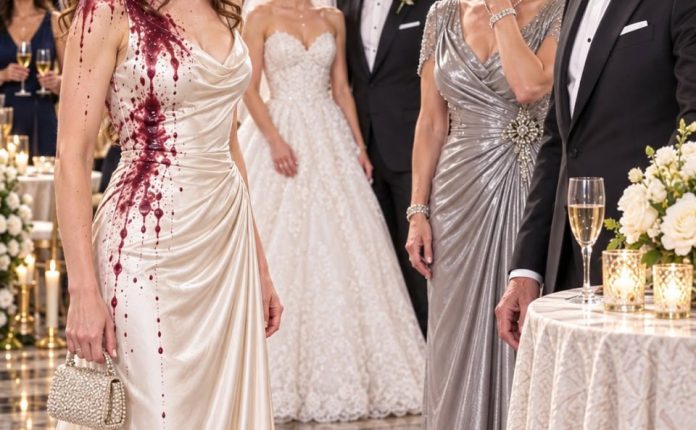
My father caught my wrist beside the ballroom doors.
“Before dinner,” he said. “I expect that acknowledgment before dinner.”
His thumb pressed against the small bones below my hand. Beyond him, a waiter carried champagne toward a room full of people who would have described Charles Hartwell as courteous.
I looked at his fingers until he released me.
“I haven't agreed to sign it.”
“Then perhaps you should consider why your sister invited you.”
I had wondered about that all afternoon.
Camille’s wedding invitation had arrived in a thick cream envelope, addressed to me alone. When I asked whether Julian was included, she said the printer had used an old list.
Two weeks later, she told me both of us were welcome.
Three days before the wedding, she called again.
“The seating is impossible. You understand, don’t you?”
“What changed?”
“Daniel’s mother has relatives coming from Toronto.”
“Then move us to another table.”
There was a pause.
“Evelyn, could you make one occasion simple?”
I told Julian afterward while he stood at our kitchen counter cutting an apple. He put the knife down before answering.
“We can decline.”
“She’ll remember that forever.”
He looked at me.
“What will you remember?”
I had no answer that satisfied either of us.
In the end, I asked him to let me attend the ceremony alone. He had meetings in Boston that afternoon anyway. We agreed he would remain nearby until I decided whether the reception was worth staying for.
He didn’t approve of the arrangement.
He respected that it was mine.
Now, standing outside the ballroom with my father, I wished I had trusted the discomfort that had begun during Camille’s phone call.
Charles straightened his cuff.
“Your mother worked very hard on this.”
“On the wedding?”
“On bringing everyone together.”
We both knew he meant the envelope.
That morning, a courier had delivered it to our apartment. The covering letter called the enclosed form an administrative acknowledgment concerning my past volunteer service with the Hartwell Education Fund.
The acknowledgment itself was less harmless.
It stated that I confirmed earlier financial decisions made in my capacity as a member of the fund’s finance committee. No decisions were itemized on its first page. The language pointed toward an attached authorization.
I had left the papers folded together because I intended to inspect them properly at home after the wedding.
That was my mistake.
I had recognized the form as something I should not sign, but I had not yet understood what my father needed it to conceal.
“Enjoy your evening,” he said.
He stepped aside with a smile ready for the next guest.
Inside the ballroom, the floral arrangements rose higher than some of the women standing beneath them. White roses filled urns, climbed columns, and framed the head table.
Camille had announced the total during a planning lunch: forty thousand imported roses.
Our mother had put a hand over hers.
“You only marry once, darling.”
I had looked at the figures printed on the florist’s proposal and said nothing.
I wasn’t responsible for their spending.
At least, that was what I had believed.
A woman in a dark suit checked the card in my hand against her seating list.
“Mrs. Vale?”
“Evelyn is fine.”
She introduced herself as Nora Quinn, one of the hotel’s event coordinators.
“Your husband’s place isn’t appearing on this revision.”
“I know.”
Something in my voice made her stop searching.
“Would you prefer another arrangement?”
“No. Thank you for checking.”
She gave me directions to my table without pretending the missing chair was an ordinary oversight.
I remembered that later.
Small acts of honesty are easier to recognize when you have spent years being told not to notice things.
My gown was ivory silk, cut simply through the shoulders, with a narrow waist and a skirt that moved easily when I walked.
I had commissioned it during a work trip to Milan. The seamstress, a woman with silver hair and measuring tape tucked into her apron, had asked what kind of occasion it was for.
“My sister’s wedding.”
“Are you close?”
I had answered too quickly.
“Yes.”
She looked up from the hem but did not question me.
Camille had approved photographs of the gown three weeks before the ceremony. Her own dress was white beneath elaborate silver embroidery, and her requested guest palette included pearl, champagne, and ivory.
“Perfect,” she had written.
I had kept the message because experience had taught me to preserve simple facts that my family might later alter.
At thirty-two, I possessed folders full of proof that should never have been necessary.
I was the eldest Hartwell daughter.
In photographs, that had meant standing beside Camille in matching coats, looking sufficiently pleased to justify our mother’s careful arrangements.
In private, it meant being old enough to know better whenever Camille was upset.
If she borrowed my necklace and broke it, I should have put it away.
If she repeated something cruel at school, I should have understood that she was young.
When I won a scholarship to study economics, my father told a dinner guest that I had always been more comfortable with numbers than people.
He said it as though the scholarship confirmed a limitation.
Camille could persuade strangers they had known her for years. She remembered names, asked charming questions, and made every introduction seem fortunate.
Our parents called that intelligence.
My intelligence was something they could use when a spreadsheet needed checking.
At twenty-four, I began volunteering for the education fund my grandmother had established. Ruth Hartwell had believed that tuition support should reach students before families were forced to abandon plans.
She disliked banquets.
My mother expanded them after Ruth died.
I served on the finance committee, reviewed award schedules, and helped reconcile donor reports. I also signed letters confirming scholarships.
For a while, I thought the fund offered a place in the family where usefulness and affection might meet.
Then I started asking why gala expenses appeared under student outreach.
My father said I lacked perspective.
My mother said I was insulting volunteers.
Two years before Camille’s wedding, I resigned.
I kept the resignation email and the board’s acknowledgment.
I had learned to keep those, too.
Professionally, my work had moved beyond the figures my family asked me to explain at dinner.
I examined proposed investments and charitable partnerships, looking for gaps between what people promised and what records supported. I negotiated disclosures, traced payments, and wrote reports that sometimes prevented expensive mistakes.
My parents described it as clerical work.
Once, after I explained a difficult acquisition review, my mother asked whether I could help Camille choose a mortgage broker.
They did not know my current title.
They had never asked.
Julian did not find that believable at first.
“Surely they understand what you do.”
“They understand what they decided I do.”
He had looked at me for a long moment.
Then he stopped insisting that ignorance had to be innocent.
We met four years earlier during a contentious investment review. His company wanted to participate in a development project whose figures looked attractive until you examined the timing of the reported revenue.
I wrote the report recommending that the investment pause.
Julian requested a meeting.
I expected an argument.
Instead, he asked which document I would request next.
When I answered, he called his team and ordered them to obtain it.
The project was eventually abandoned.
Months later, we had dinner.
I loved him long before we married, and his money had very little to do with it. I loved the way he could hear an unwelcome answer without treating the person who gave it as disloyal.
That was new to me.
We married eighteen months before Camille’s wedding, in a small civil ceremony with six people present.
My parents had been invited.
Margaret said their Nantucket plans were fixed. Charles suggested that we hold a proper celebration later, once everyone had time to arrange it.
There was no later celebration.
I sent a note saying Julian and I were married.
My mother replied, “I hope you thought carefully.”
My father did not reply.
Camille sent a heart symbol, then asked whether I could review an estimate for her new kitchen.
I stopped presenting my life for their approval.
I did not issue a dramatic declaration.
I simply ceased providing information they showed no interest in holding kindly.
That afternoon, I sat through Camille’s ceremony and watched Daniel Mercer take her hand.
He was a physician, quieter than she was, with the habit of listening until a person finished speaking. I had met him twice.
He had once asked me a question about my work and waited for the answer.
That placed him ahead of most people at my parents’ table.
When Camille walked down the aisle, I wanted to be happy without qualification.
She looked beautiful.
For a few minutes, I remembered the child who had crawled into my bed during thunderstorms and put her cold feet beneath my knees.
I remembered teaching her to ride a bicycle along a Nantucket lane.
Those memories were true.
So were the later ones.
Love had never required me to choose which history existed.
At the reception, I was seated beside two distant cousins and a man who spent the first course explaining that finance had become too complicated because people relied on computers.
I excused myself before dessert.
Near the head table, my mother touched my elbow.
“Your father says you’re being unreasonable.”
“About what?”
“Don’t do this tonight.”
“You brought it up.”
She looked past me, checking who might hear.
“People have responsibilities you don’t always appreciate.”
Two days earlier, Judith Keene, an independent trustee of the education fund, had contacted me about a donor inquiry.
The fund’s latest summary said its scholarship reserves remained intact. A supporting schedule showed a substantial payment to an unfamiliar vendor.
Judith knew I had helped establish the original reserve structure. She asked whether I recalled any authorization permitting event expenditures from that account.
I told her I did not.
She sent the relevant page through the fund’s secure portal. The vendor name was abbreviated, the explanation vague.
I called my father.
“What is the four hundred eighty thousand dollar transfer?”
“An internal allocation.”
“To whom?”
“You’re no longer on that committee.”
“Then why are you asking me to certify anything connected with it?”
He had ended the call.
The courier envelope arrived two mornings later.
I had planned to call Judith on Monday with a written response.
I did not want to accuse anyone based on an incomplete schedule.
I also did not want Camille’s wedding to become the setting for a financial dispute.
Charles apparently understood both hesitations.
They were what he hoped to use.
My mother lowered her voice.
“Whatever you think you’ve found, your father can explain it.”
“Then let him explain it.”
“He should not have to defend himself to his own daughter.”
At the head table, Camille laughed at something one of Daniel’s friends said.
I watched her for a moment.
“Does she know about the form?”
Margaret’s fingers tightened on my elbow.
“Don’t drag your sister into your obsessions.”
I gently removed her hand.
“I asked a question.”
She left without answering.
I went to the corridor and sent Julian a message.
Still here. Not enjoying it.
His answer arrived quickly.
Want me to come?
I stared at it longer than necessary.
Maybe soon.
He replied that he had finished his meeting and would be nearby.
I put away the phone.
When I returned, Charles stood beside the head table holding a glass of Cabernet Sauvignon.
He had an audience now: two partners from his firm, a former client, Margaret, Camille, and Daniel.
“Evelyn,” he called.
I stopped a few feet away.
He looked at my gown.
“Did anyone explain that guests should avoid competing with the bride?”
Camille lowered her gaze, although the corners of her mouth moved.
“You approved the dress,” I said to her.
“I approved a photograph. I didn’t realize you would make such a production of it.”
There was no production.
I had entered the room, sat at my assigned table, and spent an hour being lectured about computers.
My father took a step closer.
“This is the difficulty with you. Everything becomes a defense.”
“Because you’re accusing me of something that didn’t happen.”
He glanced at his partners.
“Always a brief prepared.”
One of them smiled uncertainly.
I could have left then.
I thought about it afterward, but not as a way of blaming myself. Leaving might have prevented the next act. It would not have changed the man willing to perform it.
“I won’t sign the acknowledgment,” I said quietly.
His face settled.
For a moment, the reception seemed to move farther away. I could hear a waiter setting down a bottle somewhere behind me.
Then Charles raised his glass.
He did not stumble.
His hand did not slip.
He turned his wrist slowly, emptying the wine across my shoulder.
The first splash was cold. The rest spread with a strange, heavy warmth as the fabric held it against my skin.
I heard someone gasp.
The orchestra stopped.
Charles placed the empty glass on a table.
“Perhaps now,” he said, “you can stop arranging every moment around yourself.”
Three hundred people stood or sat close enough to witness what he had done.
My mother covered her mouth.
Camille smiled.
I looked at their faces and recognized an expectation so old it almost felt rehearsed.
They wanted me to disappear.
They wanted a sobbing retreat they could later describe as instability.
They wanted the room to remember my reaction instead of his hand.
I took my phone from my bag.
Julian answered immediately.
“Where are you?”
“Just inside the hotel. Security is checking the ballroom entrance.”
He traveled with protection during public business appearances. Usually one person remained unobtrusively nearby. Tonight, I was grateful someone could keep my father from turning the corridor into another private room.
I looked directly at Charles.
“Perfect. I believe everyone is ready to meet you.”
I ended the call.
My father stared at my phone.
The silence had changed.
It no longer belonged entirely to him.
END PART 1