There was another reason I did not use my rank immediately.
It involved a woman named Danforth.
In 2008, I was twenty-two years old and had just made sergeant.
E-5.
One deployment behind me.
Enough experience to be confident and nowhere near enough to understand how little I knew.
We were processing a mobilization through a soldier-readiness line inside a warehouse filled with folding tables, forms and people who wanted to be anywhere else.
My assignment was to keep the line moving.
I took that responsibility very seriously.
Too seriously.
Near the back stood an older woman, probably in her fifties. Glasses. Gray beginning at her temples. Quiet manner.
She had a legitimate question about a form.
I saw only a delay.
“Ma’am,” I told her, “wait outside with the families and somebody will get to you.”
She looked at me for a second.
Her name tape said DANFORTH.
I had not bothered to read it before speaking.
She was a sergeant first class.
A reservist.
Someone with years more experience than I possessed.
“Some of us were here before the coffee was, Sergeant,” she said mildly.
Not a threat.
Just a fact.
I was twenty-two.
I heard attitude.
So I turned back toward my line.
She went outside.
Later, through the warehouse doorway, I saw her sitting in the shade on another folding chair with a folder across her knees and her hands folded over it.
Patient.
Waiting because a young sergeant in a hurry had decided she was in the way.
At the time, I felt satisfied.
I had handled the problem.
Kept the line moving.
That image stayed with me long after the satisfaction disappeared.
That evening, a warrant officer who knew Danforth told me pieces of her history.
Enough to make my face burn in the dark.
Enough to make me understand how little I had bothered to see.
I promised myself I would find her the next morning.
I would apologize.
She rotated out before I found the nerve.
I never said it.
For eighteen years, that unfinished sentence stayed with me.
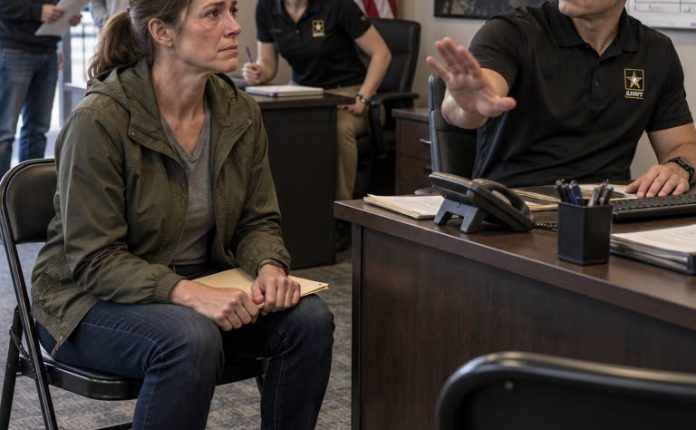
So when I sat across from Staff Sergeant Sutter and watched him look through me, I was not only the person being dismissed.
Across eighteen years, I was also the twenty-two-year-old doing the dismissing.
I understood the shape of his mistake from inside it.
That changed what I wanted to do with the next twenty minutes.
The easiest version of the story was sitting behind him on the wall.
I had every right to use it.
I chose not to.
Not yet.
The shift in the room did not begin because somebody important walked through the door.
No general appeared.
No official vehicle pulled up.
No phone call arrived to rescue me.
What changed the room had been hanging on the wall the entire time.
Staff Sergeant Sutter had walked past it every morning.
Sergeant Alvarez was the first person to actually see it.
She was probably twenty-six.
Quiet.
Junior.
The kind of person who had learned to watch a room before asking it to listen.
She had stopped chewing her pen when Sutter told me to go home and cook.
Now she looked at me.
Then the poster.
Back at me.
Back at the poster.
I counted four times.
I could have helped her.
I could have said something.
Tapped my volunteer form.
Given her the answer.
I did not.
Partly because I still had not decided what I wanted the morning to become.
Partly because some old, imperfect piece of me wanted to see whether the recognition would arrive without my assistance.
Alvarez deserved that moment.
She saw it first.
On the fourth look, she placed her pen very carefully on her desk.
Then she stood.
She crossed the carpet between the two desks.
She did not look at me.
She leaned beside Sutter and said something quietly.
I heard only part of it.
“Sergeant… look at the wall.”
Then, softer:
“Then look at her.”
Sutter responded the way people do when they are irritated and certain they are about to prove someone else wrong.
He sighed.
Turned toward the poster.
Looked at it.
Looked at me.
Looked back.
The second look lasted.
I have watched faces change in briefing rooms when information suddenly alters everything people believed five minutes earlier.
His face did that.
He stopped moving.
The woman in the photograph was thirty-seven.
Her hair was pulled into a regulation bun. Her Army green service uniform was pressed. A rack of ribbons crossed her chest.
At the top sat a small blue ribbon that most civilians would not recognize.
Most soldiers would.
The photograph had been taken three years earlier.
They had asked the woman to smile.
She had tried.
She could not.
Eventually, the photographer stopped asking.
That unsmiling image became the one distributed to recruiting stations.
It was my face.
I was the woman on Sutter’s wall.
I had been sitting beneath my own recruiting poster while he told me to go home and cook.
To Sutter’s credit, he did not perform surprise.
He did not knock anything over.
He did not start babbling.
Whatever else he was, he was not somebody who collapsed loudly.
He turned back toward his desk.
Reached for the landline.
His hand was not completely steady.
He dialed an internal extension.
“Get me the station commander.”
His voice had become careful.
Professional.
He kept his eyes on me.
For the first time since I entered the station, he was actually looking at me instead of at the category he had created.
I sat in the folding chair with the same boring folder across my knees.
And I understood that the next minute belonged entirely to me.