
My sister (30) is a single mom working 2 jobs. I babysat her 3 kids for free for 2 years to avoid daycare costs. “You’re being used,” my husband warned me. I brushed it off, saying, “You don’t set boundaries with family.”
At the time, I truly believed that. Family was supposed to be unconditional. You step up when someone is drowning, no questions asked.
My sister looked exhausted every time she dropped the kids off. Dark circles under her eyes. Coffee in hand. Apologies spilling from her mouth before she even stepped inside.
She told me daycare was too expensive. That every dollar mattered. That she was barely staying afloat after her ex “disappeared.”
So I rearranged my life around her emergencies. I shifted my work schedule. I canceled plans. I missed quiet mornings and uninterrupted deadlines.
Three kids under the age of seven is not light work. It’s snacks, spills, sibling fights, homework help, and constant supervision.
But I kept telling myself it was temporary. That this was what sisters did. That love meant sacrifice.
My husband wasn’t convinced. He watched me juggle conference calls while wiping sticky hands. He saw how drained I was.
Still, I defended her. I insisted that helping family wasn’t being used. It was being loyal.
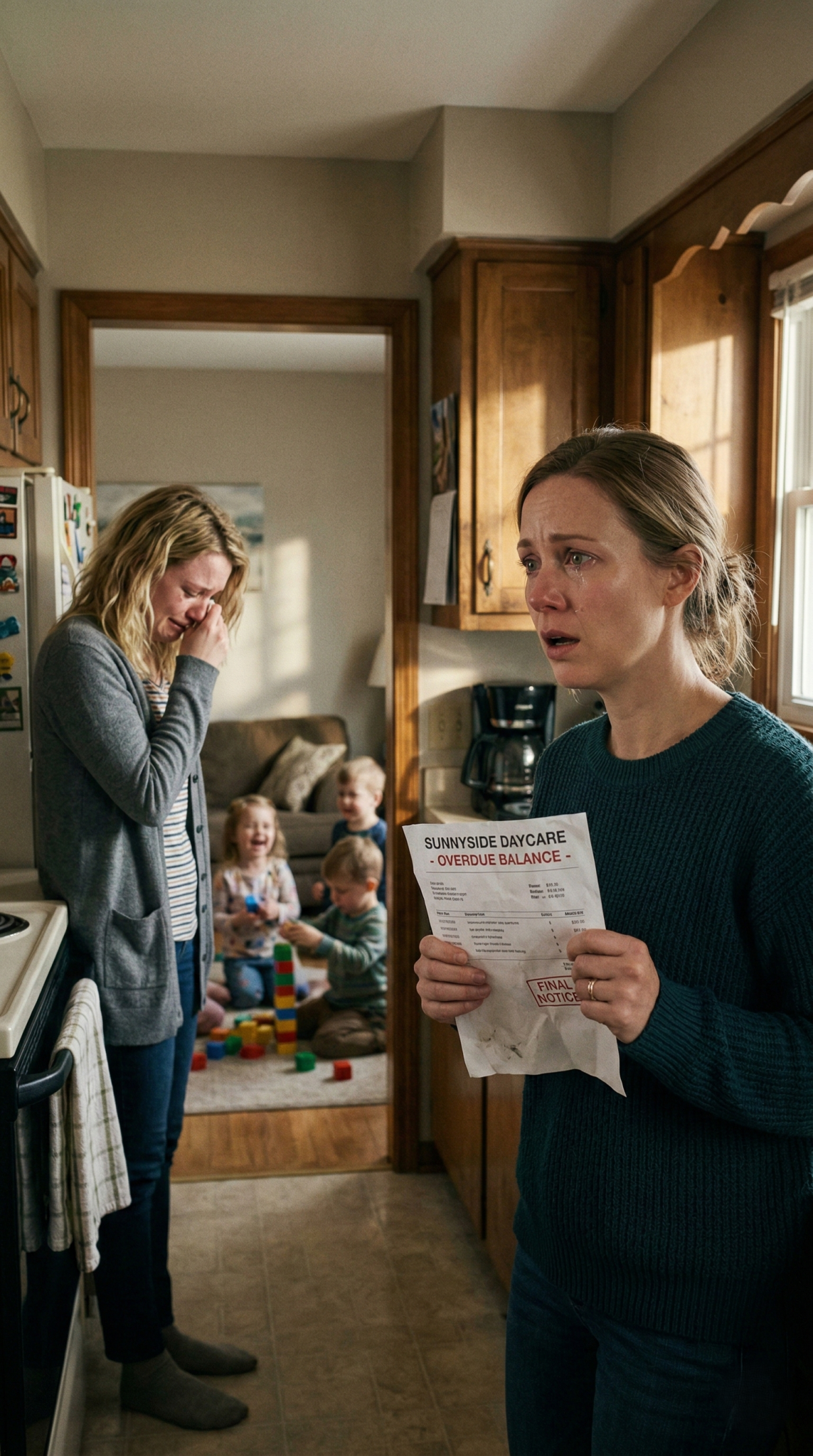
But last week, while unpacking the diaper bag, my blood ran cold. Forgotten in the side pocket was a neatly folded daycare invoice. It showed months of attendance—paid in full. Confused, I confronted her.
The paper trembled in my hands. It wasn’t a single payment. It was a pattern.
Month after month. Paid on time. No late fees. No gaps.
I stared at the dates. They overlapped perfectly with the days the kids were with me.
At first, I thought it had to be a mistake. Maybe she had tried daycare briefly. Maybe it didn’t work out.
But the invoice was current. Ongoing. Active.
When I confronted her, she didn’t deny it immediately. She just went quiet.
That silence said more than words ever could.
After a long silence, she finally admitted the truth. The bill had been paid by her ex—the same man she claimed had completely disappeared. He hadn’t. He was covering daycare so she could ease her workload.
I felt like the air had been sucked out of the room. The man she painted as unreliable and absent had been financially supporting his children all along.
She said he wasn’t emotionally present. That he didn’t visit often. But he was paying.
Instead, she dropped the kids off with me every day, let me believe I was saving her, and quietly kept the extra money for herself. That was the moment I realized my husband wasn’t being paranoid. She hadn’t just needed help. She had been using me all along.
Two years. Seven hundred thirty days.
All that time, I thought I was protecting her from financial ruin. I thought my sacrifice was shielding her from impossible choices.
Instead, I was funding her freedom. Free childcare meant extra income she never disclosed.
It wasn’t the money that hurt the most. It was the deception.
I would have helped if she had asked honestly. I would have understood if she said she needed breathing room.
But she chose to lie. She chose to manipulate my compassion.
I told her I would stop babysitting. Not out of spite, but because she had lied to me. She broke down in tears, saying she was “just trying to survive,” as if that somehow justified 2 years of deception.
Her tears were loud. Dramatic. Desperate.
She said she was overwhelmed. That she didn’t know how to ask for help without feeling ashamed.
She said if I knew daycare was covered, I might have said no. And she couldn’t risk that.
That confession stung more than anything else. She didn’t trust me to choose freely.
She preferred control over honesty.
The next day, my parents called. They said I needed to be more understanding. That she was still a single mother with no husband, that even if her ex was paying for daycare, her life wasn’t as secure as mine.
Their tone wasn’t angry. It was disappointed.
As if I had failed some invisible test of generosity.
They reminded me of everything I had that she didn’t. Stability. Marriage. A predictable income.
They framed her lie as desperation. A survival tactic.
They framed my boundary as punishment.
They reminded me that I work from home, that I have a supportive husband, and that we’re comfortable financially—implying that because I have more, I should give more. No one mentioned the lies. No one mentioned the choice she made to use me instead of being honest.
It became less about truth and more about comparison.
Because my life looked easier, my time was seen as less valuable.
Because I wasn’t visibly struggling, my exhaustion didn’t count.
It was as if comfort disqualified me from fairness.
I started to question myself. Was I being too rigid? Too proud?
But every time doubt crept in, I remembered the invoice.
The crisp fold. The clean payment history. The quiet betrayal.
Now my family treats me like the villain for refusing to keep watching the kids. As if setting a boundary is cruelty. As if my time and energy matter less because my life looks easier from the outside. I don’t know how to resolve this without betraying my own boundaries, and I need advice on what the right next step is.
The hardest part isn’t losing the babysitting routine. It’s losing the version of my sister I thought I knew.
I believed we were partners in survival. That we were navigating adulthood side by side.
Instead, I was a solution she never fully respected.
So what is the right next step?
First, I know I cannot resume babysitting under pressure. Boundaries mean nothing if they collapse at the first sign of guilt.
Second, I need clarity—not just emotion. A calm conversation, perhaps with a mediator, where the focus is the lie, not her hardships.
Because this isn’t about punishing a single mom. It’s about restoring trust.
If she wants support, it must be built on honesty moving forward.
That could mean occasional babysitting with clear expectations. Or none at all for a while.
But it cannot mean pretending two years of deception didn’t happen.
I also need to stand firm with my parents. Their empathy for her struggle should not erase accountability.
Compassion and boundaries can coexist. One does not cancel the other.
I can acknowledge her challenges without accepting manipulation.
I can love her without sacrificing my integrity.
And perhaps that is the real lesson here.
Helping someone should be a choice made freely, not a role assigned through omission and half-truths.
Family loyalty does not require self-erasure.
If anything, true loyalty demands honesty—even when it’s uncomfortable.
Right now, the silence at family gatherings feels heavy. The glances linger longer than they should.
But I would rather sit in temporary discomfort than return to quiet resentment.
Because once you ignore a boundary, it rarely comes back stronger.
It comes back weaker. Easier to cross next time.
I don’t want to become bitter. I don’t want this to fracture our family beyond repair.
But I also don’t want to teach my nieces and nephews that love means accepting lies.
Maybe the next step isn’t dramatic. Maybe it’s steady.
A clear boundary. A calm explanation. No defensiveness. No cruelty.
Just the truth.
I helped because I believed I was needed.
I stopped because I learned I was misled.
If reconciliation is possible, it will begin there.
Not with guilt. Not with comparison.
But with accountability—and a renewed respect for the fact that my time, my energy, and my trust are not unlimited resources.
And protecting them doesn’t make me selfish.
It makes me honest.