“Yes, Mom. It made me really happy.”
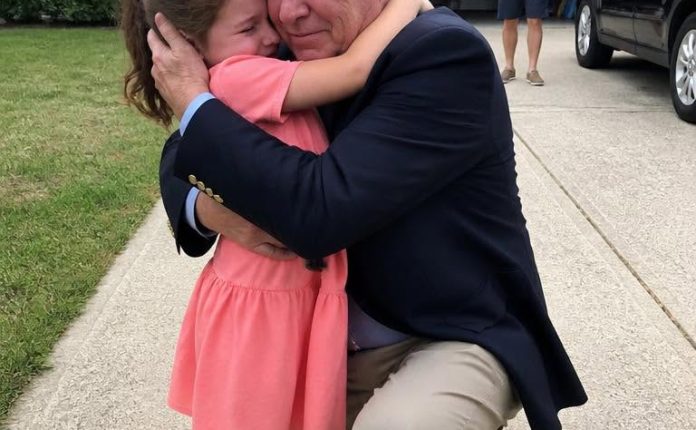
I embraced him tightly, and for once, he didn’t glance around to check whether his friends were watching. He simply hugged me back while the other children continued enjoying the fair.
Beside Morgan sat Eli, still holding his enormous cookie without opening it. His cautious expression reminded me of Morgan at the holiday party seven years earlier, when he’d been uncertain whether anyone could be trusted.
I introduced myself and reassured Eli that the cookie belonged to him. Morgan added that nobody would take it away because Mrs. Quinn wouldn’t allow anyone to mistreat him.
Eli slowly removed the red ribbon, unwrapped the plastic, and tasted a small piece. Then he broke the cookie in half and offered one portion to Morgan, explaining that Morgan hadn’t bought anything for himself.
“You didn’t get a cookie, so you should have some of mine.”
Morgan accepted the gift, and the two boys quietly ate together on the bleachers. Afterward, Eli folded the wrapper into a small square and placed it in his pocket, exactly as Morgan had done years earlier.
That evening, Morgan and I sat down for spaghetti at our kitchen table. He was exhausted after staying late to help the PTA volunteers dismantle booths and accompanying Eli to the Harbor House van.
I asked why he’d chosen not to save even one ticket for himself. Morgan admitted that he’d originally planned to buy two cookies, pepperoni pizza, and tickets for several carnival games.
He showed me a crumpled shopping list he’d written before the fair. However, his plans changed when he entered the gym and noticed children sitting on the bleachers, watching everyone else enjoy themselves.
“There were so many kids sitting there, Mom. They looked the way I felt at that holiday party when nobody noticed me.”
Morgan explained that he’d never forgotten sitting alone on the stage after another child took his tickets. What stayed with him most wasn’t the cookie itself, but the fact that I’d noticed him and chosen to sit beside him without making him feel pitied.
When he saw Eli sitting alone in an oversized jacket, he recognized the same fear and loneliness he’d once experienced. He couldn’t enjoy the games while knowing another child felt invisible.
“My highlight today was sitting with Eli. My lowlight is that he still has to go back to Harbor House.”
His words remained with me long after he went to bed. I’d been licensed as a foster parent for seven years, but after adopting Morgan, I’d allowed my license to expire because I feared disrupting our stable life.
Our apartment was small, my work schedule was demanding, and money was limited. Yet I also knew that my greatest hesitation came from the possibility of loving another child who might eventually be taken away.
That night, I kept thinking about Eli’s cautious expression, the cookie he’d shared, and the wrapper he’d carefully saved. At three in the morning, I found Theresa Kim’s number in my old contacts.
When she returned my call on Monday, I asked about Eli Parker. Theresa explained that he’d entered foster care at six and had experienced four placements in the current year alone.
His most recent foster family had returned him after two months because they believed he was too withdrawn to form attachments. He’d spent five weeks at Harbor House, and without another placement, he might soon be transferred to a residential facility in Yakima.
I asked Theresa what would be required to renew my foster license. She described background checks, additional training, a home study, and potentially finding a larger apartment.
Then she reminded me that Morgan’s feelings mattered just as much as my intentions. Bringing Eli into our household could give Morgan a brother, but another failed placement could hurt both boys.
I understood the risks, yet I couldn’t stop thinking about the child who’d carefully saved a cookie wrapper because someone had finally shown him kindness.
PART 4: THERE IS ALWAYS ROOM
That evening, I told Morgan about my conversation with Theresa and explained that Eli might eventually be transferred to a residential facility in another city. I admitted that I was considering renewing my foster-parent license, but I wanted to know how Morgan felt before making any decisions.
He immediately asked whether Eli might be allowed to live with us. I explained that the process would involve many professionals and that there was no guarantee the placement would work.
Eli had experienced repeated rejection and might struggle to trust us, while Morgan would need to share my attention and possibly his bedroom. I wanted him to understand that welcoming another child would change the life we’d carefully built together.
Morgan considered everything before asking permission to share two highlights at dinner. His first was that I’d considered helping Eli rather than simply feeling sorry for him, and his second was that he already knew what answer he’d give.