His attorney attempted to return the discussion to my conduct at the store.
“Your Honor, my client’s complaint concerns the defendant’s actions toward him in a public business.”
But the judge wanted clarification about the allegations.
Wayne claimed I’d physically grabbed him and accused him of kidnapping his daughter in front of other customers.
Neither accusation was true.
I had stood near the exit, asked the child’s name, and requested assistance from my manager. After being ordered to step aside, I’d photographed Wayne’s vehicle and called 911.
My attorney explained that I had preserved the photographs and my account of the incident.
Then he addressed the timing of the lawsuit.
Wayne had filed his complaint after being arrested for taking Quinn.
The same woman he was suing was also the person who had provided police with evidence.
I looked toward Jasmine.
She was sitting quietly with Quinn on her lap, gently smoothing the child’s curly hair.
I couldn’t imagine what she’d endured during the hour her daughter was missing, or how frightening it must have been to learn that Wayne had taken her.
When I finally spoke, my voice sounded smaller than I expected.
“I never wanted to hurt anyone. I just couldn’t ignore what that little girl was saying.”
The judge listened.
My attorney emphasized that I’d never touched Wayne and that my concern had arisen from Quinn’s repeated cries for her mother.
He also explained that Wayne’s allegations were contradicted by my account and the circumstances documented by police.
After considering the matter, the judge dismissed Wayne’s lawsuit with prejudice.
My attorney leaned toward me.
“Mavis, that means he cannot bring this same claim against you again.”
For a moment, I couldn’t speak.
The $250,000 demand that had frightened me for months was finally over.
But the judge wasn’t finished.
She referred the circumstances surrounding the lawsuit to the prosecutor for review, including whether it had been used to intimidate a potential witness in Wayne’s criminal case.
Wayne remained seated, staring at the table.
I didn’t feel victorious watching him.
I felt relieved that I could finally go home without wondering whether my savings and retirement would disappear because I’d tried to help a child.
Outside the courtroom, Jasmine approached me.
Quinn recognized me immediately.
“Sticker lady!”
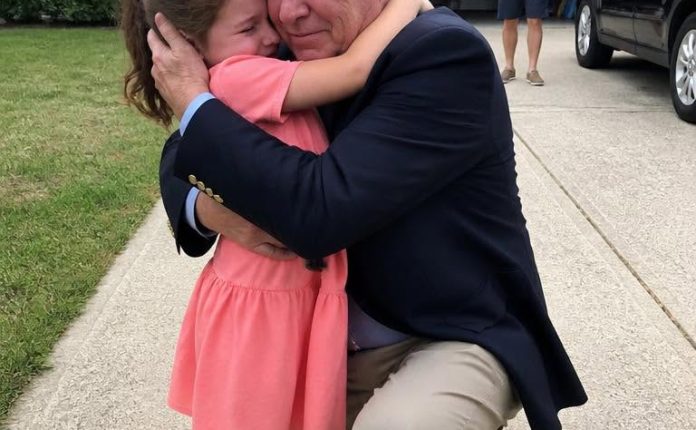
I crouched down to her height.
“Hello, sweetheart. I remember those pretty pink boots.”
She smiled and held her mother’s hand.
Jasmine’s eyes filled with tears.
“I’ve wanted to meet you since the police brought her home.”
I shook my head.
“I’m just glad she’s safe.”
“You gave the police what they needed to find her quickly,” Jasmine said. “I’ll never forget that.”
We stood together for a few minutes before saying goodbye.
That evening, I returned to my quiet house in Fort Smith.
For the first time since March, I slept without worrying about the lawsuit.
But the story wasn’t over.
Wayne still faced his criminal trial, and the store that had fired me had begun receiving questions about why its manager ignored a terrified child’s repeated warnings.
A week after the lawsuit was dismissed, my phone rang.
The caller introduced herself as a vice president from the store’s corporate office.
She said she’d reviewed what happened that afternoon in March.
Then she asked whether I would consider coming back to work.
Part 5: The Store Fired Me for Protecting a Little Girl—Then Corporate Called With an Unexpected Offer
When the vice president from corporate headquarters called, I thought she wanted to discuss the lawsuit.
Instead, she apologized.
“Mavis, we’ve reviewed the incident, your termination, and the information that came out during the court proceedings.”
I sat down at my kitchen table.
For months, I’d been treated like an irresponsible employee who had embarrassed the company. Now someone from that same company was acknowledging what had happened.
“You raised a legitimate concern about a child’s safety,” she continued. “We should have taken it seriously.”
She spent nearly twenty minutes explaining that the company had reviewed its procedures and the way my manager handled the situation.
Then she made an offer.
“We’d like you to return to your position, with a raise.”
I looked at the roll of smiley-face stickers sitting beside my telephone.
I’d kept it after Mr. Darby fired me. Some mornings, I still reached for my work vest before remembering I didn’t have a job anymore.