Part 2 — The Rescue Story My Family Never Knew
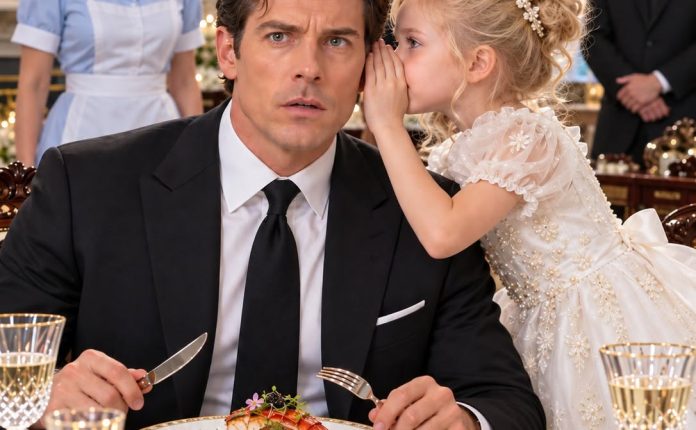
A waiter quietly swept the broken crystal away while Governor Whitaker sat beside me. Sophie climbed into my lap, completely unaware that she had returned from the children’s room holding the hand of the one man capable of turning my father’s humiliation of me into the center of the wedding.
I wanted to disappear, but leaving now would have caused an even greater spectacle, so I placed one arm around my daughter and waited.
Dad recovered first. He always did.
“Governor Whitaker,” he said, forcing a friendly laugh, “I’m Frank Carter. Natalie’s father.”
“I figured.”
Dad smiled too broadly. “Well, we’re certainly honored. Natalie never mentioned knowing you.”
Whitaker’s expression barely changed. “I imagine there are quite a few things Captain Carter never mentioned.”
The sentence landed softly, which somehow made it worse.
Mom finally looked at me. Allison stopped pretending she had somewhere else to focus. Around us, conversations were beginning again, but quieter now, people leaning subtly in our direction while trying to appear polite about eavesdropping.
Grant’s father asked the obvious question.
“How do you two know each other?”
Dad answered for him. “Probably some military event.”
“No,” Governor Whitaker said.
Dad closed his mouth.
Whitaker rested his hands on the table. “Three years ago, eastern Kentucky had catastrophic flooding after several days of record rainfall. Roads disappeared, bridges failed, and entire communities were isolated.”
I felt my stomach tighten.
I knew what was coming.
The governor continued. “My daughter Hannah was volunteering at a rural medical center that week. She had taken my grandson with her because his school was closed for weather.”
Several guests nodded as they remembered the disaster from television coverage. They remembered helicopter footage, houses split open by brown water, people standing on roofs waving towels toward rescue aircraft. What most people did not remember were the smaller places where cameras never arrived.
The hospital had been one of them.
“Water rose faster than predicted,” Whitaker said. “By late afternoon, the lower floor was unusable. Roads were cut off. Patients, medical staff, families, and several children were trapped.”
Dad looked at me.
I stared at Sophie’s tiny fingers playing with the bracelet on my wrist.
“The National Guard and regional emergency crews began evacuations,” Whitaker continued. “Captain Carter was coordinating aerial medical extraction.”
Allison frowned. “Natalie?”
The governor turned toward her. “Yes.”
My sister’s face changed.
For years, Allison had reduced my military career to absence. Natalie missed Thanksgiving. Natalie couldn’t attend the baby shower. Natalie was overseas again. Natalie was difficult after coming home. She had never once asked what I was doing while I was gone.
Whitaker continued. “Conditions deteriorated shortly before dark. The safe flight window was closing. A retaining wall failed and water surrounded the building.”
I remembered every second.
Jet fuel.
Wet nylon.
Radio static.
Rain striking my helmet so hard it sounded like gravel.
A nurse screaming that an elderly patient had disappeared from the evacuation staging area.
“The official recommendation was to suspend operations,” Whitaker said. “Captain Carter refused to leave while people remained inside.”
“That’s not exactly how it happened,” I murmured.
Whitaker glanced at me with the faintest smile. “You argued professionally.”
A few people laughed, but nobody at our table did.
Dad leaned forward. “How many people?”
I looked at him.
“What?”
“How many people were trapped?”
“Forty-seven when we arrived.”
His expression shifted.
Whitaker answered the question Dad was too stunned to ask next. “Every surviving patient and civilian was evacuated.”
Mom covered her mouth.
Allison whispered, “Oh.”
The governor’s voice softened. “My grandson had an asthma attack during the evacuation. Hannah believed he was going to die because they couldn’t get him to an aircraft quickly enough.”
I remembered the boy.
Seven years old.
Blue raincoat.
Terrified eyes.
He had clutched my sleeve while I carried him through waist-high water toward the extraction point.
“I didn’t know he was your grandson,” I said.
“I know.”
“That wouldn’t have mattered.”
“I know that too.”
Dad stared between us.
Whitaker looked around the table. “Captain Carter spent nearly nineteen hours rotating between evacuation coordination and direct extraction. The last aircraft barely cleared before visibility collapsed.”
Mom’s eyes filled.
Dad whispered, “Natalie, you never told us any of this.”
I looked at him for several seconds.
“You never asked.”
His face tightened as if I had slapped him.
Whitaker said nothing. He didn’t need to.
Dad tried again. “Of course I would’ve wanted to know.”
“No, you wanted the parts that were easy to hear.”
The words escaped before I could stop them.
Dad stared at me.
I kept my voice calm. “Whenever I mentioned the Army, you changed the subject or made a joke. When I came home, you complained that I didn’t have a real career. When I retired, you told people I couldn’t handle military life anymore.”
“You were injured.”
“Yes.”
“That’s what I meant.”
“No. It isn’t.”
Silence returned.
Allison shifted in her chair. “Natalie, this is my wedding.”
There it was.
Not concern.
Not embarrassment over what Dad had done.
Fear that attention had left her.
I turned toward her. “I didn’t invite the governor.”
Whitaker raised one eyebrow. “She definitely did not.”
Grant touched Allison’s arm under the table, but she pulled away.
Governor Whitaker reached inside his coat. “Frank, may I show you something?”
Dad nodded.
Whitaker placed a folded newspaper clipping on the table.
I recognized the photograph before Dad opened it.
It showed me standing knee-deep in floodwater near a helicopter, my uniform soaked dark, one arm around an elderly woman wrapped in a thermal blanket. I hated the photograph because it captured the moment after we had lost another patient despite trying for forty minutes to revive him.
Dad studied it.
Below the picture was a headline about the rescue.
“Where did you get this?” he asked.
“My office saved everything from that operation.”
Dad turned toward me. “Why didn’t we see this?”
“Because I didn’t send it to you.”
“Why not?”
I laughed once, quietly.
“Because by then I was tired of proving that my life counted.”
Mom began crying.
Not dramatically. She simply pressed a napkin beneath her eyes while staring at me as if she were mentally reviewing years of conversations and discovering all the questions she had failed to ask.
Whitaker watched my father carefully.
“Your daughter declined every interview offered after that flood,” he said. “Including mine.”
Dad seemed unable to understand. “Why?”
“Because the people we rescued mattered more than my name appearing on television.”
The governor nodded. “Exactly.”
Dad lowered his eyes to the photograph.
A long moment passed.
Then Whitaker said, “Frank, I’ve met plenty of people who want to look important. Your daughter spent most of her adult life doing important things when nobody she loved was watching.”
Dad’s face went pale.
Across the ballroom, the band started playing again. Servers moved between tables, glasses clinked, and conversations slowly returned, but nothing at our table felt normal anymore.
For the rest of dinner, my father barely spoke.
That alone felt historic.
Governor Whitaker stayed forty minutes. Before leaving, he crouched beside Sophie and told her, “Your mom once helped my family when we were very scared.”
Sophie looked at me.
“You did?”
I swallowed.
“Yes, baby.”
She considered this seriously, then wrapped both arms around my neck.
When Whitaker stood, he shook my hand.
“You still planning to sneak out early?”
“Yes.”
He smiled. “Good.”
Dad looked confused.
The governor turned toward him before leaving.
“One piece of advice, Frank.”
Dad straightened.
“Sometimes veterans stop talking because explaining becomes more exhausting than carrying the memories alone.”
Then he walked away.
I sat completely still.
Because the governor had exposed something my family still did not understand.
The flood was not the worst thing I had survived.
It was merely the first thing anyone had bothered to ask about.
End Part 2