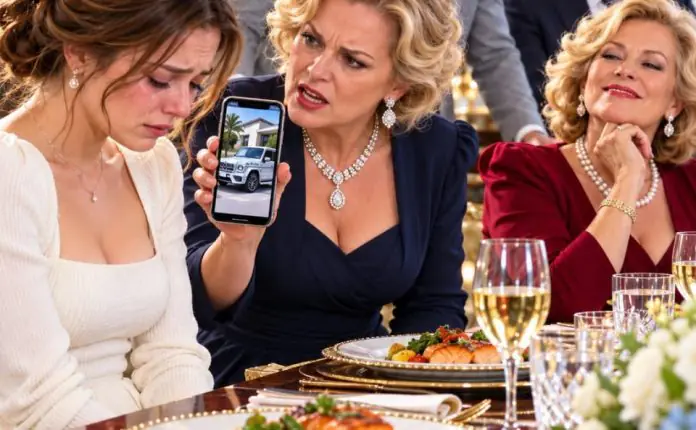
I had been taught, as so many women are taught, that endurance is a virtue — that the strong woman is the one who bears things, who holds the family together through her own quiet suffering, who does not complain, who keeps the peace at any cost to herself.
I had built my entire identity on that idea.
I was proud of how much I could endure.

And it very nearly killed me, because the terrible secret about endurance is that it changes nothing.
Enduring an abuser does not soften them; it teaches them what they can get away with.
Enduring exploitation does not earn you eventual gratitude; it establishes the baseline they will only demand you exceed.
Every year I endured the Miller family taught them, precisely, that I would endure a little more, and so they asked for a little more, and I gave it, and called the giving strength.
Endurance is not strength.
Endurance is often just fear wearing strength’s clothes — the fear of the confrontation, the fear of the upheaval, the fear of starting over, dressed up as a virtue so that we can bear it.
Real strength is the opposite of endurance.
Real strength is the thing that refuses to endure — that says no, that files the report, that packs the bag, that turns the key in a new lock.
It is action, not tolerance.
And the proof was written into the very night I was beaten: I had endured that family for ten years and it had saved me from nothing, and then a stranger who did not endure a single second of it, who heard screaming and acted, picked up a phone and got me out alive.
The endurer suffered for a decade.
The actor saved a life in ninety seconds.
I know, now, which one I intend to be for the rest of mine.
Chapter 5 — It Didn’t
When Bruno arrived at the hospital the next afternoon, a naive part of me still hoped that the sight of his wife bruised and broken in a hospital bed might awaken some last thread of humanity in him.
It didn’t.
“My parents aren’t criminals, Jade,” he said, rubbing his temples as if I were giving him a headache.
“They just lost their tempers because you’re so stubborn.
Just give them the money and we can put this behind us.”
I looked at him through my swollen eye.
“Did you know they were going to demand it from me last night?” He looked away — just slightly, just for a second — and that small shift of his gaze told me everything I needed to know.
“I only told them to talk to you,” he muttered.
“And when they called you,” I said, “to tell you they’d beaten me bloody?” He stood up and straightened his jacket.
“Stop making a scene.
Get some rest.
I have an executive meeting.”
The moment the door clicked shut behind him, I wept.
But I want to be precise about what I was weeping for, because it was not for Bruno, and it was not for my marriage, both of which I understood in that moment to be already dead.
I wept for the woman I had been for ten years — the loyal, enduring, sacrificing woman who had genuinely believed that absorbing cruelty without complaint was the same thing as love.
I wept for her because she had just died too, there in that hospital bed, and because I was the one who had to bury her.
And then, when I was finished, I dried my eyes, and I picked up the phone, because that woman was gone, and the woman who had taken her place did not weep.
She planned.
I have wondered, since, whether it was cold of me — to move so quickly from weeping to planning, to feel the marriage die and, within the same hour, begin engineering the destruction of the people who had killed it.
And I have decided that it was not cold.
It was survival, and it was, in its own way, the healthiest thing I have ever done.
Because for ten years, in the face of that family’s cruelty, I had done the opposite.
I had felt, and felt, and felt — hurt, and grief, and hope, and fear — and I had done nothing, and the feeling without the acting had kept me trapped, had made me a woman who suffered eloquently and changed nothing.
Grief that does not move you to act is just a way of marinating in your own pain.
And lying in that hospital bed, I made a decision that I believe saved my life a second time: that I would allow myself as much grief as I needed, and not one ounce more than I could convert into action.
I would weep, fully and honestly, for the woman I had been and the decade she had lost — and then I would stand up, and I would use everything I was feeling as fuel rather than as a place to live.
That is the difference, I think, between grief that heals and grief that traps.
Healing grief has a destination; it moves through you toward something, toward action, toward change, toward a locked door and a new life.
Trapping grief has nowhere to go; it circles, and deepens, and becomes an identity, until you are not a woman who was hurt but a woman who is hurt, permanently, as a way of being.
I refused to become the second kind.
I wept for one hour in a hospital bed.
And then I picked up the phone, not because I had stopped hurting, but because I had decided that my hurt was going to build something instead of drowning me.
The planning was not the absence of grief.
It was grief, finally, with somewhere to go.
Chapter 6 — Two in the Morning
At two in the morning, when the hospital had gone quiet, I called a college friend who had become a senior litigation attorney, and I told him, in a whisper, exactly what I needed.
“I need to get out of here without them knowing where I go,” I said.
“And I want to press full criminal charges.
All of them.”
And then I told him something that Bruno and his parents, in their arrogance, had completely forgotten.
Five years earlier, when Indigo’s business had failed and he had come within weeks of losing that gated-suburb house to a defaulted commercial loan, it had been me who stepped in and covered nearly all of the mortgage payments to save it.
And I, being an accountant, being careful, being exactly the sort of woman my grandmother had raised, had kept everything.
Every wire-transfer receipt.
Every bank confirmation email.
And, most importantly, a signed and notarized contract in which Indigo explicitly acknowledged my financial contribution to the property.
The house they bragged about as their family legacy, the house they had beaten me in for refusing to fund their next scheme, was a house I had a documented, notarized, legally enforceable claim against.
They had spent ten years certain that I was the powerless one, the dependent one, the daughter-in-law who could be cornered and dictated to.
They had never once imagined that the quiet accountant they underestimated had been keeping the receipts the entire time.
My grandmother gave me a door.
My own carefulness, it turned out, had given me a battering ram.
I have thought about how strange it is that the very qualities my in-laws most dismissed in me were the ones that destroyed them, and I do not think it is a coincidence, because I have come to believe that abusers systematically undervalue exactly the traits most dangerous to them.
For ten years, the Millers had treated my carefulness as a joke — the fussy accountant who kept her receipts, who noted things down, who could not simply relax and trust the family the way a good daughter-in-law should.
My insistence on documentation was, to them, evidence of my coldness, my lack of familial warmth, my failure to embrace the loose, generous, no-tabs-kept ethos that Indigo preached and that conveniently allowed him to take whatever he wanted without a record.
They wanted me careless, and pressured me, constantly, toward carelessness, framing every act of financial prudence on my part as a small betrayal of the family’s trust.
And this is the thing I understand now: they were not pushing me toward carelessness because they valued trust.
They were pushing me toward carelessness because a careful person is a documented person, and a documented person cannot be robbed in the dark.
My habit of keeping receipts was not coldness.
It was, though I did not know it at the time, self-defense — the accumulated evidence that would one day let me prove, in a court, everything they had done.
They spent ten years trying to train the carefulness out of me precisely because the carefulness was the one thing that could defeat them, and they had reason to fear it, and wrong to believe they had succeeded.
I kept the receipts.
I kept them all.
And when the day came, I did not have to convince anyone of anything with my word against theirs, because I had the paper, and paper does not flinch under cross-examination the way a frightened woman does.
To every woman who has ever been made to feel that her carefulness with money, her documentation, her refusal to simply trust and let go, is somehow unloving or cold: keep the receipts.
Your carefulness is not a character flaw.
It may, one day, be the only thing that saves you.
Chapter 7 — The Protective Order
My attorney arrived before sunrise.
Within hours, we had secured an immediate protective order, sealed my medical files where the family could not reach them, and formally lodged criminal complaints for aggravated assault, domestic battery, and attempted financial extortion.
And then, before he left my room, he opened his laptop, and his face turned grave.
“Jade,” he said.
“I have to tell you something.
The assault is only half the story.”
He had done what good attorneys do before dawn while their clients sleep: he had started pulling threads.
And one of the threads, tied to Indigo’s old defaulted commercial loan, had led somewhere strange.
There was a wire transfer — money moving in a direction and a pattern that did not fit a simple failed business.
The recipient account belonged to a company that was a frequent vendor for the logistics firm where Bruno worked as a commercial director.