“It wasn’t like tonight. His mouth felt strange and he got itchy. I told him to see a doctor.”
“And?”
“He wouldn’t.”
“Why?”
Paige gave me a miserable look.
“You know why.”
I did.
Because Trevor had spent his entire life making fun of me.
Because admitting he might have developed the same allergy would destroy the story he had built about me being weak.
Because the golden child in my family would rather gamble with reality than admit his sister had been telling the truth.
“He had another reaction two months ago,” Paige said. “Milder. He still wouldn’t get tested.”
“And you watched him eat crab soup tonight?”
“I tried to stop him.”
“You whispered one word.”
“I didn’t know he’d actually swallow it!”
Before I could answer, a voice came from the doorway.
“You need to put that phone down.”
My father was standing there.
I hadn’t heard him come back.
His coat was open, his face pale from the cold.
“Trevor’s on the way to the hospital,” he said. “Your mother went with him. I came back for some things.”
I held up the phone.
“Dad, they were trying to expose me to shellfish.”
His eyes closed.
Only for a second.
But I saw it.
And suddenly the betrayal became larger.
“You knew something.”
“No.”
“You knew.”
“I knew Trevor wanted to prove a point.”
My chest tightened.
“What point?”
Dad looked exhausted.
“He thought you were exaggerating.”
“And what did you think?”
He said nothing.
That silence hurt more than Trevor’s laughter.
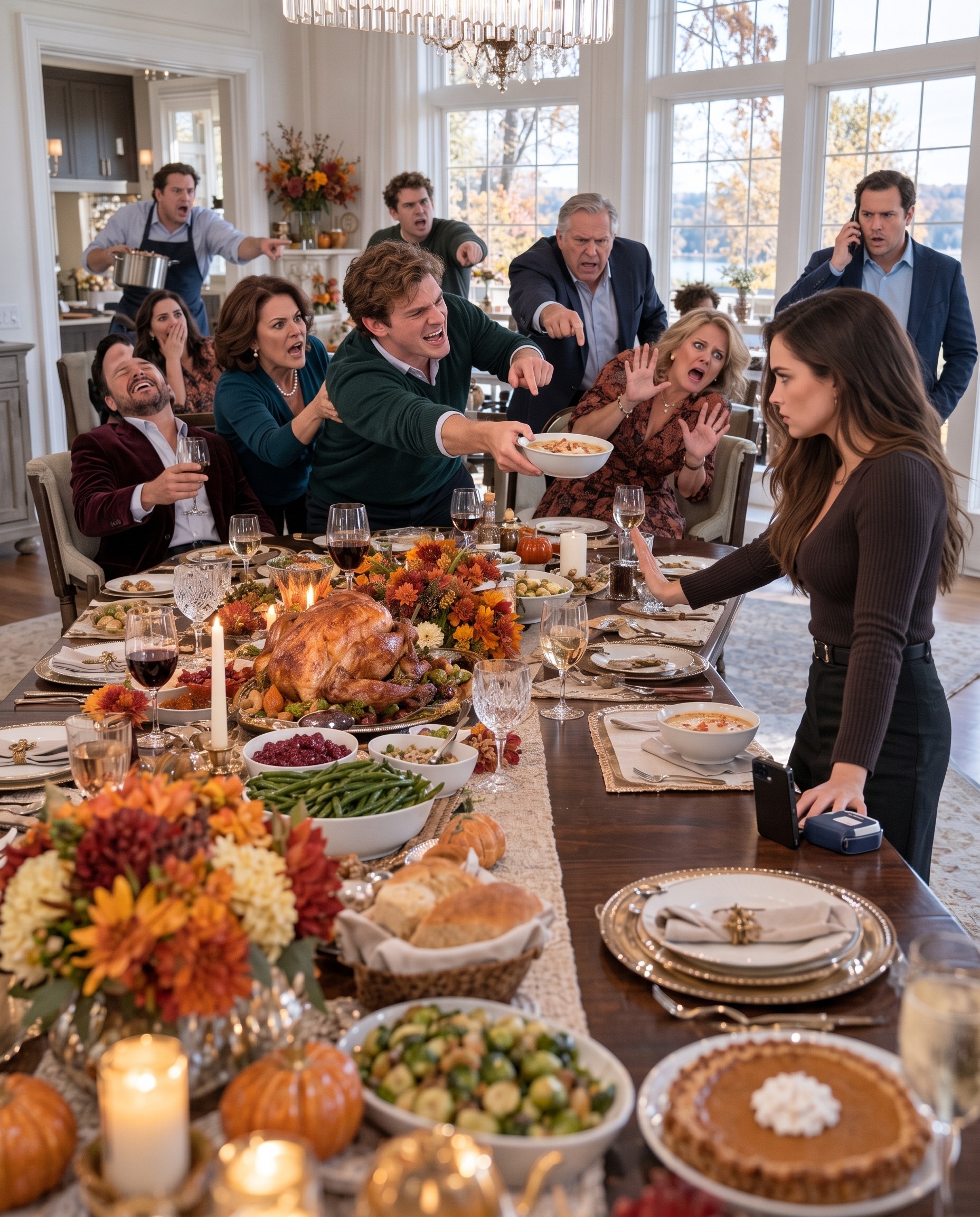
I looked at the Thanksgiving table, at the food I had cooked for people who apparently discussed whether my medical condition was economically inconvenient.
Then my father’s voice dropped.
“Maya, whatever you’re thinking about doing, remember that your brother nearly died tonight.”
I stared at him.
I couldn’t believe he had said it.
Not, “Are you okay?”
Not, “They could have killed you.”
Not even, “I’m sorry.”
His first instinct was already to protect Trevor from consequences.
Again.
“What are you asking me?”
“I’m asking you not to make tonight worse.”
Behind him, blue and red lights flashed across the front windows.
A police officer had just stepped out of a car in our driveway.
I looked down at Trevor’s phone.
Then back at my father.
And for the first time in my life, I realized I didn’t need my family to believe me.
I had evidence.
### Part 3
My father saw the police cruiser and immediately changed his tone.
“Maya.”
It was the voice parents use with children standing too close to traffic.
“Don’t.”
I almost laughed.
“Don’t what?”
“Do something emotional.”
That sentence should have angered me.
Instead, it made everything incredibly clear.
I had spent years being trained to doubt my reactions whenever another member of my family hurt me. If Trevor humiliated me, I was emotional. If Denise mocked me, I was sensitive. If Mom ignored something cruel, I was holding a grudge.
Apparently even discovering a plan to deliberately expose me to a life-threatening allergen could be reduced to me “doing something emotional.”
The officer knocked.
I opened the door.
My father whispered, “Maya, please.”
I didn’t look at him.
The officer introduced himself and explained that emergency responders had reported an unusual situation because there had been uncertainty about what caused Trevor’s reaction and multiple people had mentioned intentional food contamination during the commotion.
That surprised me.
Then I remembered Paige.
While I had been helping Trevor, Paige had been screaming, “I told you not to do this.”
Someone had heard.
The officer asked whether I could explain what happened.
My father answered first.
“It was a family misunderstanding.”
I turned around.
“No. It wasn’t.”
His jaw tightened.
“Maya.”
I held out Trevor’s phone.
“You should probably see this.”
The officer didn’t simply take the phone and start scrolling through it. Instead, he asked whose device it was, what I had seen, and whether anyone had intentionally altered or contaminated food. I explained the notifications, the open conversation, and the messages I had read.
Paige sat down at the table and started crying again.
The officer looked at her.
“Ma’am, were you part of that conversation?”
She nodded.
My father whispered something under his breath.
The officer separated us and began asking questions.
Within twenty minutes, another officer had arrived.
My mother called three times.
Dad ignored the first two.
On the third call, he walked into the hallway.
I could hear only his side of the conversation.
“He’s stable?”
A pause.
“Thank God.”
Another pause.
“No, there’s an officer here.”
His voice lowered.
“Maya showed him the phone.”
Silence.
Then my father glanced toward me.
I had never seen disappointment on his face quite like that.
Not disappointment in Trevor.
In me.
That was the moment the final piece of my childhood fell apart.
I suddenly remembered being twelve years old and crying in our garage after Trevor locked me outside during a thunderstorm. Dad had found me and said, “You know how he is.”
I remembered being sixteen when Trevor took my emergency kit from my backpack and hid it because he thought my panic would be funny. Mom made him return it, then asked me not to tell the school because it could “follow him forever.”
I remembered college, when Denise complained that my restaurant restrictions were ruining her birthday dinner and my mother suggested I stay home.
Every memory contained the same lesson.
Trevor could do something wrong.
I could respond wrong.
Those were considered equal offenses.
The officer eventually asked me whether I wanted to make a formal statement.
“Yes.”
My father came back into the room.
“What did you say?”
“I said yes.”
“Maya.”
“Stop saying my name like I’m five.”
“Your brother is in a hospital.”
“Because he ate something he knew he might react to while trying to expose me to something that could kill me.”
“He made a terrible mistake.”
“A mistake is using salt instead of sugar.”
“He wasn’t thinking.”
“He planned it for days.”
Dad lowered his voice.
“Do you understand what a criminal investigation could do to his life?”
I stared at him.
“Do you understand what dying could have done to mine?”
That stopped him.
Not because he suddenly understood.
Because the officer was standing close enough to hear.
Dad looked away.
The officer asked whether there might still be contaminated items in the kitchen. I showed him which dishes and utensils I had prepared, which containers Trevor brought, and which areas had been unattended.
I did not know exactly what Trevor had done.
That uncertainty was terrifying enough.
The officers told us not to throw anything away.
By then, Mom had returned from the hospital.
She walked into the dining room with mascara streaks beneath her eyes and immediately hugged my father.
Then she saw me talking to the officer.
Her expression hardened.
“Is this necessary?”
I couldn’t believe it.
“Mom.”
“Trevor almost died.”
“So could I.”
“But you didn’t.”
Three words.
That was all it took.
Something inside me went silent.
Not broken.
Finished.
Paige looked up from the table.
“Mrs. Bennett, they put something in Maya’s food.”
Mom stared at her.
“You don’t know that.”
“I do.”
Aunt Denise arrived fifteen minutes later from the hospital parking lot. When she saw the officers, she stopped just inside the front door.
Nobody needed to explain why they were there.
Her face gave her away.
“I didn’t touch anything,” she said immediately.
One officer looked at her.
“I didn’t ask whether you did.”
Denise closed her mouth.
That would have been almost funny under different circumstances.
The questioning continued.
By midnight, Thanksgiving felt as if it had happened weeks ago.
Trevor remained under observation at the hospital. Doctors believed he had experienced a severe allergic reaction, and later testing would confirm that he had, in fact, developed a shellfish allergy. Apparently his earlier symptoms had been warnings he chose to ignore.
The irony wasn’t satisfying.
I didn’t feel victorious.
I had watched my brother struggle to breathe.
I had used the medication that might have saved his life.
And I would do it again.
Saving someone from dying does not require forgiving what they were trying to do to you.
That distinction became important during the following week.
My parents called constantly.
At first, my mother’s messages sounded grateful.
“Trevor keeps asking about you.”
“You saved your brother.”
“We’ll never forget what you did.”
Then the investigation became more serious.
The tone changed.
“Maybe you don’t need to pursue this.”
“Your brother has learned his lesson.”
“Think about his future.”
Aunt Denise called once.
I blocked her without answering.
Paige asked to meet me.
Against my better judgment, I agreed.
We met at a small coffee shop three towns away, where nobody knew us. Rain streaked the windows, and the smell of espresso and wet coats filled the room.
Paige looked like she hadn’t slept.
“I left Trevor,” she said.
I wasn’t expecting that.
“When?”
“The morning after he came home.”
“Why?”
“Because I finally understood that if he’s willing to do something like that to his sister, someday he’ll justify doing something terrible to me.”
I didn’t respond.
She wrapped both hands around her coffee cup.
“I should have told you.”
“Yes.”
“I was scared he’d hate me.”
“He probably would have.”
“I thought it was just a prank.”
“You knew what my allergy could do.”
She nodded, crying quietly.
“I’m sorry.”
I believed she was sorry.
That did not erase what she had done.
“I’m cooperating with the investigation,” she said.
“Good.”
“Trevor thinks I betrayed him.”
I looked at her.
“You did.”
She flinched.
Then I finished.
“You just betrayed him after helping him betray me.”
She nodded.
“That’s fair.”
Before leaving, Paige told me something else.
The Thanksgiving stunt wasn’t Trevor’s entire plan.
For almost a year, he had been quietly building a case inside my parents’ company to remove me.
Complaints.
Misrepresented expenses.
Claims that clients found my medical needs disruptive.
Emails implying my remote-work arrangement was favoritism.
He wasn’t merely trying to humiliate me at Thanksgiving.
He was preparing to take my job.
And according to Paige, my father had already agreed to discuss my termination after the holidays.
### Part 4
The Monday after Thanksgiving, I walked into Bennett Property Group at eight-thirty carrying a cardboard box.
The office occupied the second floor of a renovated brick warehouse overlooking a narrow river. I had designed the company logo, every brochure template, the website, the conference-room graphics, the recruiting materials, and most of the campaigns that had doubled our online leads over the previous three years.
My father used to introduce me to clients by saying, “Maya makes us look better than we are.”
Apparently that didn’t make me indispensable.
The receptionist looked startled when she saw the box.
“Maya?”
“I’m cleaning out my desk.”
“Did your dad fire you?”
“No.”
I smiled.
“I’m quitting before he gets the chance.”
My office was small but bright, with two windows facing the river. I packed my sketchbooks, two framed photographs, a ceramic mug, three design awards, and the ridiculous miniature cactus Trevor had given me for Christmas five years earlier.
I threw the cactus into the trash.
Halfway through packing, Dad appeared.
He closed the door behind him.
“What are you doing?”
“Leaving.”
“You don’t need to do this.”
“I know.”
“Then stop.”
I continued packing.
Dad stood there for several seconds.
“Trevor had concerns about payroll.”
“Trevor had concerns about losing money.”
“It’s a business.”
“Then you should understand why I’m making a business decision.”
“Maya, you’re angry.”
“There it is again.”
“What?”