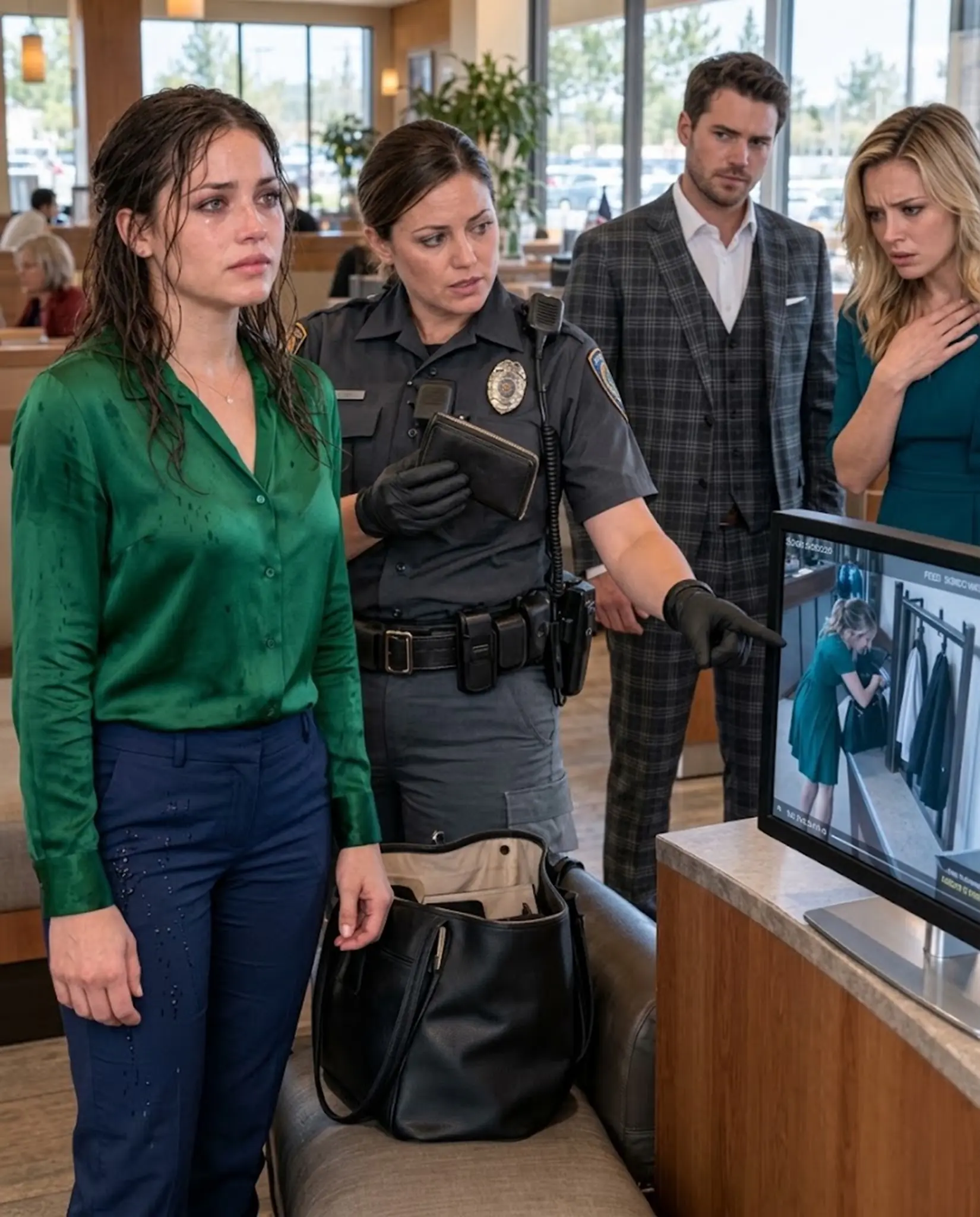
The officer photographed the wallet and sealed it in an evidence bag. Her partner exported the restaurant footage while Elena retained the original.
No one arrested me. No one arrested Sloan that night, either. Officer Shaw said the conflicting theft claim required investigation, but the video had removed any reason to treat me as the person who had planted the evidence.
Mom approached me after the officers finished.
“Naomi, honey, we didn’t know.”
I stepped away from the arms she opened. Water still darkened my blouse, and melted ice had left the fabric clinging to my skin.
“You didn’t ask.”
“Everything happened so fast.”
“You made me leave just as fast.”
Dad stood behind her with his birthday ribbon still pinned to his jacket.
“Let’s all go home,” he said. “We can talk tomorrow when everyone is calmer.”
Caleb remained beside Sloan, although he no longer touched her. He looked from the evidence bag to me as though he wanted the video to contain instructions for what a brother should do next.
I went home alone.
In my bathroom, I peeled the blouse away from my skin and left it in the sink. The water had not seriously hurt me. That almost made it easier for everyone to treat the incident as a dramatic gesture instead of an act of physical intimidation.
What stayed with me was the second after the glass hit, when every person at the table looked at Sloan and then waited for me to solve the problem she had created.
I changed clothes and wrote down the evening in chronological order while the times were still fresh: when I arrived, where Sloan put my tote, when she announced that the wallet was missing, who told me to leave, and when I asked Elena to preserve the recording.
I saved screenshots of the messages already arriving on my phone.
I was not preparing revenge. I was protecting the truth from being edited overnight.
At midnight, our family message thread filled with explanations. Mom said Sloan had frightened everyone. An aunt wrote that finding the wallet made the accusation look convincing. Dad asked us not to discuss the incident with his former coworkers.
Caleb said he needed time to understand what he had seen.
Not one of them began with the fact that they had known me my entire life.
Mom called three times before dawn. On the fourth call, I answered.
“Can you at least tell me you’re safe?” she asked.
“I was safe until you handed me my bag and put me outside.”
I had always been the person my family described as strong. When Caleb needed help, Mom said I was independent. When a holiday argument became uncomfortable, Dad asked me to be mature. When Sloan arrived late, changed plans, or needed money for another boutique event, everyone said I could handle the inconvenience.
Caleb had once been the person who protected me. As children, he waited outside my classroom when I was bullied and walked me home. At Northline Grill, he had stood between Sloan and me, then turned his body toward me and told me to leave.
The camera proved where the wallet came from. It could not explain why twenty-nine years of knowing me had carried less weight than five minutes of Sloan crying.
That answer had been developing for seven years.
When Caleb first brought Sloan home, I liked her. She remembered birthdays, brought flowers without being asked, and made ordinary meals feel like occasions. After Mom had medical appointments, Sloan drove her home and checked on her for days. When Dad retired, she managed the guest list, decorations, and cake.
Her kindness was not entirely false. That made what happened harder to dismiss as one cruel person deceiving a room full of innocent people. Sloan had become useful, then important, then almost impossible for the family to challenge without appearing ungrateful.
She also understood exactly what each person wanted from her. Mom wanted frequent calls and gratitude. Dad wanted celebrations to remain pleasant. Caleb wanted a marriage in which someone else managed the uncomfortable details.
Sloan gave all three of them those things. In return, they stopped asking what her emergencies cost everyone else.
The boutique reinforced the arrangement. Its social-media pages showed polished product photographs, busy pop-up tables, and grateful customer comments. Relatives treated every new collection as proof that Sloan was building something important. When she needed help packing orders or covering an event, declining did not sound like refusing unpaid work.
Inside our family, it sounded like refusing to support her dream.
I had helped with her boutique, too. I photographed products, corrected website descriptions, and spent weekends packing launch orders. When the requests stopped feeling temporary, I began saying no.
Three weeks before Dad’s dinner, Sloan came to my apartment with coffee and a folder bearing the Sloan & Sage logo.
“I’m opening a better inventory line,” she said. “I want to give family the first chance to participate.”
“How much are you trying to raise?”
“Enough to move quickly. I thought you might invest.”
I asked for a profit-and-loss statement, current inventory numbers, payment-processor reports, and a list of debts.
Her smile disappeared.
“I’m asking my sister-in-law for support, not applying for a bank loan.”
“If it’s an investment, I need to know what I’m investing in.”
She closed the folder without showing me a single page.
By that evening, Mom was calling my questions cold and unnecessary. I still did not give Sloan money.
“She came to you as family,” Mom said.
“She came to me for an investment.”
“Not everything needs paperwork.”
“Anything involving my savings does.”
Mom sighed as though responsibility were one of my more exhausting personality traits.
Sloan did not speak to me directly for several days. At Dad’s dinner, her embrace made me think she had decided to let the disagreement go. I had not understood that she had converted my refusal into a motive other people would recognize.
Two days after the dinner, Caleb called.
“Did you tell Sloan how much I have saved?” I asked.
He was silent long enough to answer me.
“I said you had an emergency fund. She was worried about the business, and I told her you’d managed to put away around twenty thousand.”
“Twenty-two.”
“I didn’t give her your account number.”
“You gave her a reason to choose a number I could pay.”
“I didn’t know she would do this.”
“No. You just gave private information to someone who was asking me for money.”
He said he had mentioned the savings while trying to reassure Sloan that one bad month did not mean everyone around her was struggling. He had not shared account numbers or documents. He had given her something more useful: confidence that $13,000 was an amount I could transfer quickly and still survive.
“Did you ever ask why she needed to know?” I said.
“She was my wife. I didn’t think I had to examine every question.”
“You examined none of hers, and believed every accusation she made about me.”
He apologized, then asked whether I thought Sloan might have acted out of panic. Even while confronting the frame-up, he was searching for a version in which her fear mattered more than my safety.
That Monday, Officer Shaw called to ask what I knew about Sloan’s claimed buyer.
I knew only that Sloan had mentioned trying to move old inventory. She had never given me a buyer’s name, an invoice, or proof that any sale had occurred.
I forwarded the messages from our investment conversation. They showed Sloan asking for money and refusing to provide records, but they did not prove that she had invented the cash. Officer Shaw was careful about that distinction. She did not tell me what she suspected. She told me what investigators could verify.
The question was no longer how Sloan’s wallet entered my tote. It was whether the $13,000 had existed at all.
The answer emerged through records, not another dramatic confession.
Sloan told investigators that a private buyer had purchased a block of boutique inventory in cash on Saturday afternoon. She could not provide a signed receipt. The boutique’s sales system showed no transaction matching the amount, and its inventory records showed no corresponding removal of merchandise.
Bank records showed no deposit from the supposed sale.
Her written complaint created additional problems. She claimed that she had placed the wallet on the dinner table shortly before noticing it was missing. Restaurant footage showed no black wallet near her plate and no moment when she retrieved one from her purse.
She claimed I had become physically aggressive. The recording instead showed her throwing the water while my hands remained visible at my sides.
The camera could not prove that cash had never been inside the wallet earlier that day. That required the financial investigation. It could prove that Sloan repeatedly described events that had not happened, even after she knew the recording existed.
Caleb was an authorized user on the business email account and one of the credit cards used for boutique expenses. Once he stopped accepting Sloan’s summaries and opened the accounts himself, he found what she had concealed.
He later told me that he began with the card Sloan called their emergency account. It was nearly at its limit. From there, he found unpaid shipping invoices, refunds funded by new sales, and personal household purchases labeled as marketing expenses.
The business had not suffered one unlucky weekend. It had been consuming future income for months.
A supplier had issued a final demand for $12,860. Payment was due Monday. Sloan’s payment processor had placed a hold on incoming funds because of chargebacks, and the business did not have enough available cash to satisfy the demand.
Caleb also found a message Sloan had sent the supplier before Dad’s dinner:
“I will have $13,000 from family by Sunday night. Please do not close the account.”
He provided the message and financial records to his attorney, who arranged for them to be delivered lawfully to investigators.
When Officer Shaw later explained that chain of evidence to me, the number finally stopped looking mysterious.
The supplier’s demand had arrived before Sloan visited me with the investment folder. She already knew the business needed a large payment. My questions had not insulted a growing company. They had threatened to expose an emergency she was hiding from her husband.
Sloan had not lost $13,000.
She owed almost that amount.
The complete plan became clear from the footage, her changing statements, the records, and what she later admitted through counsel.
She expected Mom to demand a search of my tote. The family would find her wallet without cash. Sloan would insist that I had removed the money and use everyone’s outrage to pressure me into transferring $13,000 before Monday.
If I paid, she could announce that the matter had been resolved privately. If I refused, the family would continue treating me as a thief.
She had built both outcomes around one assumption: none of us would involve the police.