He said I didn’t ask their opinion as much.
I didn’t change plans just because my mother was upset.
I didn’t automatically spend every holiday the way my parents wanted.
When my husband needed something, I made decisions with him instead of calling my mother first.
Apparently, she had been keeping score.
My father admitted she had told him before Christmas that if I showed up expecting help without arranging it properly, they were going to say no.
He had agreed because, in his words, he thought she meant they would make me stay and talk for a few minutes.
“Then the girls came to the door without you,” he said.
“And you still went along with it.”
“Yes.”
He didn’t soften it.
For once, he didn’t blame her temper, her pride, or the stress of the holiday.
He just said yes.
That mattered, but not in the way he probably hoped.
An admission isn’t the same thing as repair.
I asked him one question.
“When you saw them walking away, why didn’t you go after them?”
His voice broke.
“Because she told me if I did, you’d never learn.”
I gripped the phone harder.
“And what were my daughters supposed to learn?”
He had nothing.
Nothing.
That was the moment I stopped trying to understand my parents’ reasoning.
There wasn’t enough reason inside it to understand.
There was only pride, control, and two adults convincing themselves that children were acceptable collateral in a fight with their daughter.
My father asked if he could come to the hospital.
I said no.
He asked if he could bring something for the girls.
I said no.
He asked if he could apologize.
“Not today.”
He started crying.
I didn’t change my answer.
Later that morning, my mother called from her own phone.
I almost ignored it.
Then I answered because I wanted to hear whether she had anything left besides excuses.
She opened with one.
“Your father is making this sound much worse than it was.”
I looked at my sleeping three-year-old.
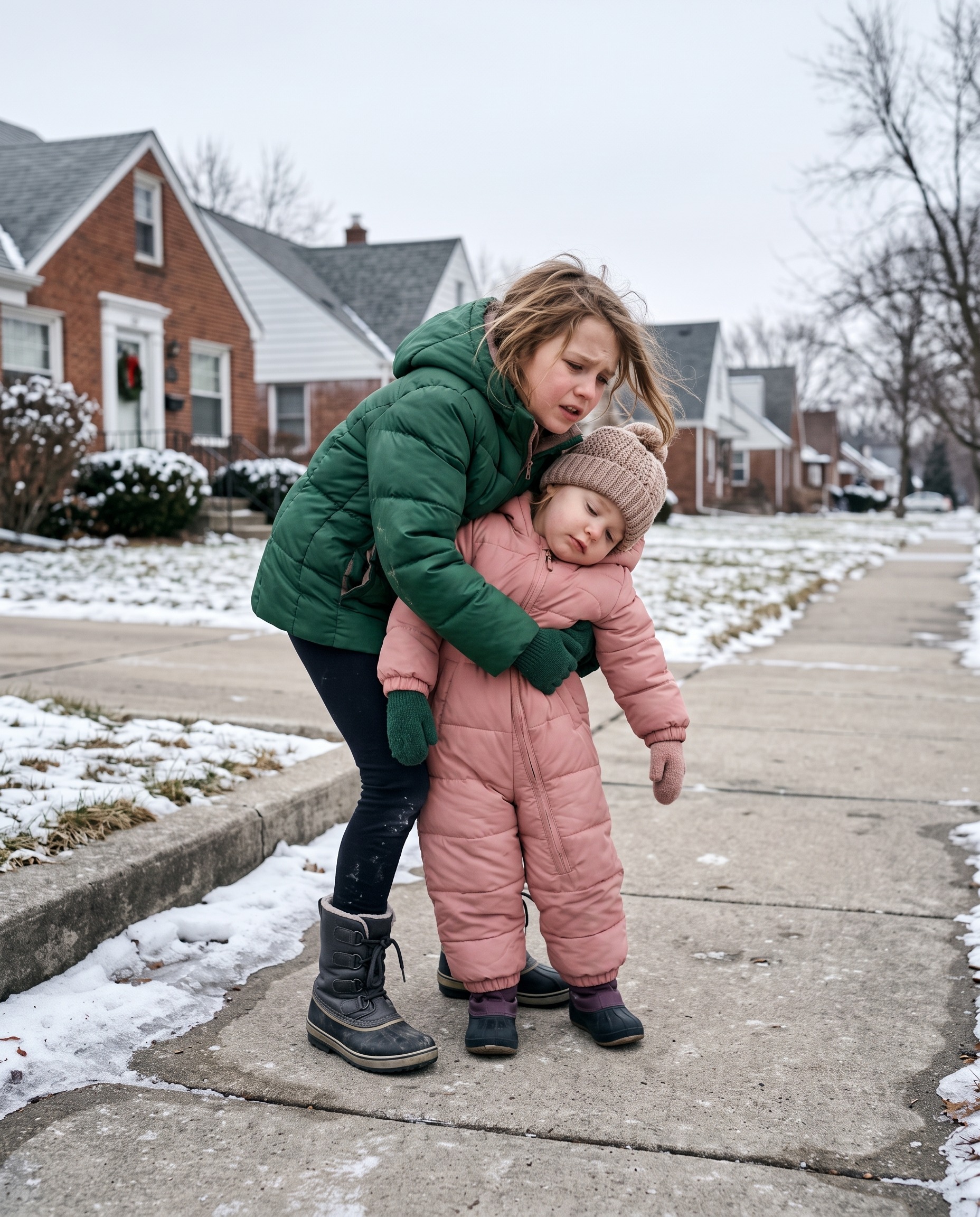
“She collapsed outside.”
My mother went quiet.
“Your granddaughter collapsed outside after you shut the door on her. What version of that sounds better?”
“I didn’t know that would happen.”
“You didn’t know what would happen after sending two little girls away in freezing weather?”
“I thought you would come back.”
There it was again.
Not concern about the girls.
Not even denial anymore.
Her defense was that her plan had failed because I hadn’t behaved the way she expected.
She had imagined me realizing they weren’t inside, turning my car around, coming back angry, and finally having the confrontation she wanted.
But I hadn’t known.
I had driven away believing the door would open for my children because it always had before.
My mother mistook trust for permission.
“Did you ever consider calling me?” I asked.
“I was angry.”
“Did you ever consider calling them back?”
“Your father could have.”
That answer ended something for me.
Not because she blamed him.
Because even then, after everything, she was still talking about who could have fixed the problem instead of the two children who had paid for it.
I said, “You are not coming to the hospital.”
Her tone changed immediately.
“You cannot keep my grandchildren from me because of one mistake.”
I looked at my eight-year-old’s empty shoe beside the bed, waiting for a dry sock.
“You didn’t forget a birthday. You didn’t say something rude. You put them outside and watched them leave.”
“Your father watched them.”
“And you told him not to stop them.”
She didn’t deny it.
I continued.
“You will not pick them up. You will not babysit them. You will not show up here. If they want contact with you someday, we will decide what that looks like based on what makes them feel safe.”
My mother said I was punishing her.
“No,” I said. “I’m changing what you have access to.”
Then I ended the call.
My hands shook afterward.
My husband noticed when I returned to his room.
“Done?”
“For now.”
He nodded.
He didn’t tell me what I should do next.
That was one of the reasons the contrast hurt so much.
For years, my mother had treated love like authority.
My husband had never needed control to prove he cared about me.
We had disagreed plenty.
We had gone to bed frustrated with each other.
We had argued over bills, work schedules, whose turn it was to handle school pickup, and whether we were spending too much money ordering food on weeks when both of us were exhausted.
But he never turned disagreement into a test of obedience.
He never made me choose between him and another person just to see whether I would choose correctly.
And lying in a hospital bed, he still hadn’t asked me to defend him to my mother.
He had asked me to sit with our daughters.
That afternoon, my eight-year-old wanted to see him.
We waited until everyone agreed she was ready to walk the short distance down the hall.
She insisted on going herself.
I stayed beside her.
When we reached her father’s room, she paused at the doorway.
My husband opened his arms.
She crossed the room fast.
He couldn’t sit up as quickly as he wanted, so she climbed carefully beside him and pressed her face against his shoulder.
“I tried to get her home,” she said.
He held the back of her head.
“I know.”
“I couldn’t.”
“That wasn’t your job.”
She cried then.
Not loudly.
Just the exhausted crying of a child who had been holding herself together for too many hours.
He kept one arm around her while I stood beside the bed.
A little later, her three-year-old sister was brought in bundled in a blanket.
The first thing she did was reach toward her dad.
He laughed once and then covered his eyes because he was crying too.
Christmas had become four people in one hospital room with bad coffee, wrinkled blankets, and no idea what time anybody had last eaten.
It was still better than the Christmas my mother had been trying to force us back into.
My father respected the boundary for three days.
Then he left a voicemail.
He said he had found something near the end of their driveway.
My daughter’s missing mitten.
He didn’t ask to come over.
He didn’t ask me to forgive him.