“He eats my sandwiches?”
Edward almost smiled.
“He calls them Rachel sandwiches.”
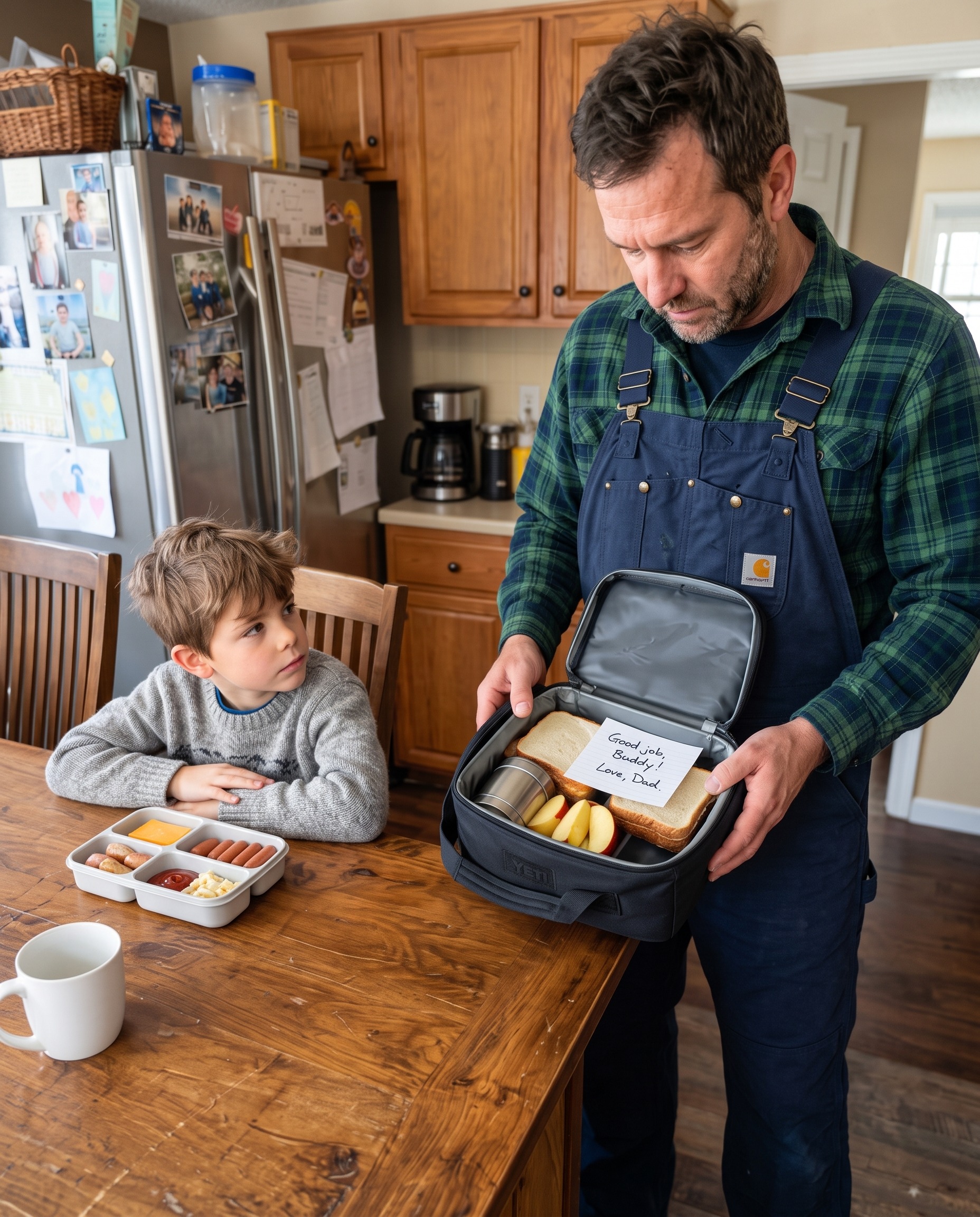
Despite everything, I nearly laughed. Then I asked the question that mattered more.
“And my notes?”
Edward reached inside his suit jacket and removed the folded card I had written that morning.
“You kept this?”
“All of them.”
I stared at him.
“All?”
“Every single one.”
There were twelve years of notes, hundreds of mornings I thought had disappeared into construction-site lunch breaks.
“Where are they?”
“My office.”
I stood immediately.
“I want to see them.”
Edward led me upstairs and into a corner office filled with architectural drawings, photographs of Jamie, our wedding picture, and a candid photograph of me laughing in our kitchen. Then he opened the bottom drawer.
Inside was an old shoebox overflowing with folded index cards. It contained twelve years of my handwriting, twelve years of Jamie’s little messages, and twelve years of mornings Edward had secretly carried into a life I never knew existed.
Part 3: Twelve Years Inside a Shoebox
I reached into the shoebox and picked up one of the folded cards at random. Jamie’s uneven childhood handwriting covered the front.
“I LOVE YOU DAD. YOU ARE THE BEST DAD.”
Underneath it was a message from me explaining that Jamie had written it himself and I had only helped him spell. I picked up another card from before Jamie was born, then another about apples, another about an argument, and another joking that Edward owed me after Jamie had asked where babies came from.
“You actually kept all of them.”
“All of them.”
“Even the ones when I was angry?”
“Especially those.”
Edward explained that the notes mattered because I never performed for him in them. Whatever I felt that morning—affection, frustration, exhaustion, or amusement—was exactly what I wrote before folding the card and placing it in his lunch.
“I’ve carried the truth of our life in my pocket for twelve years.”
I wanted to be moved by that, but the office surrounding us kept reminding me that Edward had carried my truth while hiding his own.
Margaret appeared at the door to remind him about an afternoon presentation. Edward hesitated, clearly unwilling to leave me alone after everything I had discovered, but I told him to go.
“We have a lot to discuss, but you have a presentation and Jamie gets out of school at three-thirty. I need some time.”
Before leaving, Edward told me I could stay as long as I wanted and ask his employees anything. Their curious expressions suddenly made sense because they all knew who I was from the photographs in his office and from the notes Edward occasionally shared.
Then Margaret admitted that she had recently given him an ultimatum.
“If he didn’t tell you by Friday, I was going to.”
“You seem sensible.”
Edward sighed.
“She usually is.”
After he left, Margaret sat across from me and admitted that she had known from the beginning that hiding Meridian from me was a terrible idea. However, she had convinced herself that Edward’s marriage was not her responsibility.
She also told me something I had never understood about my husband. During Meridian’s difficult first year, Edward often doubted whether he was talented enough to succeed, but one morning, after reading one of my notes at his desk, he had looked at Margaret and said:
“I remember why I’m doing this.”
That afternoon, I stayed in Edward’s office and read through pieces of our marriage. I found cards about Jamie’s birth, school mornings, vacations, arguments, family jokes, and completely ordinary Tuesdays.
I had always believed the sandwiches were feeding my husband. Instead, they had been feeding Robert, but every word I wrote had reached Edward.
He had read them, saved them, and carried them with him.
Edward returned around 4:30, and we talked for hours. He finally told me about the night classes he had taken after construction shifts, architecture school, licensing exams, and the fear that had started the entire lie.
At first, he had hidden school because he was terrified of failing.
“I would’ve loved you through failing,” I told him.
“I know that now.”
“I would have loved every version of you.”
“I believe you.”
That was the part that hurt most. Edward had built hospitals and bridges because he understood how structures carried enormous weight, yet he had never trusted our marriage to carry the truth.
Eventually, he asked what I wanted from him. I thought about the photographs downstairs, the architectural models, and one particular structure I had admired without knowing it belonged to my husband’s secret life.
“I want you to show me your bridge.”
Edward stared at me.
“The pedestrian bridge?”
“Yes.”
“Now?”
“Right now.”
For the first time since I had followed him that morning, I wasn’t interested in uncovering another secret. I wanted Edward to finally show me the man he had spent nine years hiding.
Part 4: The Life I Had Never Known
The sun was beginning to set when Edward and I reached the pedestrian bridge. I had crossed it before, admired its graceful structure, and even taken a photograph of it when it first opened, but that evening I saw it differently because I finally knew whose mind had helped create it.
Edward began explaining the design almost immediately. He told me about the unusual bend in the river, the engineering problems it created, the neighborhood objections, months of planning meetings, and the redesigns required before construction could begin.
As he spoke, something changed in him. His hands moved constantly, his attention sharpened, and the man who had spent the afternoon apologizing suddenly seemed completely at ease.
“You love this.”
“Yes.”
“This is who you are.”
Edward looked toward the bridge.
“Yes.”
I studied the structure again.
“It really is beautiful.”
A faint smile appeared on his face.
“You’ve told me that before.”
“I sent you a photograph of your own bridge.”
“Yes.”
“And you still didn’t tell me.”
“No.”
I asked what he had felt when my message arrived. Edward remained silent for several seconds before answering.
“Like I was the luckiest man alive.”
Then his expression changed.
“And the worst.”
Every evening for nine years, he had returned home wearing construction clothes and promised himself that tomorrow would be the day he finally told me. But each morning, fear won again.
“And tomorrow became nine years.”
“Then tell me now.”
“All of it?”
“Everything.”
We sat beside the river for nearly two hours while Edward unfolded the life he had hidden from me. He told me about projects that succeeded, designs that failed, buildings he loved, how he met Margaret, how Meridian survived its earliest years, and the community center they were currently designing with a roof garden, children’s play areas, and a performance room.