His expression changed immediately. The anger remained, but caution had slipped underneath it.
“Why would you need a property manager involved?” Melissa asked.
“Because you brought a trailer to my house after telling me this was a reunion.”
Mom switched tactics and softened her voice.
“You are embarrassing us.”
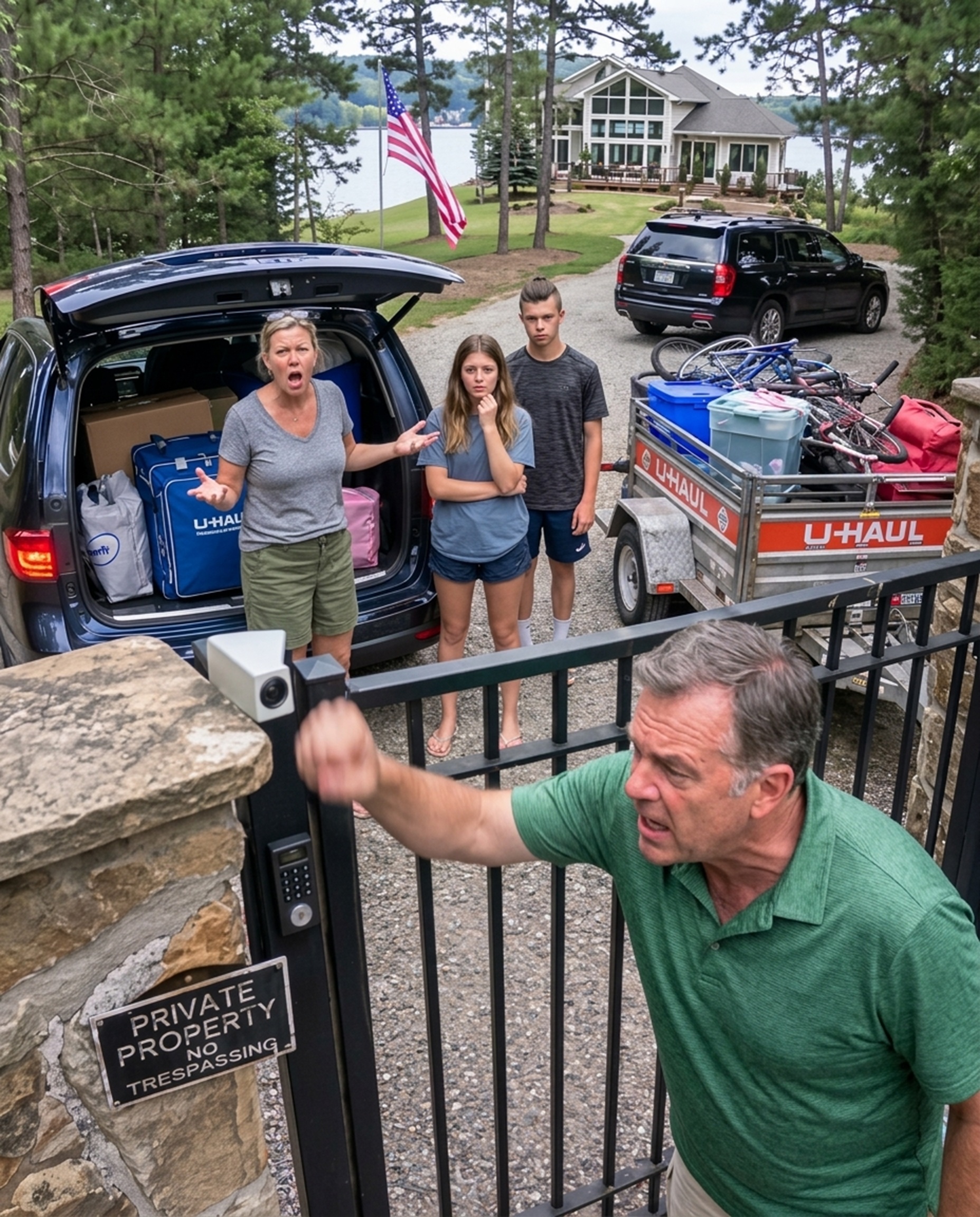
I almost laughed. They were standing outside my property with a U-Haul and a schedule assigning themselves bedrooms, yet somehow my refusal was the embarrassing part.
“I am not opening the gate.”
Dad removed his sunglasses and stared directly into the camera.
“After everything we did for you?”
There it was, the argument my family had used for years. Every sacrifice of parenthood had apparently accumulated into an invisible debt I was expected to repay with unrestricted access to my life. My throat tightened, but I kept my voice steady.
“You raised me. You did not buy lifetime access to everything I own.”
Nobody answered. One of Melissa’s boys called something from inside the minivan, and she impatiently told him to wait. Hearing him reminded me what would happen if I surrendered.
Their exhaustion would become my responsibility. Their meals, their mess, their boredom, their expectations, and eventually their anger when I wanted my own house back would all become mine to manage. So I repeated myself.
“The gate is not opening.”
Dad tried once more.
“We can talk about this inside.”
“No.”
“You’re really going to leave your own family in the driveway?”
I looked at the locked gate between us.
“You are not in my driveway. You are outside my gate.”
For once, there was a physical boundary my family could not guilt their way across. I didn’t shout, threaten anyone, or call the police. I simply remained on the intercom and repeated the same instruction until they finally understood I wasn’t changing my mind.
“You need to leave.”
It took forty-four minutes. Eventually, Melissa climbed back into her minivan, Mom finished making angry phone calls, and Dad returned to his SUV. The U-Haul moved last.
As I watched that trailer reverse away from my gate, I didn’t feel victorious. I felt exhausted because something I had suspected for years had finally become impossible to deny.
My family had never misunderstood my boundaries. They had understood them perfectly. They had simply counted on me surrendering before the gate did.
Part 3: Four Screenshots Changed the Story
That evening, my family group chat exploded. Mom announced that I had humiliated everyone, while Dad accused me of letting money change me. Melissa focused on her sons and asked how I could possibly disappoint children who had spent weeks looking forward to a summer at the lake.
Then the cousins joined in, and most of them had clearly heard only one version of what happened. According to that version, my family had innocently arrived for a reunion I had already approved, only for me to lock everyone outside and refuse to let tired children through the gate.
For years, I would have responded by defending myself. I would have written paragraphs explaining my intentions, listed every favor I had done for them, and tried desperately to prove that saying no once did not make me selfish. This time, I opened the folder on my phone instead.
I selected four screenshots. The first showed the deed with my name on it, while the second showed the security work order confirming that I had changed the access codes.
The third contained the gate log documenting Dad’s repeated attempts to enter. The fourth showed Melissa’s minivan parked outside my gate with a rented U-Haul trailer behind it, loaded for something far more ambitious than a weekend reunion.
Then I sent one message.
“No one has permission to stay at my lake house unless I invite them directly in writing. Do not give out my address, gate code, or access information. Do not arrive uninvited again.”
The group chat went silent. It wasn’t the comfortable kind of silence that follows the end of an argument; it was the silence that appears when everyone suddenly realizes the evidence doesn’t match the story they were told.
Melissa responded first.
“That was private.”
I stared at those three words for a long time. She wasn’t saying their plan had been private; she was upset because the proof of that plan was now visible to everyone.