Do not make tonight harder than it already is.
Do not start something you are too tired to finish.
I looked at the nurse.
Then at the bag she had forgotten.
Then at my husband’s hand beside his thigh.
Then at the front door.
There are moments that look small while they are happening.
A person asks a question.
Another person gives an answer.
Nothing falls over.
No music swells.
The walls do not change.
But afterward, you can divide your life around that answer.
Before I said it.
After I said it.
“He pushed my head over the trash can,” I told her.
My voice was thin.
I kept going.
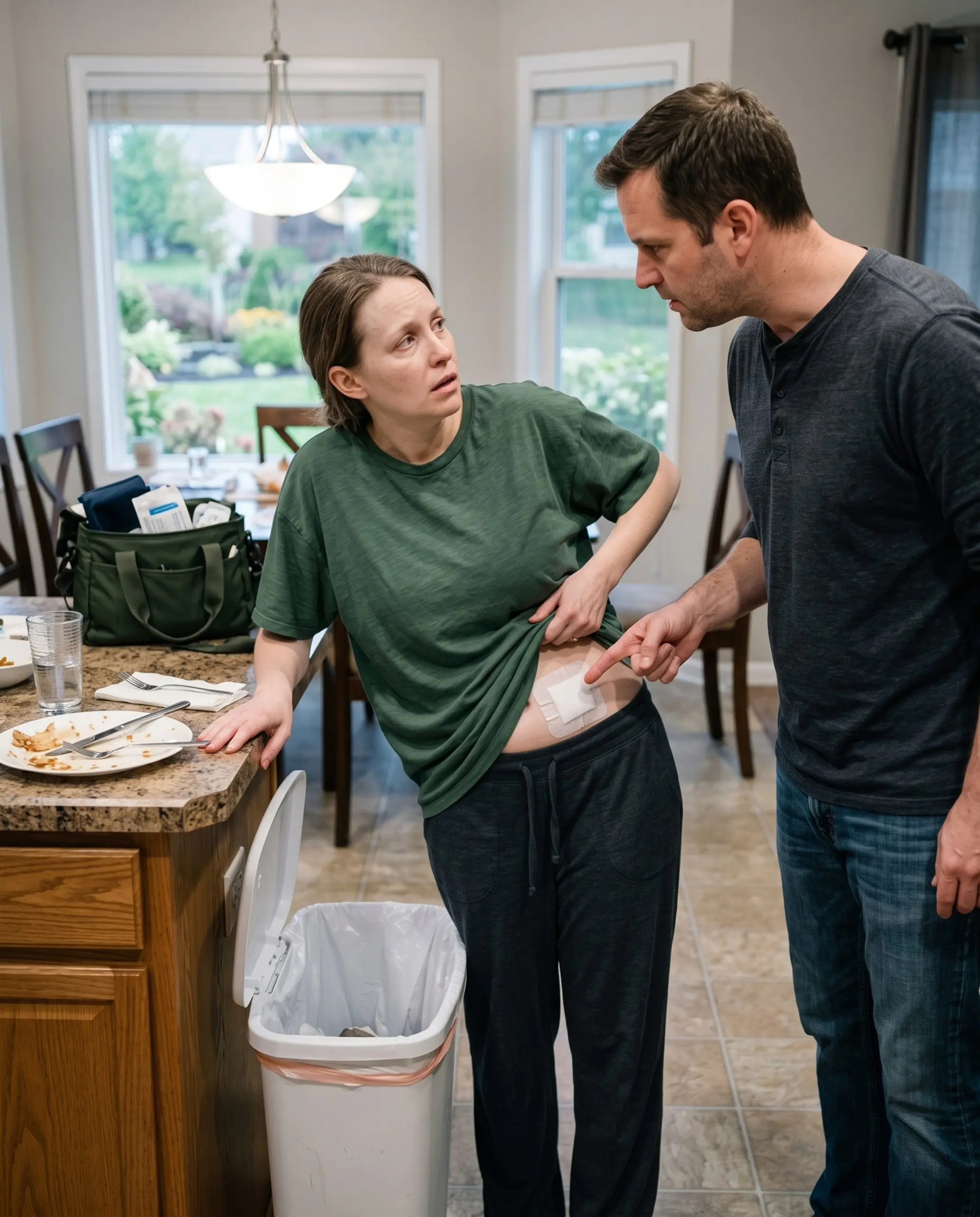
“And he pressed on the surgical area after you left.”
My husband laughed once.
Short.
Dismissive.
The kind of laugh meant to tell another person that the situation was too ridiculous to take seriously.
“She’s in pain,” he said. “She doesn’t know what she’s saying.”
I had heard versions of that argument before.
Not those exact words, maybe, but the structure was familiar.
If I was upset, I was emotional.
If I was exhausted, I was confused.
If I remembered something differently, I was stressed.
Now cancer itself could be used to make my own account of my body less believable.
The nurse did not debate him.
She did not turn the room into a courtroom.
She came closer to me instead.
She crouched enough to look carefully at the dressing without touching it.
“When I left,” she said, “this dressing was clean.”
That simple observation changed the room.
She was not guessing about our marriage.
She was not claiming to know what had happened during every minute she had been gone.
She was stating what she personally knew.
The dressing had been clean.
Now it was not.
My husband started explaining.
He talked about dinner.
He talked about the nausea.
He talked about how difficult the last few weeks had been for both of us.
He described exhaustion as if exhaustion itself had pressed his finger into the surgical area.
The nurse let him speak.
She did not interrupt him.
That seemed to make him talk more.
He kept reaching for the version of events in which he was a tired husband dealing with a sick wife and I was too overwhelmed to understand what had happened.
But he could not make the clean dressing disappear.
He could not make the timing disappear.
And he could not make the nurse stop asking me directly.
“Do you want me to stay?” she asked.
“Yes.”
One word.
My husband’s jaw tightened.
The nurse gave me another question, slower this time.
“Do you want to be alone with him right now?”
“No.”
Another word.
It felt bigger than the first.
My husband stepped closer.
“This is getting blown way out of proportion.”
The nurse straightened.
She still did not accuse him of anything beyond what she could observe.
She did something much more important for me in that moment.
She kept treating my answers as answers.
She moved her forgotten bag away from him and closer to me.
Then she asked whether I wanted to leave the room with her.
I looked at the doorway.
For weeks, pain had trained me to bargain with every movement.
Standing meant deciding whether the pain was worth standing.
Walking meant deciding whether I had enough strength to reach the next place.
Eating meant wondering whether my stomach would reject the effort.
Even sleep had become something I approached carefully.
My world had narrowed because healing demanded it.
Somewhere inside that narrow world, I had started treating every other decision the same way.
Could I survive the next argument?
Could I avoid upsetting him tonight?
Could I wait until tomorrow?
Could I say nothing now and figure it out later?
Small thinking had helped me manage pain.
But small decisions were still decisions.
“Yes,” I told her. “I want to go with you.”