I had imagined crimes worked like television: show the forged deed, show the frightened mother, point to the guilty person, and someone gets arrested before the next commercial.
Real life moved slower.
Officer Brooks explained that the deed, management authorization, bank records, and Mom’s statement all had to be properly documented. The county recording office needed to verify the filing. The notary information had to be checked. The renters also had legal rights, even if Vanessa had no right to rent them the rooms.
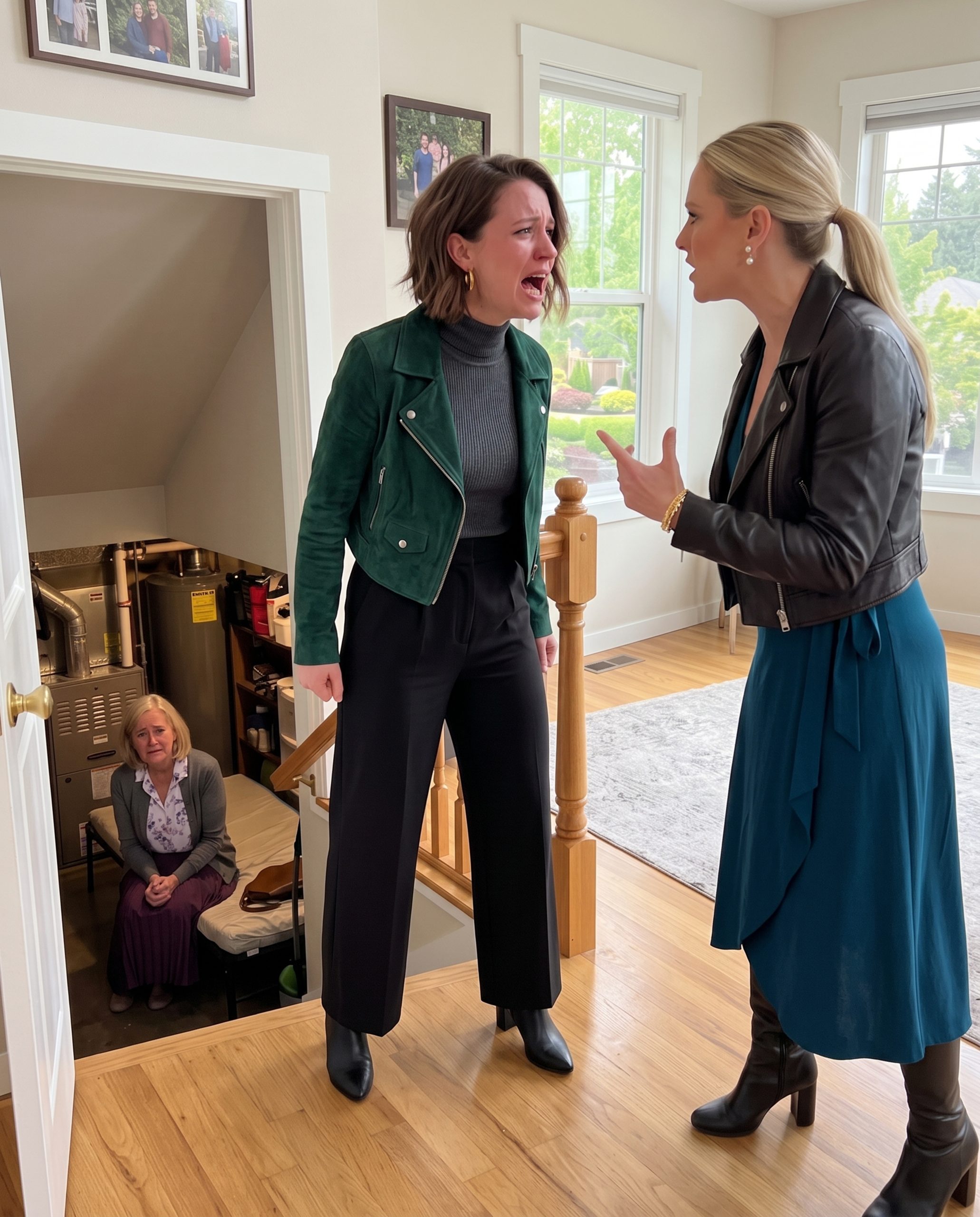
So the first victory was smaller but more important.
Mom came upstairs.
Marcus posted the basement as unsafe for sleeping. I moved Mom into the downstairs guest room Vanessa had been using as an office. Vanessa protested until Officer Brooks reminded her Mom had established residency long before she had.
I slept on the living-room sofa.
Nobody slept much.
At six the next morning, I found Mom at the kitchen table wearing one of Dad’s old cardigans. The pearls and bracelet were lying in front of her.
Vanessa had placed them there sometime overnight.
Mom touched the bracelet with one finger.
“She took more than these.”
“What else?”
Mom gave me a weary look. “Your father’s watch. My emerald ring. The silver tea service from Grandma. She said she was putting things somewhere safe.”
“Did she?”
“I stopped asking.”
That sentence hurt more than Vanessa shouting at me.
I made coffee and opened my laptop.
By eight, my attorney, Rachel Kim, joined us by video call. Rachel had handled the original purchase and still had certified copies of my deed and closing documents. She explained that recording the quitclaim deed did not automatically settle ownership. A forged instrument could be challenged, and the title company’s fraud department needed immediate notification.
“What do we do about the renters?” I asked.
“Nothing impulsive,” Rachel said. “Do not change locks. Do not shut off utilities. Do not throw out property. We handle each tenancy according to Washington law.”
That was when I understood how much damage Vanessa had created.
Three strangers had paid thousands of dollars in good faith. They were not my enemies. They had been deceived too.
At nine, I gathered them in the kitchen.
Caleb came down first. The other two were Priya Shah, a software tester, and Jordan Ellis, a restaurant manager. All three looked terrified I was about to put their belongings on the curb.
“I’m not doing that,” I told them. “You’ll receive everything in writing. Until my lawyer sorts this out, nobody is being forced onto the street today.”
Priya exhaled so sharply I heard it across the table.
Then Jordan said, “There’s something you should see.”
He opened his phone.
Vanessa had advertised the rooms through a local housing group. The listing described the property as “owner-managed.” She had also charged every tenant a security deposit.
None of those deposits had been placed where Rachel expected a landlord to account for them.
Then Caleb showed me a text Vanessa had sent two weeks earlier.
If the older woman downstairs asks you questions, don’t give her information. She gets confused.
Mom read it over my shoulder.
Her expression stayed still, but she pushed away her coffee.
That afternoon, the title company called Rachel.
The notary listed on the quitclaim deed was real.
The notarization was not.
His commission number had been copied from an unrelated public record, and he confirmed he had never met me or notarized anything bearing my name.
The signature was fake.
The acknowledgment was fake.
And Vanessa had used the fraudulent deed to open a home-equity line of credit.
One hundred and twenty thousand dollars.
I asked Rachel to repeat the amount.
Mom covered her mouth.
I stepped into the backyard because suddenly I could not breathe in that kitchen.
Six years of work flashed through my mind: overnight flights, missed holidays, conference rooms, lonely hotel breakfasts, every month I moved money into an account labeled MOM HOUSE.
Vanessa had turned it all into collateral.
When I returned inside, she stood at the bottom of the stairs with a suitcase.
“I’m leaving,” she said.
Rachel, still on speakerphone, told me not to interfere.
I didn’t.
Vanessa pulled the suitcase toward the front door, then stopped beside Mom.
“You’re really choosing Clara?”
Mom looked up.
“No,” she said. “I’m choosing myself.”
Vanessa gave a bitter laugh.
“You think she’s better than me because she paid for everything?”
“No.”
“Then what?”
Mom answered quietly.
“She never made me afraid to answer my own phone.”
Vanessa’s face hardened.
She left without saying goodbye.
For the next three weeks, the house became an office.
Detectives interviewed Mom twice. A financial-crimes investigator collected copies of transfers, rental payments, and the forged deed. Adult Protective Services interviewed Mom separately and documented the living conditions and threats she described.
Rachel filed the civil action needed to clear the fraudulent deed from the title record and notified the lender that the equity loan was disputed as fraud.
I discovered Vanessa had not spent the money on one dramatic purchase.
There was no secret mansion. No luxury car hidden somewhere.
It had vanished in pieces.
Credit-card debt.
Online shopping.
A leased SUV she could barely afford.
Two trips to Miami.
A failed boutique she had never mentioned.
Cash withdrawals.
Sports betting deposits.
And almost fourteen thousand dollars sent to a man named Eric whom none of us knew.
That somehow felt worse.
She had risked Mom’s home not for survival, but because every bad decision demanded another lie to cover the previous one.
The missing jewelry appeared at three pawn shops.
Dad’s watch was recovered.
The emerald ring was recovered.
The silver tea service had already been sold.
Mom cried over that one.
Not loudly. She just sat on her bed holding the empty velvet case.
“I was saving it for you girls,” she said.
I sat beside her.
“You don’t have to save everything for us.”
She looked at me.
“I thought that was what mothers did.”
“No. Mothers are allowed to keep things too.”
A month after I returned, Vanessa was charged with multiple offenses connected to the forged documents and financial transactions.
The case took months to resolve, and Rachel warned me from the start not to build my life around some spectacular courtroom ending.
She was right.
There was no shouting confession from the witness stand.
There was paperwork.
Interviews.
Continuances.
Bank subpoenas.
Expert signature reviews.
A negotiated plea.