I had noticed Emily’s favorite photograph missing from the refrigerator, and Vanessa claimed it probably fell behind the counter.
“What else did she ask you not to tell me?”
Emily’s eyes filled.
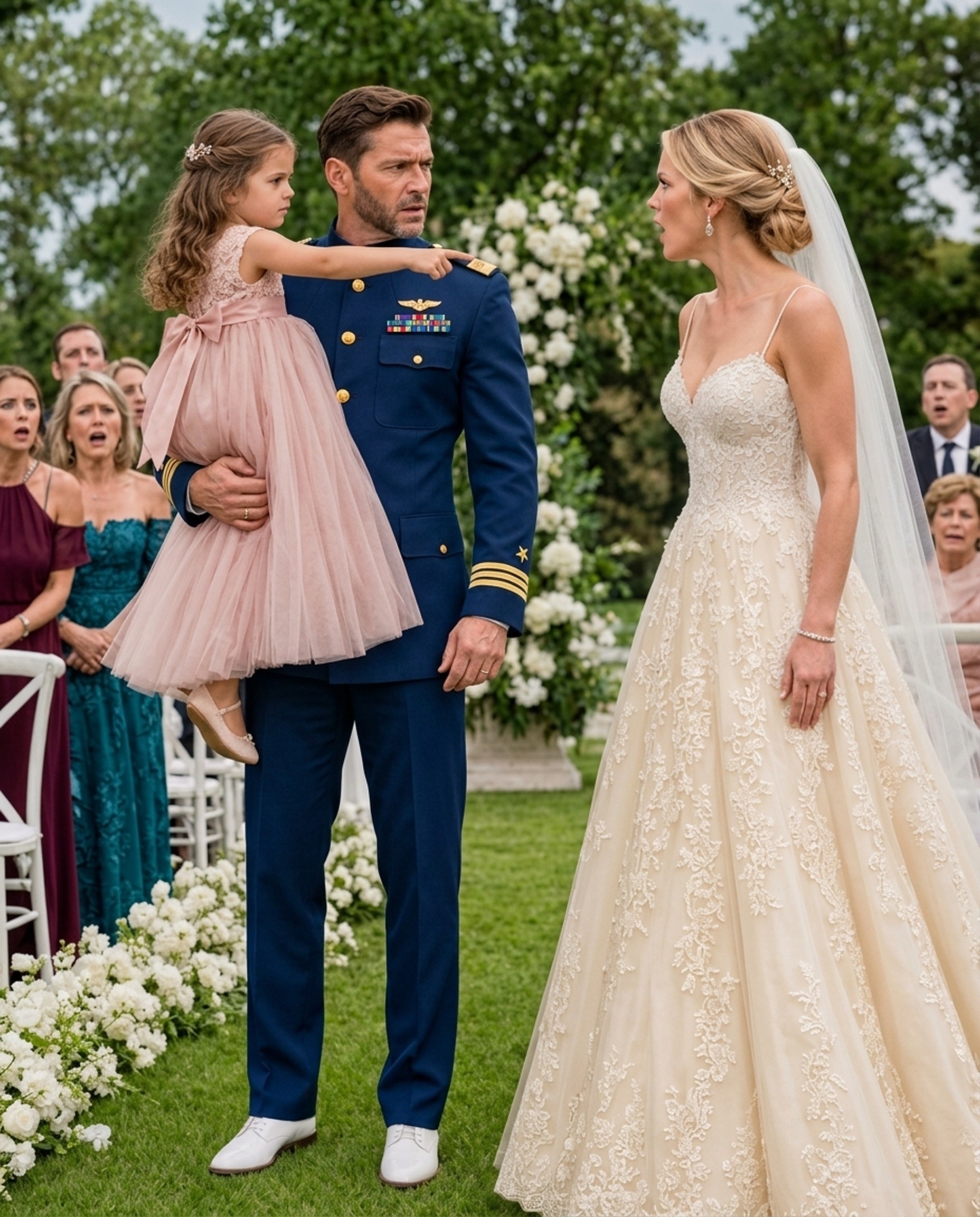
“She said my bedroom would become the nursery because it has better windows. She said I could sleep in the smaller guest room after you got married.”
Vanessa’s face reddened.
“Those were preliminary possibilities, and she misunderstood an adult conversation.”
“You discussed removing my daughter from her bedroom without speaking to me.”
“I was planning for our future, which somebody inside this family needs to do.”
I finally understood.
Vanessa’s affection had not suddenly disappeared.
It had always been conditional.
She accepted Emily only while believing marriage would eventually give her authority to make my daughter less important.
PART 3: THE CEREMONY THAT NEVER BEGAN
The wedding music started because the coordinator had not seen our confrontation.
Guests turned toward the aisle while Vanessa tried to regain control.
She reached for my hand.
“We are both emotional, so let us complete the ceremony and handle this afterward like adults.”
I stepped back.
“There will be no ceremony.”
Her face emptied.
“You cannot cancel our wedding because Emily misunderstood one conversation.”
“I am canceling because you deliberately isolated my daughter, treated her as an obstacle, and planned to restructure her home after obtaining my commitment.”
Vanessa looked toward my commanding officer, our relatives, friends, and members of her family.
“Do not humiliate me publicly over something we can repair privately.”
For a moment, the request almost sounded reasonable.
My professional life rewarded discretion, control, and solving problems without spectacle.
But protecting Vanessa from embarrassment would mean allowing Emily to believe the embarrassment belonged to her.
I walked with my daughter toward the microphone near the arbor.
The music stopped when the coordinator realized something had changed.
“Thank you for coming today, although the wedding will not take place.”
A confused murmur moved through the chairs.
Vanessa followed us.
“Andrew, please do not announce private accusations without explaining the context.”
I faced the guests.
“Several minutes ago, I found Emily sitting on the floor of a locked service room. Vanessa instructed her to remain hidden until after the ceremony because my daughter supposedly interfered with the family we were creating.”
Vanessa stepped toward the microphone.
“That is a distorted description of a complicated family matter.”
“Did you tell Emily she could not participate?”
She avoided the question.
“I told her emotions were already difficult and everybody needed space.”
“Did you tell her she would no longer remain the most important girl in my life?”
“You cannot expect your wife to accept second place forever.”
Several guests lowered their eyes.
I removed the wedding band intended for Vanessa from my jacket pocket and placed it beside the microphone.
“I will not marry anybody who views my daughter as a rival requiring removal.”
Vanessa stared at the ring.
“You are discarding our entire future because of one conversation with a child.”
Emily tightened her grip around my hand.
“I am protecting my future because that child finally told me the truth.”
Vanessa’s mother approached and urged everyone to pause before making irreversible decisions. She described Vanessa as overwhelmed by wedding stress and suggested blended families often experienced difficult transitions.
“Wedding stress does not place a child behind a locked door,” Laura replied.
Vanessa accused my sister of undermining our relationship from the beginning, but the argument no longer mattered.
The coordinator released the catering staff from ceremonial duties while guests began leaving quietly. Some approached Emily gently, though Laura prevented anyone from demanding details.
Vanessa followed me into the lodge.
“If you leave now, I will never forgive you.”
“Forgiveness is not the immediate concern.”
“I changed my entire life for you and accepted every military interruption, every photograph of Caroline, and every mood your daughter brought into our home.”
That word—accepted—clarified everything.
Emily and I had never been people she loved completely.
We were burdens she tolerated while waiting for greater authority.
“You did not accept my daughter because you merely postponed rejecting her.”
Vanessa removed her engagement ring and set it hard against the reception table.
“Someday Emily will grow up and leave, and you will realize you sacrificed everything for somebody who was never supposed to remain the center of your life.”
“A child does not need to remain forever to deserve protection today.”
I left both rings behind and walked away with Emily.
PART 4: WHAT MY DAUGHTER HAD BEEN HIDING
At home, Emily changed from her blue dress into sweatpants and one of my old Army T-shirts.
Laura stayed while I contacted the venue, coordinator, and attorney about cancellations and retrieving property.
The practical work delayed the emotional collapse until Emily fell asleep on the living-room sofa.
Laura handed me coffee and asked the question I’d avoided.
“How long was Vanessa treating Emily differently when you were absent?”
The answer emerged over several days.
Vanessa had begun removing Caroline’s photographs from shared rooms about six months earlier.
She told Emily that talking about her mother made me sad and suggested silence was a form of kindness.
She repeatedly described my deployments and training obligations as choices proving adult relationships mattered more than children.
Whenever Emily questioned wedding plans, Vanessa accused her of demanding attention.
Most painfully, Vanessa warned that telling me about these conversations could make me cancel the wedding and become lonely again.
Emily had believed protecting my happiness required tolerating mistreatment.
That realization forced me to examine my own blindness.
I had interpreted Vanessa’s willingness to help with homework and attend school functions as proof of lasting affection.
I overlooked how quiet Emily became when Vanessa entered a room.
I dismissed her resistance to household changes and assumed wedding anxiety explained her stomachaches.
During one counseling session, Emily finally described the laundry-room conversation completely.
“Vanessa said you needed a normal family, and I was making everything harder because Mom died.”
My hands tightened, but the counselor reminded me that visible anger might make Emily believe she had caused another crisis.
“Your mother’s death was never your responsibility, and you are not an obstacle preventing me from having a family.”
“What if you want to marry somebody later?”
“Then that person must understand that loving me includes respecting you, your mother, and the life we experienced before meeting her.”
Emily considered the promise.
“Would you cancel another wedding for me?”
“I hope I become observant enough that neither of us reaches another wedding before discovering the truth.”