“He is not coming back, Clara,” I said, my voice barely louder than the hum of the cicadas in the maples.
Clara did not look surprised, nor did she offer the usual empty reassurances that people use when they do not know what else to say. She simply nodded once, her gaze drifting toward the empty driveway where her husband’s old sedan used to sit.
“He left three months ago,” I added, the words spilling out before I could stop them. “He does not answer my calls anymore.”
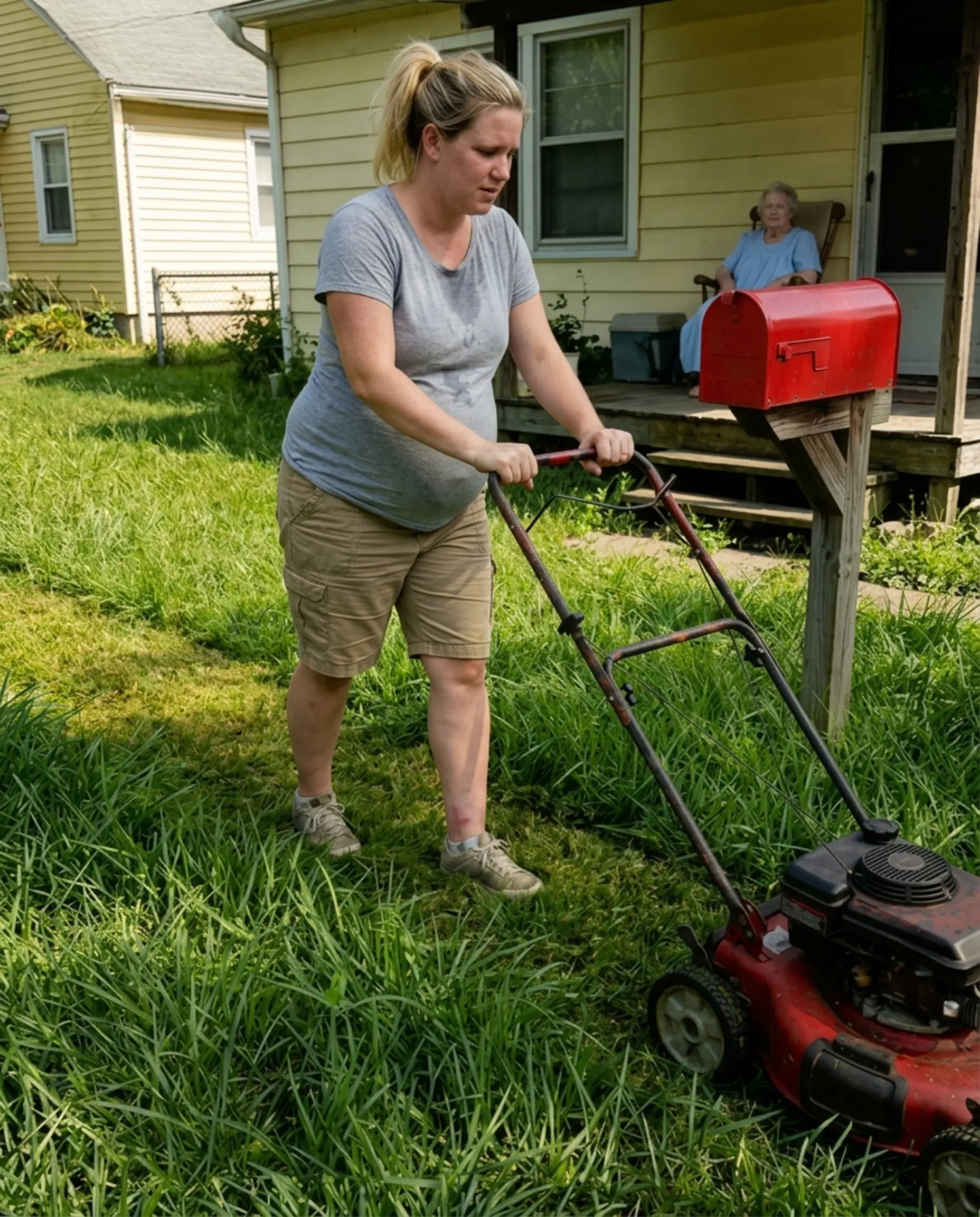
“And the bank?” she asked quietly.
My hand went instantly to my lower back, my fingers pressing into the muscle as a sharp wave of anxiety hit me. I had not told anyone about the missed payments, not even the mail carrier who had delivered the red-bordered envelope.
“I am handling it,” I said, though my voice lacked any real conviction.
Clara reached out from under her apron, her hand still trembling, and placed her fingers over mine. Despite the frailty of her wrist, her grip was surprisingly firm, her fingers locking onto my hand with a strength that startled me.
“Some burdens are too heavy for one pair of shoulders, dear heart,” she said.
I looked at her, wanting to ask what she meant, but she was already releasing my hand and pulling her yellow hat lower over her brow. She stood up slowly, her knees making a dry clicking sound, and turned toward her front door without another word.
The screen door clicked shut behind her, leaving me alone on the porch with the melting ice.
The porch door clicked shut behind me. I walked back into my own quiet house, the heat of the afternoon pressing against the windowpanes.
I sat down at the kitchen table with a yellow legal pad and a sharpened pencil. The mortgage statements were piled in three neat rows, each white envelope marked with those bright red borders that seemed to glow under the yellow ceiling bulb.
I wrote down the numbers one by one. The principal, the late fees for June, the late fees for July, and the additional penalty interest the bank had tacked on for August. My hand hovered over the paper, my pencil lead lingering on the bottom line.
The total was seven thousand four hundred twenty dollars.
My phone screen lit up on the counter, showing my bank balance of three hundred forty dollars. If I did not find a way to pay the full seven thousand four hundred twenty dollars, the house would go to the county auction on October twelve.
The kitchen wall clock read half past six when the landline finally rang. I picked up the receiver and held it close, listening to the static of the local housing assistance office.
“Nora, it is Sarah,” the voice on the other end said. “I went over the county registry files you mentioned. Oak Valley Bank is clearing their books fast this quarter.”
“Can we ask for a delay?” I asked, my fingers tracing the edge of the yellow notepad. “Just until after the baby comes.”
“They are pushing every default straight to the courthouse,” Sarah said. “Without a steady household income, a standard mortgage refinance is going to be nearly impossible to get approved.”
“There has to be another program,” I said.
“Unless you have a co-signer with significant assets, you are looking at a hard wall,” Sarah said. “They want the property, Nora, not a new payment plan.”
I set the receiver back on its cradle. The house felt too small, the silence too heavy, so I picked up Clara’s empty lemonade glass and the silver thermostatic cup from the counter.
The air outside had begun to cool, but the humidity still clung to the screen door as I pushed it open. Clara was sitting on her porch glider in the graying light, a small leather ledger open on her lap.
“I brought these back, Clara,” I said, setting the glass and the silver cup on the small wicker table beside her.
Clara looked up, her fingers resting on the open page of her ledger. “Thank you, dear heart. Sit down for a moment.”
“I should get back inside,” I said, though I did not move toward the steps.
“Nora, let me ask you something,” Clara said, her voice dropping to a quiet, steady tone. “Do you have a good local attorney, or someone you trust with your financial affairs?”
I looked at her, my hand instinctively reaching for my lower back. It was a strange question for a neighbor to ask on a Tuesday evening.
“I never really needed one,” I said. “My father handled everything before he passed.”
“A good advisor is like a strong roof,” Clara said, closing the small leather book with a soft snap. “You do not think about them until the weather turns.”
She stood up slowly, her hand resting on the porch railing for support, and gestured toward her front door. “Come inside for a minute. I want to show you something Arthur left behind.”
The parlor was cool and smelled of beeswax and old paper. Clara walked over to the mahogany desk in the corner and picked up a framed black-and-white photograph of a young man in a dark suit.
“Arthur made sure that our savings could always be used for what mattered most,” Clara said, her thumb tracing the edge of the silver frame. “He spent three months working with our attorney, George Sterling, to set up our estate plan.”
I looked at the photograph, then at the neat stacks of legal documents resting on the desk. “It sounds like he took care of everything.”
“He did,” Clara said, turning to look at me with a soft, serious expression. “George knows every loophole in the county. A good plan can solve problems even after a person is gone.”
I nodded, but my mind was still on the seven thousand four hundred twenty dollars I owed the bank. Clara turned back to her desk and opened her leather ledger again, her pen poised over a column of figures.
I stood near the door, looking at the old ledger on Clara desk, wondering why the older woman is organizing her papers so late at night.
The double glass doors of Oak Valley Bank did not keep out the heavy August humidity, but the lobby air conditioning was high enough to make my collar feel damp. I walked toward the cubicles at the back of the room, the clicking of my flat shoes against the polished tile sounding far too loud in the quiet, carpeted space.
Thomas Kelly did not look up from his computer screen when I approached his desk, though he must have heard me coming. He tapped his silver pen against his leather folder, the rhythm fast and steady, while he finished typing a long line of numbers on his keyboard.
“Sit down, Ms. Miller,” he said, his voice flat as he finally clicked his mouse and turned his attention to me.
I took the chair across from him, adjusting my position to ease the dull ache in my lower back before placing my manila folder on the desk. The yellowed mortgage notice with its bright red border was folded neatly underneath my budget page, its edges slightly frayed from how many times I had smoothed them out on my kitchen table.
“This is the hardship application we discussed on the telephone,” I said, keeping my tone as measured as I could manage. “I have included the full ledger of my seasonal bookkeeping clients and the expected payment dates.”
Thomas picked up the papers with a detached look, his eyes scanning the columns of numbers without lingering on any of them. He did not look at my face, nor did his eyes drift to the heavy, unmistakable silhouette of my thirty-four weeks of pregnancy.
“We have rigid guidelines for these accounts, Ms. Miller, and exceptions are rare,” he said, his thumb flicking the corner of my handwritten budget sheet. “The bank expects accounts to be brought current, not merely documented.”
“I have outlined every monthly expense,” I said, pointing to the line where I had noted the cost of groceries and basic utilities. “If you look at the second page, you will see my projected income for the autumn, which will allow me to make double payments.”
“A projection is not a payment,” Thomas said, setting the papers back down on the desk with a neat, dismissive slide. “Our mortgage department cannot accept a payment plan that relies on unsecured future earnings.”
“I can pay twelve hundred dollars by Friday afternoon,” I said, leaning forward slightly and resting my hands on the edge of his desk.
He tapped the silver pen against his leather folder again, the metal clicking against the dark cowhide in a sharp, impatient rhythm.
“The bank cannot accept a partial payment plan under these circumstances,” he said. “The system is automated, and it does not allow us to hold a foreclosure file once the sixty-day default window has closed.”
I looked at the neat stack of files on his desk, wondering how many other families in Oakhaven were represented by those identical blue tabs. “I just need a small window to get my footing before the baby arrives.”
Thomas did not look up from the folder he was now opening. “The bank requires seven thousand four hundred twenty dollars to clear this file and remove it from the default registry.”
“That amount is the total of three full payments plus late fees,” I said, my fingers pressing into my lap. “I told you on the phone that the seasonal bookkeeping contracts do not pay out until the first week of September.”
“The contract terms are between you and your clients, Ms. Miller,” Thomas replied, his tone as level and dry as dust. “Our concern is the security of the loan, and the terms of your deed of trust are very clear.”
“But the house has been in my family for forty years,” I said, the wood of his desk cool under my hand. “My grandfather built the back porch, and I have never missed a payment until this summer.”
Thomas clicked his pen once, the sharp sound echoing in the small cubicle. “The bank holds the deed, and our investors expect their scheduled returns regardless of the property’s history.”
“Surely there is some sort of grace period for long-term customers,” I whispered, looking around the quiet lobby to see if any of the tellers were watching us.
“Your grace period expired thirty days after the first missed payment in June,” he said, his eyes scanning a spreadsheet on his screen. “We have already delayed the initial filing by two weeks as a professional courtesy.”
“We are already in the middle of August,” I said, my hands resting on my knees to keep them from shaking. “If you can give me a thirty-day extension to consult a financial planner, I know we can find a way to restructure the remaining debt.”
Thomas stopped typing and leaned back in his mesh chair, his expression perfectly blank. “The foreclosure sale is set for October twelve, Ms. Miller, and the bank is moving forward with the auction preparations.”