He dropped it into the center of the coals. The blue glaze immediately turned grey under the soot. Inside the mug, the small, faded square of the polaroid photo of my mother on the porch at Piedmont Road caught fire, flared bright white for one second, and disappeared into grey ash.
I rubbed the small scar on my left palm, my thumb pressing hard against the rough skin. My hands were empty.
“That was hers,” I said.
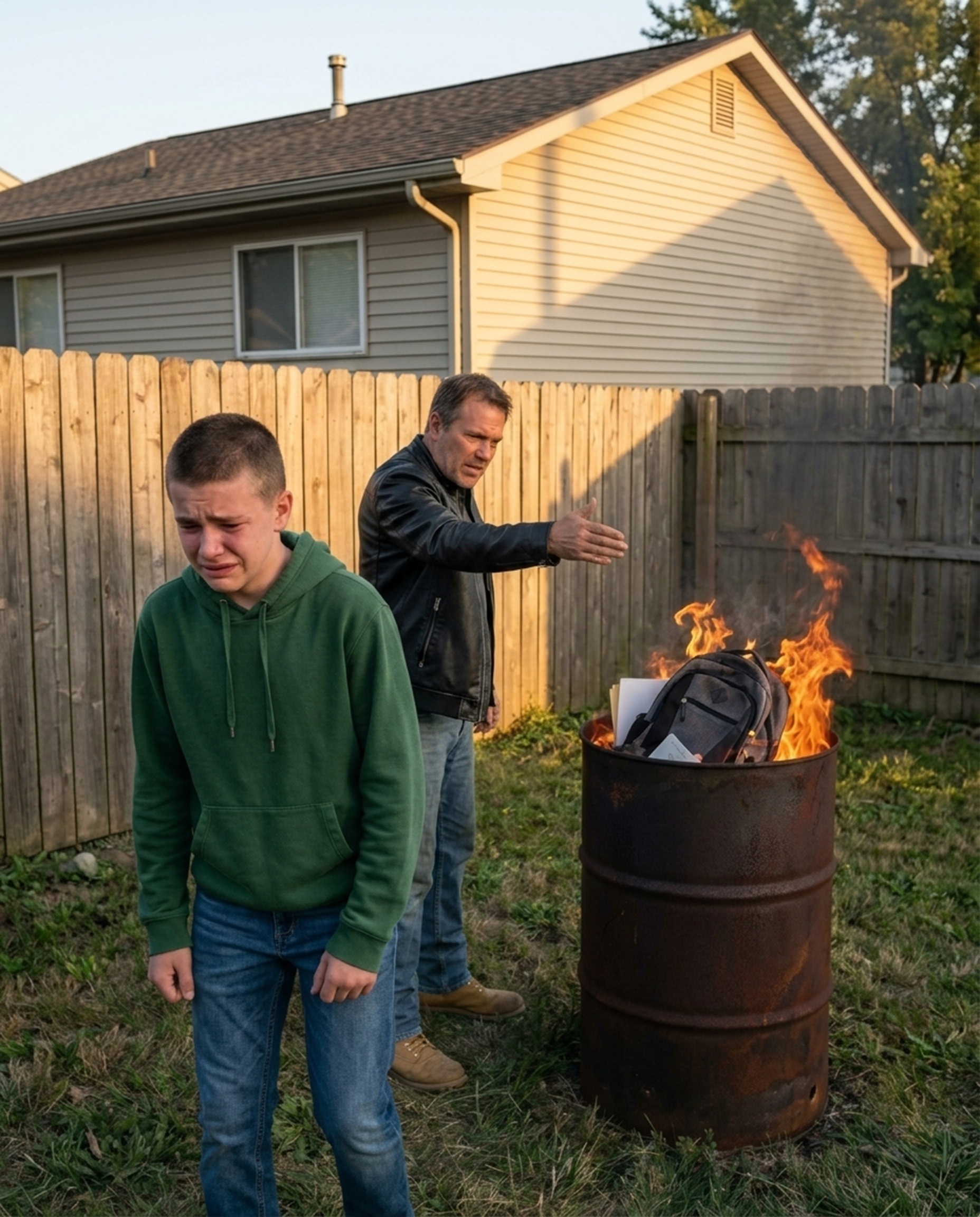
“This house is mine,” he said. “Everything in it is mine until you pay for the food you ate this winter.”
He threw the empty plastic bin onto the grass. The black smoke drifted over the garage, thick and heavy in the July air.
He walked back toward the kitchen door, his boots kicking up grey gravel. He did not look back at the fire.
I stood by the barrel until the sun began to slip behind the neighbor’s maples. The metal drum radiated a dull, dry heat that made my skin itch.
The laptop was a melted lump of silver and black plastic now. The blue mug was cracked into three pieces at the bottom of the drum, covered in grey ash.
I reached into the grass and picked up the white envelope containing my registration receipt. It had fallen near the fence when he tossed the lid. It was the only thing left besides my forty-three dollars in cash.
At six, a horn tapped twice from the street. Nate’s old blue sedan sat idling by the curb, the tailpipe coughing a pale cloud of exhaust into the evening air.
I walked down the driveway with only my hands in my pockets. My father was sitting on the front porch step, a cup of lukewarm water in his hand. He did not get up as I approached the sidewalk.
“You will be back before the first frost,” he said.
“No,” I said. “I won’t.”
“You do not know how to run a job,” he said, looking down at his boots. “You do not know how to talk to inspectors. You will fail in a month.”
I kept walking. The passenger door of the sedan was already open, and Nate was leaning across the vinyl seat.
I got into the car and pulled the door shut. The vinyl seat was hot against my back, sticky from the afternoon sun.
Nate tapped his fingers rapidly against the steering wheel, his eyes darting from me to the porch where my father sat.
“He really did it, didn’t he?” Nate asked, his voice fast and hushed. “I saw the smoke from the corner.”
“He burned it,” I said.
“The computer too?”
“Everything,” I said.
I reached into my front pocket and pulled out my cash. I had one twenty, two tens, and three ones.
“Forty-three dollars,” I said, laying the bills on the dashboard.
Nate let out a low whistle and shifted the car into drive. He looked in the rearview mirror as we pulled away from the curb.
“My cousin Otis has that place on the south side of Columbus,” Nate said, chuckling nervously. “It is just a living room floor, but he said you can stay if you do not mind the dust.”
“I do not mind,” I said.
I looked out the passenger window as we turned onto the main road. The sun was gone now, leaving a dull orange line on the horizon.
We drove south on Route 4 for twenty minutes without speaking. The headlights of oncoming trucks swept over the dashboard, lighting up the forty-three dollars.
“We need gas before the highway,” Nate said.
He pulled into a bright Sunoco station near the interstate ramp. The fluorescent lights made the gravel lot look bleached and cold.
Nate turned off the engine and looked at the dashboard. “I have twelve dollars on my card. That gets us to the city, but we need food.”
I picked up two of the single bills and went inside the station. The air conditioning was humming loud behind the counter.
I bought a cup of black coffee for ninety cents and a box of crackers. The clerk handed me ten cents back.
I sat back in the passenger seat and set the paper cup in the holder. The coffee was thin and bitter.
“We have forty-one dollars and ten cents,” I said, counting the remaining bills in my lap.
“Otis wants fifty dollars a week for the floor,” Nate said, tapping his fingers on the wheel again. “He needs it by Saturday.”
“I will find a job tomorrow,” I said.
“Doing what?”
“Labor,” I said. “Demolition. Whatever pays cash.”
I took a sip of the coffee and looked at my worn tennis shoes. They were light canvas, thin at the toes, not meant for a job site.
Nate started the engine. The car vibrated, the dashboard rattling where the plastic was loose near the glove box.
“The highway is clear,” Nate said.
He pulled out of the station lot, the tires crunching on the loose stones before catching the smooth asphalt of the ramp.
I watched the green sign for Interstate 71 South slide past in the headlights. The road ahead was dark, stretching sixty miles through the empty fields.
The car accelerated, the wind whistling through the dry rubber seal of my window. I did not look back toward Dayton.
The car pulled onto the highway toward Columbus.
The car ride ended in a gravel parking lot behind a three-story brick building on Fourth Street, where the grease from a nearby rail yard hung thick in the morning air. Nate led the way up the back metal stairs, which rattled under our boots with a thin, hollow sound that made me grip the handrail.
His cousin Otis opened the door with a grease-stained towel in his hand and did not step back to let us in. He looked at my single cardboard box of estimating books, then down at the paper envelope containing my forty-three dollars.
“Two weeks,” Otis said, keeping his hand flat against the screen door. “That is what Nate asked for, and that is what you get.”
“I will pay my way as soon as I get a check,” I said.
Otis wiped his forearm with the towel, leaving a dark smudge of oil on his skin. He pointed to a brown vinyl couch that had a three-inch tear along the piping of the center cushion.
“The couch is yours, but you stay out of the kitchen after eight,” Otis said. “I work the early shift at the bottling plant, and I do not want to hear a peep from the living room.”
“Two weeks is all I need,” I said, setting my box on the linoleum floor.
I rubbed the small, hook-shaped scar on my left palm, feeling the raised skin. My hand was already stiff from the long drive, but the room smelled like cold bacon and laundry soap, which was better than the lingering scent of my father’s metal burning barrel back in Dayton.
Nate tapped his fingers against the doorframe, his knuckles making a quick, nervous rhythm. He looked at Otis, then back at me, giving a short chuckle that did not sound very happy.
“He is good for it, Otis,” Nate said. “Leo works harder than any three guys in Dayton.”
“Dayton is forty miles back down the road,” Otis said, turning his back to us. “In Columbus, nobody knows his name.”
He walked into the back bedroom and shut the door with a click that sounded final.
I sat down on the vinyl couch, which sank almost to the floorboards. The springs groaned under my weight, but it was dry, and the ceiling did not have the water stains I had spent the last three years patching on Piedmont Road.
“I have to get to the shop,” Nate said, looking at his watch. “Are you going to be okay here?”
“I am going to find a job before the sun goes down,” I said.
I took the trade school registration receipt out of my envelope and smoothed the crease against my knee. It was the only paper I had left that proved I was trying to become something more than a hand for my father’s failing business.
“I will check in tonight,” Nate said.
The door clicked shut behind him, leaving me alone in the quiet apartment.
By two in the afternoon, the sun had baked the asphalt on Broad Street until the air smelled like hot tar. I walked three miles to a fenced lot where a crew was pulling down the brick facade of an old bakery to make room for a parking garage.
A man in a yellow hard hat stood near a flatbed truck, writing on a clipboard with a yellow pencil. He had a gray beard that looked like steel wool and a silver watch that sat loose on his thick wrist.
“You hiring clean-up?” I asked, stopping near the gate.
He did not look up from his clipboard for ten seconds. He completed a row of figures, then turned his head to look at my hands.
“You ever worked a shovel?” he asked.
“Five years,” I said. “Framing, roofing, and demolition.”
“I am Jim,” he said, tapping the clipboard against his thigh. “I pay twelve dollars an hour. No overtime, no side deals, and I do not keep guys who stand around.”
“I do not stand around,” I said.
Jim looked down at my feet. I was wearing my old canvas tennis shoes, which had gray dirt embedded in the seams and a small split near the left toe.
“We start at six sharp and you need steel toes,” Jim said.
“I can work in these for a day or two,” I said.
“Not on my site,” Jim said. “An inspector catches you without safety boots, it costs me five hundred dollars. You show up tomorrow at six with proper boots, or do not bother coming back.”
“I will have them,” I said.
“We will see,” Jim said, turning back to his truck.
He walked toward the brick pile without looking back to see if I was still standing there.
I walked out of the lot and counted the bills inside the paper envelope in my pocket. There were two twenties and three ones, the forty-three dollars I had saved from my last side job in Dayton.
The cheap boots at the hardware store back home cost twenty-nine dollars, but those were regular work boots, not steel-toed. A real pair of safety boots with a steel shank would run at least fifty-five dollars plus tax.
I had twelve dollars less than the price of the boots, and my classes at the trade school started on Monday.
The registrar’s office at the Columbus Trade Institute was located on the second floor of a converted brick schoolhouse on Town Street. The hallway smelled of floor wax and old radiator steam.
A woman named Martha sat behind a high oak counter, sorting yellow index cards into green metal boxes. She wore thick glasses that slid down her nose when she blinked.