
Grandma Ruth had been dead for three weeks. I still had not unpacked the black dress from the funeral. It hung in the garment bag on the back of my closet door, zipped shut like something I was not yet ready to examine, and some mornings I caught a faint trace of the cedar sachet Ruth always kept in her coat closet clinging to the fabric when I reached past it for a sweater.
Her voice still lived in odd corners of my day. I heard it when I reached for the tea canister, because she had been the one who taught me to steep loose leaves instead of using bags. I heard it when I passed a garden center and saw flats of chrysanthemums going bronze in the autumn air. I heard it once on a Tuesday walk home when I spotted an old retriever leaning into its owner’s legs on the sidewalk with the trusting weight of a creature that had never once been made to earn affection.
My mother skipped all of that. She did not ask how I was sleeping. She did not ask whether I missed Ruth’s Sunday phone calls. She went straight to the will.
Ruth had left me the house in Stillwater, the investment accounts, and the remainder of her estate after a twenty-thousand-dollar donation to the animal shelter where she had volunteered every Saturday for fifteen years. My parents had decided I should split everything with my older sister, Olivia. It was, my mother said, in her careful schoolteacher’s voice, only fair.
In my family, fair had never been about balance. It was a command dressed up to sound moral, a conclusion reached in advance and then handed to me wrapped in the language of obligation, the way you might wrap a brick in tissue paper and call it a gift.
I told her Ruth had been precise. If she had wanted Olivia in the will, Olivia would have been in it.
My mother’s tone changed immediately. She did not yell. She did something worse. She sounded hurt, and the hurt carried a particular texture I had known since childhood, the sound of a woman who believed that her disappointment alone should be enough to rearrange other people’s decisions.
She said Olivia had two children and real responsibilities. Mason was only four. Lily had just turned two. They were trying for another baby. I was single, childless, and doing just fine in the city. What did I even need that much money for?
There it was, the old family equation. Olivia counted extra because she had a husband and babies. I counted less because my life did not fit the script that made sense in our hometown.
When Olivia wanted cheerleading, my parents paid for summer camps, uniforms, competition travel, and salon appointments before every regional meet. When I asked for Saturday art classes in seventh grade, my father told me the library had books on drawing and that real talent did not need expensive lessons. Olivia’s college tuition was funded. Mine came with federal loans I spent more than a decade paying down.
My mother once told me I was lucky that Olivia was generous enough to pass on her old clothes. She said it while folding a stack of Olivia’s castoffs on my bed, her voice bright and genuinely pleased, as if inheriting my sister’s leftovers was a privilege I should recognize. I was fourteen.
Eventually, I learned the family role assigned to me and performed it well. I became the low-maintenance daughter. The independent one. The one who did not need much and who could be counted on to manage, to make do, to smile at Christmas and say everything was fine.
It took me years, and a therapist named Claire, to understand that people are often most generous with the child they assume will ask for nothing. The generosity is not real. It is convenience dressed in affection, and it survives only as long as the quiet child remains quiet.
After I hung up, I sat at my kitchen table staring at the skyline until the light softened from gold to the bruised violet of early evening, and my phone buzzed again. Olivia. She wrote that Mom had told her about the inheritance. We should get coffee and talk about how to handle everything. The kids needed winter coats. Preschool was expensive. Everything was expensive.
She ended with a smiling emoji and the word “love,” and I read the message three times trying to locate the grief in it and finding none. It was not sorrow. It was entitlement softened by the language of motherhood, the way Olivia had learned to make every want sound like a need.
I deleted the text and searched my inbox for Lawrence Whitfield, Ruth’s attorney. The house was appraised at roughly four hundred thousand dollars. The investment accounts held approximately six hundred thousand. Ruth had not done that by accident. She was the least accidental person I had ever known.
She was also the only person in my family who had ever looked at me without comparing me to Olivia. She remembered the names of my coworkers. She mailed me newspaper clippings about women in finance. She sent watercolor postcards of Lake Superior. She never asked when I was going to settle down. The last time I visited, she squeezed my hand across her kitchen table and told me there was more than one way to build a full life.
By the time I closed my laptop that night, I knew what I was doing. I booked a flight to Minnesota for Friday evening and emailed Whitfield to ask for the earliest meeting he had on Saturday.
The pressure campaign began before sunrise the next day. My mother texted about family obligations. Olivia called twice and left a voice message with her children laughing in the background. My father left a voicemail so angry I had to replay it once to believe he had really said those things. He called me selfish, ungrateful, and humiliating. Then my mother sent the text that turned all of it from manipulation into clarity: “Transfer it to her or don’t bother coming home.”
Something in me went cold and steady. That night, I changed every banking password I had, added two-factor authentication to all my accounts, froze my credit with all three bureaus, and emailed Whitfield to instruct him not to discuss the estate with anyone but me under any circumstances.
By midnight, I had forty-three missed calls. The line that stayed with me from my father’s voicemail was not the anger. It was the contempt. He said nobody leaves everything to the daughter who moves away unless she has been manipulated. Not loved. Not trusted. Not chosen. Manipulated.
Friday evening, I flew to Minnesota. At O’Hare, Olivia sent a photo of Mason in a puffy blue jacket, cheeks red from the cold, with the caption that he did not understand why this winter was so hard for them. I did not answer. I put my phone in my bag and watched the runway lights blur.
Whitfield’s office was in a brick building on Main Street, quiet and almost excessively tidy. He led me into his office, offered brief and genuine condolences, and outlined the estate process clearly. Then he paused and told me there was one more matter.
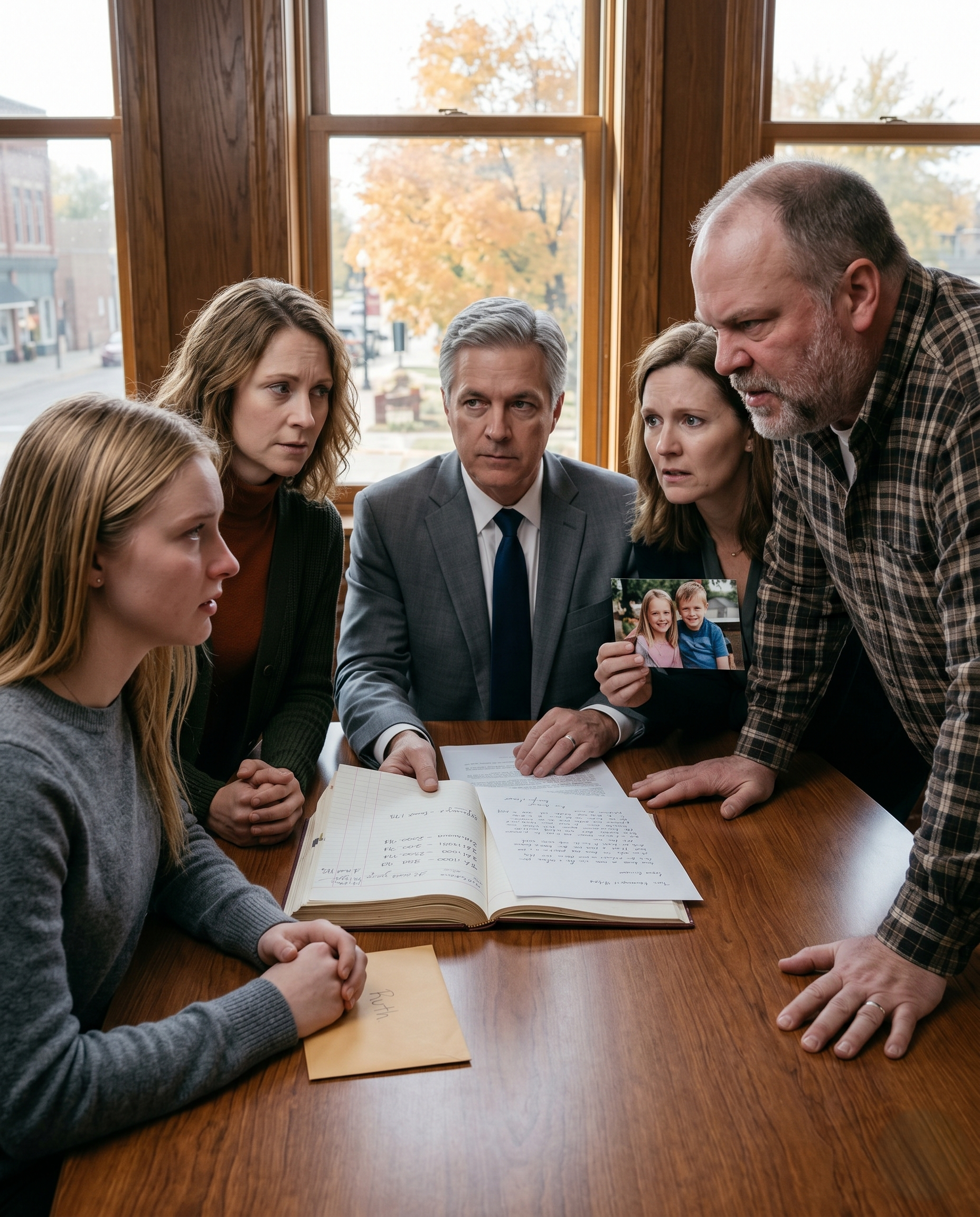
Ruth had left a sealed envelope with specific instructions that it be opened only if anyone attempted to pressure or coerce me regarding the terms of the will. Before I could ask what the envelope contained, voices rose in the hallway.
My mother’s clipped tone came first. Then Olivia’s breathless urgency. Then my father’s heavy anger. The office door opened without anyone inviting them in.
Whitfield stood up. He did not raise his voice. He told them they could either remain civil or leave.
Olivia said we could still do this the easy way. My father said family money stays in the family. Whitfield opened Ruth’s sealed envelope and placed it on the conference table. Then my father made the mistake that changed the room. He leaned forward, planted both hands on the table, and said Ruth had been confused near the end. He said older people could be influenced. He looked at me when he said it, and I understood that he was calling me a predator who had tricked an elderly woman.
Whitfield lifted one finger, waited for silence, and said Ruth had anticipated that accusation as well. He broke the seal and pulled out a letter written in Ruth’s careful slanted handwriting. Attached was a physician’s affidavit confirming that Ruth was fully competent and of sound mind when she updated her will six months before her death.
Behind the affidavit sat a ledger spanning nearly fourteen years. Whitfield read it aloud without drama.
Forty-eight thousand dollars for Olivia’s college tuition. Twenty-three thousand for her wedding. Seventeen thousand for a minivan. Seventy-five thousand toward her house down payment. Fourteen thousand in daycare assistance. Multiple credit card rescues for my parents. Roof repairs on their house, paid in full. The total came to just over three hundred thousand dollars.
Olivia stopped crying. The tears dried up so abruptly it was almost mechanical. My mother lost color. My father stared at the documents like they had betrayed him personally.
Ruth’s letter continued. She wrote that she was leaving her estate to me because she was done watching the same imbalance repeat itself. Olivia had already received a substantial portion of family resources in advance. I had received expectations, hand-me-downs, and praise for being easy. She said she would not allow her final act on this earth to become one more reward for the people who had always expected me to live on less.
Whitfield read on. Ruth had written that I had never once asked her for money. Not when I was paying student loans on a starting salary that barely covered rent. Not when my landlord raised the rent by three hundred dollars. Not when my car died and I took two buses and a train to work for three months. I had asked for recipes, advice, old family stories, and once for the name of the rose she grew by the front porch. She wrote that people always notice the child who asks loudly. They rarely notice the one who learns to need quietly.
Then came the line that cut deepest of all. Ruth wrote that if anyone claimed she had been manipulated, they should ask themselves why it felt more believable that an old woman had been tricked than that she had simply seen the family clearly and made her choice.
My father stood up so fast his chair hit the wall behind him. My mother said it was petty to keep a running tally. Olivia snapped that children changed everything, that I would not understand because I had no one depending on me.
I looked at her and, for the first time in years, felt no urge to soften myself. I told her that her children were not a receipt she could hand me for reimbursement. I told my parents that being the daughter who managed on her own had never made me less deserving. It had only made them more comfortable taking from me.
Whitfield quietly added that Ruth had instructed him to issue formal cease-and-desist notices if harassment continued. The meeting ended badly, because it was always going to. My father called me ungrateful in the hallway. Olivia said she hoped I enjoyed buying a life with blood money. My mother walked out without looking back.
But none of it landed the way it once would have. Their words hit a surface that had changed while they were not paying attention.
Whitfield gave me a smaller envelope, separate from the legal file, addressed in Ruth’s handwriting with my name on the front. I did not open it until I was sitting alone in Ruth’s kitchen.
The house smelled faintly of cedar and tea and the lemon hand cream she rubbed into her knuckles every winter. I stood with my hand on the back of her chair for a long time, because grief, real grief, the kind that matters, is often delayed until the room is quiet enough to hear it.
Her note was only two pages. She wrote that she was sorry she had not protected me more loudly when I was younger. She knew who got funded and who got lectures. She knew who got indulgence and who got told to be sensible. And then, in one line that made me sit down and cry the way I had not cried since I was a child, she wrote: “Choose yourself at least once, darling. No one ever taught you how.”
The harassment did not stop immediately. Whitfield mailed the cease-and-desist letters on Monday. The messages slowed almost overnight. The legal contest Olivia had threatened never materialized.
Silence settled where obligation used to be. No check-ins. No birthday calls. No awkward Sunday dinners. It turned out that when money was removed from the conversation, so was most of my family.
I could not keep the house permanently. My life was in Chicago. The following spring, I sold it to a young couple expecting their first child. I kept the rosebush by the porch alive through the winter, and in April, I took a cutting for the flight home. I planted it in a heavy terra-cotta pot on my condo balcony, where by June it produced three small red blooms that smelled exactly the way Ruth’s front walk had smelled in July.
I paid off the remainder of my mortgage. I padded my retirement accounts. I enrolled in weekend painting classes at an art studio near the lake. I also used a portion of the estate to establish a modest scholarship fund in Ruth’s name at a local arts program for girls whose families could not or would not pay for extra lessons. When the paperwork was finished and the first recipients had been notified, I sat in my car and cried again, but this time it was not only grief. It was the strange, clean relief of turning an old wound into something that might spare somebody else the same scar.
Almost a year passed before my mother reached out again. She mailed a Christmas card with no note inside, just a glossy family photo. I stood over my recycling bin for a long time with that card in my hand. I tucked it into a drawer with the rest of the things I was not ready to define.
On nights when doubt still creeps in, I unfold Ruth’s letter and read the line that mattered most. She was not giving me more because I needed more. She was giving it to me because I had been asked to live on less for far too long, and she refused to let that be the final word.
That was the real inheritance. Not the house. Not the accounts. But the proof that at least one person had seen the family clearly, seen me clearly, and chosen me anyway.