
“Your grandfather would have wanted me to enjoy life,” my Uncle David said.
He said it with infuriating calmness. Standing right beside my grandmother’s crackling fireplace, lazily swirling a glass of eggnog, he looked at me as if I was the one who had just ruined Christmas.
I could feel my jaw lock tight. My fingers gripped the faded blue folder with such force that the thick cardboard was permanently creased.
“He wanted us to have memories,” David added, taking a slow, deliberate sip. “That Florida house brought this family together for twenty straight years. You simply can’t put a price tag on that, Ellen.”
“I can,” I said, my voice shaking with a mix of rage and adrenaline. “The bank put a price tag on it. It’s exactly four hundred and twelve thousand dollars.”
The crowded living room went completely, suffocatingly silent. My grandmother’s house in South Bend was always a bit too cramped for our annual Christmas gatherings, but with thirty-five people packed shoulder-to-shoulder, the sudden quiet felt incredibly heavy.
Nobody dared to move. My cousin Sarah froze mid-bite, a piece of pecan pie hovering near her mouth. My aunt Linda slowly, silently set her coffee mug down on the wooden side table, her eyes wide.
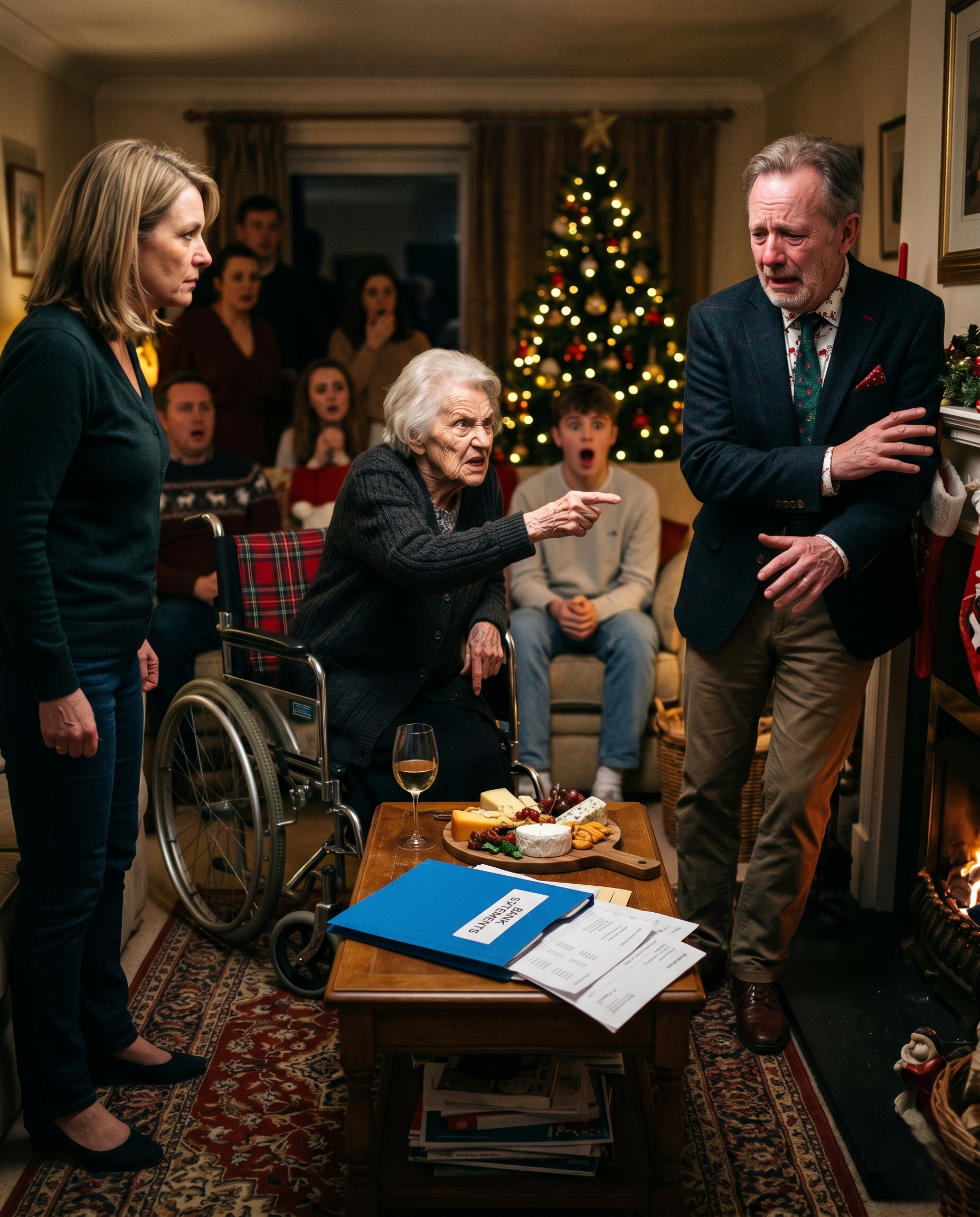
Everyone was staring at the stark white papers I had just spread out across the coffee table. The bank statements. The transfer slips. Twenty-two years of meticulous monthly withdrawals, all of them funneling directly into a single mortgage in Fort Myers, Florida.
“Let me explain something to you,” David said, his voice dropping into that smooth, practiced tone he always used whenever he needed to talk his way out of trouble. “You’re making a massive scene over a simple misunderstanding.”
“It’s not a misunderstanding,” I countered, standing my ground. “You stole the trust.”
To understand how we arrived at that explosive moment in the living room, I have to take you back to 1985.
That was the year my grandfather, Arthur, set up the family trust. He was a quiet, profoundly hardworking man who had put in thirty-eight grueling years at the local paper mill. He drove an old, gray Buick with blossoming rust spots on the passenger door, and he spent his Sunday mornings meticulously clipping grocery coupons until his thick fingers were permanently stained with newsprint ink.
He didn’t believe in luxury, and he certainly never spent money on himself. But he believed fiercely in family.
“I want the kids to have a head start,” he told my grandmother the day he signed the legal papers. He had managed to scrape together a total of one hundred and twenty thousand dollars—a massive, almost unfathomable fortune for a man who wore the same faded blue work shirts every single day of his life.
The rules governing the trust were simple and fair. There were twelve grandchildren in total. When each of us turned eighteen, we were promised exactly ten thousand dollars to help launch our adult lives. The remaining balance was supposed to sit securely in a high-yield savings account, steadily compounding over time. The idea was that when the youngest of the cousins finally reached eighteen, whatever money was left over would be split equally among the twelve of us.
My grandfather passed away in 1991. In his will, he left Uncle David as the sole executor of the trust simply because David was the “successful” son. He was the one who wore tailored suits, worked in an air-conditioned office, and lived in a sprawling, pristine subdivision.
For years, the system seemed to work flawlessly.
When my older cousin Michael turned eighteen in 1998, he received his ten-thousand-dollar check without a hitch. When Sarah turned eighteen in 2001, she got hers right on time. We all naturally assumed the trust was safe, sitting quietly and accumulating interest in the dark vault of the old County Trust bank down the street.
Then came the Florida house.
In the summer of 2002, Uncle David purchased a beautiful, sprawling three-bedroom cottage right near the shimmering water in Fort Myers. He affectionately named it “Sunset Cottage.” He casually told everyone he had made some exceptionally smart investments in the market. He was incredibly generous about it, too. Every single year, without fail, he invited the entire extended family down to Florida for Thanksgiving.
We spent two decades building cherished memories on that property. We ate roasted turkey on the expansive wooden deck, watched the fiery sunsets dip over the Gulf of Mexico, and endlessly congratulated David on his hard-earned success.
“David is the absolute anchor of this family,” my aunt Linda used to say every year, sighing happily as we lounged on the beach. “Your grandfather would be so incredibly proud of how he looks out for all of us.”
I believed her. We all did.
But the illusion shattered last month when my son, Toby, finally turned eighteen.
Toby is a good, grounded kid. He never asked for a flashy car or a massive graduation party. Instead, he had been accepted into a highly competitive local electrical apprenticeship program, and he desperately needed eight thousand dollars to cover his professional tools, his thick textbooks, and his first-year tuition fees.
“Mom,” he asked me one morning while we were eating cereal at the kitchen table. “Do you think I could get my trust money now? It would pay for everything I need. I wouldn’t even have to take out a student loan.”
“Of course, sweetheart,” I smiled, warmly patting his hand. “That’s exactly what your great-grandfather wanted that money for.”
I called Uncle David that very afternoon. I naively figured it would be a brief, five-minute conversation.
“Hey, David,” I said cheerfully when he answered. “Toby just turned eighteen. He’s starting his trade school program next month, and we need to arrange getting his ten-thousand-dollar check from the trust.”
There was a heavy, agonizingly long pause on the other end of the line.
“Ellen,” David finally said, his voice unusually soft and cautious. “I’m glad to hear Toby is doing so well. But there’s a bit of a problem with the trust.”
“What kind of a problem?” I asked, a small, cold knot suddenly forming in the pit of my stomach.
“The money isn’t there,” he replied.
“What do you mean it isn’t there?” I let out a nervous laugh, genuinely thinking it was some kind of dark joke. “There should be well over four hundred thousand dollars in that account by now with all the compound interest.”
“It’s empty, Ellen,” David stated, his tone abruptly turning cold, sharp, and defensive. “Market fluctuations. Bad investments. The money is gone. I did my absolute best to manage it, but these things happen.”
My heart didn’t stop, but my stomach went completely numb. I remember just staring blankly at the faded floral pattern on my kitchen linoleum, momentarily unable to draw a breath.
“You’re telling me my son gets absolutely nothing?” I whispered, my voice trembling. “What about the other younger cousins? What about little Leo and Lily?”
“They get nothing,” David said flatly. “It’s a shame, but that’s life. Don’t make a big deal out of this, Ellen. It’s just money.”
Then, he hung up on me.
I sat frozen at that kitchen table for twenty minutes. Then, I picked up the phone and called Frank Harris.
Frank is a semi-retired estate lawyer who used to play golf with my grandfather every weekend. He’s seventy-five years old, sharp as a tack, and absolutely doesn’t take any nonsense from anyone.
“Frank,” I said, my voice finally cracking. “David says Grandpa’s trust is empty.”
“That’s impossible,” Frank replied immediately, his tone firm. “Arthur was remarkably conservative with that money. It was locked tightly into treasury bonds and blue-chip mutual funds. Unless someone physically dug it out of there, it’s still there.”
It took us three grueling weeks to secure a court order. Since David was the legal trustee, we had to prove to a judge that there was a reasonable suspicion of fiduciary neglect just to peek at the bank records.
When the heavy stack of papers finally arrived at Frank’s mahogany desk, we sat down with two steaming cups of black coffee and started reading. My eyes blurred with unshed tears as I tracked the numbers line by line.
It wasn’t a sudden, catastrophic drop in the stock market. It was a slow, deliberate, and steady bleed.
Starting in June of 2002—exactly three months before David purchased the Florida house—a monthly withdrawal of fifteen hundred dollars began. Every single month. For twenty-two long years.
The money was transferred directly from my grandfather’s trust account into a personal checking account clearly labeled “David Miller – Sunset Cottage.”
He hadn’t just skimmed the interest. He had greedily eaten through the principal, the financial growth, and the rightful future of his own nieces and nephews. He had stolen from his own dead father’s legacy to buy himself a luxury beach house, and then he had the sheer audacity to invite us all there to celebrate the importance of family.
“He took everything,” I whispered in horror, staring at the blue-ink authorization signatures on the transfer slips. “He left exactly sixty-four dollars in the entire account.”
“He’s the trustee,” Frank said, his wrinkled face grim and furious. “He had legal access to move the funds, but secretly using them for personal real estate is a blatant criminal offense. You can take this straight to the district attorney right now, Ellen.”
“No,” I said, a strange, icy calmness suddenly washing over me. “Not yet. Christmas is in four days.”
I wanted the entire family to see it with their own eyes. I wanted every single person who had blindly praised him, every aunt who had tearfully called him the family “anchor,” and every cousin who had raised a glass to his success on that Florida deck to look at the ugly truth.
So, I waited.
On Christmas Eve, we all gathered at my grandmother’s house, just as we did every year.
My grandmother, Clara, is ninety-two. Six months prior, she had suffered a severe stroke that left her largely confined to a wheelchair. She hadn’t spoken a single coherent word since June. She simply sat in her usual corner of the living room, bundled securely in a hand-knitted blanket, watching the chaotic family dynamics with quiet, tired eyes.
Uncle David was in exceptionally high spirits. He had brought three bottles of ridiculously expensive wine and was loudly telling everyone in the kitchen about his grand plans to install a brand-new swimming pool at the Florida house.
“We’ll all have to go down in April!” he boomed, laughing heartily as he clapped my younger cousin Leo on the back. “A little spring break getaway for the family!”
I stood silently by the kitchen door, clutching the heavy, faded blue folder against my chest. My cousin Sarah walked past me, balancing a large plate of frosted sugar cookies.
“You okay, Ellen?” she asked, pausing as she noticed the tension in my face. “You look like you’re a million miles away.”
“I’m right here,” I replied quietly.
After dinner, when everyone was comfortably gathered in the living room around the glowing Christmas tree, I took a deep breath and stepped right into the center of the room.
“David,” I said loudly, my voice cutting sharply over the festive chatter. “I have a late Christmas present for you.”
He looked up from his drink, an amused, arrogant smile playing on his lips. “Oh yeah? What’s that, Ellen?”
I walked straight over to the coffee table and dropped the heavy blue folder right in the middle of the fancy cheese board and the scattering of empty wine glasses. It landed with a loud thwack.
“It’s the bank records for Grandpa’s trust,” I said clearly.
The room went dead quiet.
“Ellen,” my aunt Linda warned, her brow furrowing in deep disapproval. “Not now. Please. This is Christmas.”
“No, Linda, right now is the perfect time,” I shot back, keeping my eyes locked on David. “Because David told me last week that the trust was completely empty due to ‘market fluctuations.’ He told me my Toby doesn’t get his ten thousand dollars. He told me the younger kids get absolutely nothing.”
David’s arrogant smile instantly froze. He slowly, carefully set his glass of eggnog down on the brick mantel.
“I think everyone in this room should see what those market fluctuations actually look like,” I continued.
I flipped open the folder and handed the first three pages of statements directly to Sarah. She looked down at them, her brow furrowing in confusion. Then, as she read the lines, her eyes went wide with shock.
“What is this?” she whispered, her hands trembling as she passed the paper to her mother, Linda.
“It’s a withdrawal of fifteen hundred dollars a month,” I said, my voice echoing off the walls of the small room. “Every single month, stretching back to 2002. Transferred directly to David’s Florida mortgage account. He didn’t buy that beautiful beach house, guys. We did. Our children did.”
“This is absolutely ridiculous,” David stammered, his face rapidly draining of color until it turned a sickly shade of gray. “These are highly private financial documents. You had no right—”
“I had a federal court order, David!” I shouted, the months of stress and boiling anger finally bursting out of me all at once. “You stole from your own father! You stole from my son! You sat there and let us gather on that deck in Florida and thank you for your incredible generosity, while you were quietly paying for it with the money Grandpa worked thirty-eight grueling years in a paper mill to save!”
The room completely erupted.
Aunt Linda was staring at the undeniable paper trail, her hands shaking violently. “David… please, look at me and tell me this isn’t true. Tell me this is just some kind of horrible administrative mistake.”
“It’s not a mistake,” my older cousin Michael said. His voice was deep, guttural, and furious as he read the documents over his mother’s shoulder. “The account numbers match perfectly. It’s his own personal name on every single transfer.”
David darted his eyes around the room, desperately looking for an ally. The smug, overly successful businessman was completely gone. In his place stood a terrified, cornered animal. But then, reverting to his lifelong habit of entitlement, he drew his shoulders up, trying in vain to claw back some shred of dignity.
“Your grandfather would have wanted me to enjoy my life,” he snapped, looking at me with absolute, undisguised contempt. “He loved that I had that beautiful house. It was for the good of the family. I kept us all together!”
“He wanted his grandchildren to have a secure future!” I screamed back at him. “Not to fund your luxury vacations!”
And then, something happened that not a single one of us expected.
From the quietest corner of the room, my grandmother’s wheelchair loudly creaked.
We all turned our heads in unison.
My grandmother, Clara, was gripping the padded armrests of her chair. Her knuckles were stark white, and her thin, frail frame was trembling violently with a physical effort we hadn’t seen from her in many months. Her live-in nurse immediately tried to step forward to assist her, but my grandmother waved the woman off with a sharp, jerky, commanding motion of her hand.
She slowly, agonizingly pushed herself up onto her feet.
She hadn’t stood up without someone holding her in over half a year. But she was standing on her own now, her spine rigidly straight, her chest heaving as she breathed in the thick, tense air of the living room. She stared directly and unwaveringly at David. Her favorite son. The golden child she had fiercely protected and endlessly praised for his entire life.
“Mother,” David whispered, instinctively taking a hesitant step toward her, his voice suddenly small, childlike, and terrified. “Please, don’t get yourself excited. It’s really just a massive misunderstanding—”
“Be quiet,” she commanded.
The words were thick and heavily slurred from the lingering effects of the stroke, but they were loud. They were crystal clear.
The entire room collectively held its breath.
“You are a thief,” my grandmother whispered harshly, her blazing eyes locked onto her son’s pale face. “You stole from your father’s memory. You stole from his babies.”
Hot tears began to roll down David’s cheeks. “Mother, I swear I—”
“You will sell that house,” she interrupted, her voice steadily growing stronger, visibly fueled by a deep, ancient, maternal anger. “Every single stolen penny will go right back into that family account. You will pay these children back for exactly what you took from them.”
David just stood there, his shoulders slumped, his head bowed in absolute defeat, openly weeping in front of thirty-five stunned members of his own family.
“And if you don’t,” my grandmother finished, raising a violently shaking finger and pointing it directly at the front door, “I will be the one who personally calls the police. I will sign the prosecution papers myself. Now, get out of my sight.”
David didn’t dare say another word. He didn’t even stop to grab his winter coat. He simply turned on his heel and walked out the front door. The bitter, freezing Indiana wind howled into the room for a brief second before the heavy wooden door clicked firmly shut behind him.
The silence that filled the house afterward was entirely different. It was no longer the stunned silence of shock. It was the heavy, settling silence of a long-overdue reckoning.
My grandmother slowly, exhaustedly sank back into the seat of her wheelchair. She looked completely drained, her wrinkled face incredibly pale, but her eyes shone with a profound peacefulness. She weakly reached out her thin, trembling hand toward my son, Toby.
Toby immediately walked over and gently took her hand in his.
“Thank you, Grandma,” he whispered, his own eyes shining.
She just nodded once, slowly closing her tired eyes.
The weeks that followed that explosive Christmas were undeniably messy.
Our family was fractured, but not in the divisive way David had probably hoped. Instead of tearing us apart, my aunts and uncles—fully realizing the staggering depth of his betrayal—united as a solid front against him. Under immense legal pressure from the family’s newly hired lawyers, David quietly listed the Florida house for sale in early January.
It sold remarkably fast to an all-cash buyer. Because of the strict court order and the looming threat of criminal prosecution from my grandmother, every single dollar of the home’s equity was legally funneled directly into a newly secured trust account, aggressively managed by a neutral professional firm this time around.
When the final financial tally was returned, justice was served: Toby finally got his ten thousand dollars, and so did the younger cousins who had been promised nothing. There was even enough money left over to fairly distribute the remaining investment growth among the older grandchildren who had been quietly cheated out of their rightful share of the interest over the decades.
I vividly remember the chilly morning Toby’s check finally arrived in the mail. We were sitting together at the kitchen table, the exact same place where we had sat when he first asked me about his great-grandfather’s trust. He carefully tore open the envelope and just stared at the typed paper in his hands.
“It’s real,” he said softly, a small, relieved smile spreading across his face.
“It’s very real,” I agreed, resting my hand on his shoulder.
Three months later, Toby officially started his electrical trade school program. He used the money to buy his own tools—heavy, professional-grade steel wrenches and wire strippers that smelled richly of machine oil and grease. He kept them meticulously organized in a sturdy, black metal toolbox out in our garage. Sometimes, when I go out there to switch the laundry, I pause just to watch him working diligently at the wooden workbench, practicing his intricate wiring, proudly using those very tools to literally build his own future from scratch.
We didn’t travel down to Florida for Thanksgiving this year.
Instead, we stayed right here in South Bend. We happily crammed thirty people into my grandmother’s small, overheated house. It was incredibly loud, it was wonderfully messy, and the cramped kitchen was an absolute disaster zone of spilled flour and turkey grease.
David wasn’t there. Nobody even bothered to mention his name.
But right in the middle of the chaotic dinner, Toby proudly stood up from his chair and raised his water glass high.
“To Grandpa Arthur,” he said loudly, looking around the crowded, smiling table. “And to Grandma Clara. For keeping the promise.”
My grandmother, sitting quietly in her wheelchair at the very head of the table, smiled warmly and took a slow, peaceful sip of her sweet tea.
She didn’t need to say another word.