
I used to think silence meant peace. In the ruthless, high-stakes world of international corporate takeovers, my days were filled with the noise of boardrooms, negotiations, and closing bells.
Everything in my life ran on logic, numbers, and calculated outcomes—a place where the loudest voice often dominated, but the quietest man was usually the one already counting his winnings.
So when I came home to our glass-walled, multi-million-dollar house in the hills of Westchester, I longed for stillness. I believed the quiet inside those walls proved I had built something safe for my wife, Ava, and our newborn son, Noah.
I was wrong. Completely.
I had spent my entire career spotting hidden risks in billion-dollar deals, yet I failed to see the collapse happening inside my own home. Silence wasn’t peace. It was suffocation. A heavy, invisible weight where truth quietly disappeared.
Over the past six months, Ava had changed in ways I couldn’t ignore anymore. She used to be brilliant—sharp, confident, an architect known for bold designs that carried strength in every line. But now she seemed… diminished. Hollow eyes. Soft apologies. Constant exhaustion.
“It’s just fatigue,” she would say.
“Postpartum,” the doctors suggested.
But I noticed things they didn’t. The way her hands trembled when she reached for a glass. The way her voice shrank in certain rooms. The way she looked at my mother, Margaret Cole, with something deeper than discomfort—something closer to fear.
Margaret had moved in “to help” after Noah was born. She was the embodiment of legacy and control, a woman who wore perfection like armor and saw weakness as something to eliminate. Her presence filled the house—the sharp click of her heels, the scent of expensive perfume, the quiet authority that made everyone adjust themselves around her.
“She’s fragile, Daniel,” my mother would murmur in the hallway, her tone smooth but cutting. “Some women just aren’t built for this life. Don’t worry. I’ll keep things together while you focus on your work.”
And I believed her. That’s the part I can’t forgive myself for.
I wanted to help Ava, but every time I tried, she pulled away. “I’m fine. Just go to work,” she’d say, her voice distant, empty of the warmth it once carried.
Finally, one morning—after weeks of hearing my son cry in a way that didn’t feel normal, didn’t feel right—I made a decision I never thought I would.
I installed a hidden security camera.
It was disguised as a small wooden owl on the nursery shelf. High-resolution. Audio-sensitive. Invisible.
I told myself it was to protect Ava. To help her. To make sure everything was okay.
I didn’t realize I was about to expose something far worse.
That morning, as I drove away for a major merger meeting, I glanced in the rearview mirror and saw my mother standing at the nursery window. She wasn’t waving.
She was smiling.
Cold. Sharp. Victorious.
Then she reached out and pulled the curtains closed.
That moment stayed with me.
And minutes later, my phone vibrated.
A motion alert.
I expected something ordinary. Quiet. Peaceful.
Instead, I watched my world break apart.
The nursery door slammed open.
Not gently—violently.
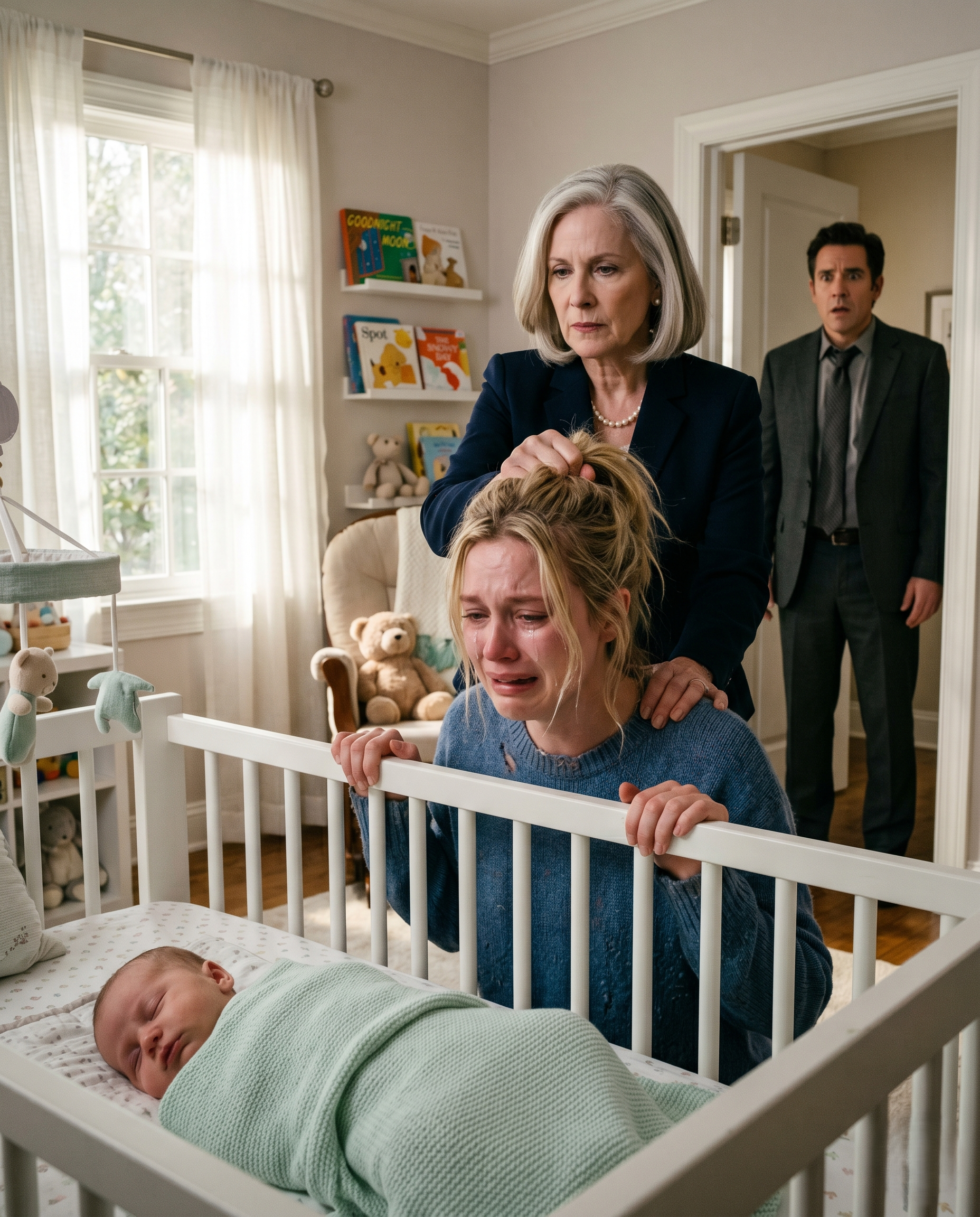
Margaret stormed inside, her expression completely different from the woman I knew. The warm, composed grandmother was gone. In her place stood someone cold, cruel, unrecognizable.
Ava sat in the rocking chair, holding Noah as he cried uncontrollably. She looked small. Fragile.
“You’re a parasite, Ava,” my mother’s voice cut through the speaker.
I froze.
Ava whispered, “He’s been crying for hours. I think he’s sick. Please, let me call the doctor.”
“You will do no such thing,” my mother snapped. “You’re useless. If Daniel knew what you really were, he’d have left you already.”
Then it got worse.
Much worse.
My mother grabbed Ava by the hair and yanked her head back.
Noah screamed.
I waited—hoping Ava would fight back. That she’d push her away.
She didn’t.
She just… went still.
A tear slid down her cheek.
That’s when I realized this wasn’t new.
This had been happening.
For a long time.
My mother leaned in closer, her voice dripping with venom. “Maybe today I finally show him the records I’ve been preparing. Let him see what kind of woman he married.”
I couldn’t breathe.
I kept watching.
And then she pulled out a small pill bottle.
“Time for your nap,” she said with a quiet laugh.
I didn’t go to the meeting.
I drove to a nearby park, parked, and opened the full recording archive.
If I was going to face this, I needed everything.
What I found… wasn’t just abuse.
It was calculated destruction.
I saw her intentionally waking the baby every time he tried to sleep—clapping loudly just to keep him crying.
I saw her walk into our bedroom afterward and blame Ava for “not handling the child.”
I heard her whisper lies.
“Daniel doesn’t want to come home because of you.”
“You’re a burden.”
“I’ll make sure you lose custody.”
Then I saw the worst part.
The kitchen.
She crushed pills into Ava’s water.
Calm. Precise. Routine.
“Sleep,” she muttered. “So he can see how useless you are.”
That’s when everything inside me changed.
I wasn’t just angry.
I was done.
I downloaded everything. Backed it up. Sent copies to my lawyer—and to a contact in the district attorney’s office.
I wasn’t preparing for an argument.
I was preparing for war.
When I returned home, everything looked the same.
Quiet. Beautiful. Perfect.
My mother greeted me with a smile. “You’re home early. Ava isn’t feeling well again. I’ve had to step in.”
I said nothing.
I walked to the living room TV and connected my phone.
“Daniel?” she asked, her voice tightening slightly.
I hit play.
The room filled with her own voice.
Her cruelty.
Her actions.
Her lies.
Her face lost all color.
“That’s not real,” she stammered. “It’s fake—”
“The timestamps are verified,” I said calmly. “I saw everything.”
Ava appeared in the hallway, weak but awake. She saw the screen.
And for the first time… she saw the truth exposed.
She broke down.
The front door burst open.
Not the police.
A private investigator my mother had hired.
Holding photos.
Photos meant to frame Ava as negligent.
That was her plan.
Destroy her. Take control. Rewrite reality.
I shut it all down in seconds.
By the time the police arrived, everything was already in motion.
My mother screamed.
“I did this for you!”
“No,” I said. “You did it for control.”
She was arrested that afternoon.
The neighbors watched.
Her perfect image shattered in real time.
One year later, the house feels different.
Alive.
Noah laughs as he takes his first steps.
Ava is herself again—strong, brilliant, rebuilding her career and designing spaces meant to protect others.
The camera is gone.
We don’t need it anymore.
My mother lives in a controlled facility now, cut off from the world she once ruled.
Her “final secret” turned out to be nothing more than a desperate lie.
That was all she had left.
Fear.
And illusion.
I sold her estate and donated the money to support women facing abuse like Ava endured.
Now, when I sit in the quiet of my home, it finally feels real.
Not empty.
Not suffocating.
Just… peaceful.
Ava looks at me one evening and smiles—the kind of smile that reaches her eyes again.
“Ready for the guests?” she asks.
I take her hand.
“I’ve been ready for a long time.”
And for once, silence doesn’t hide anything.
It simply lets us breathe.