
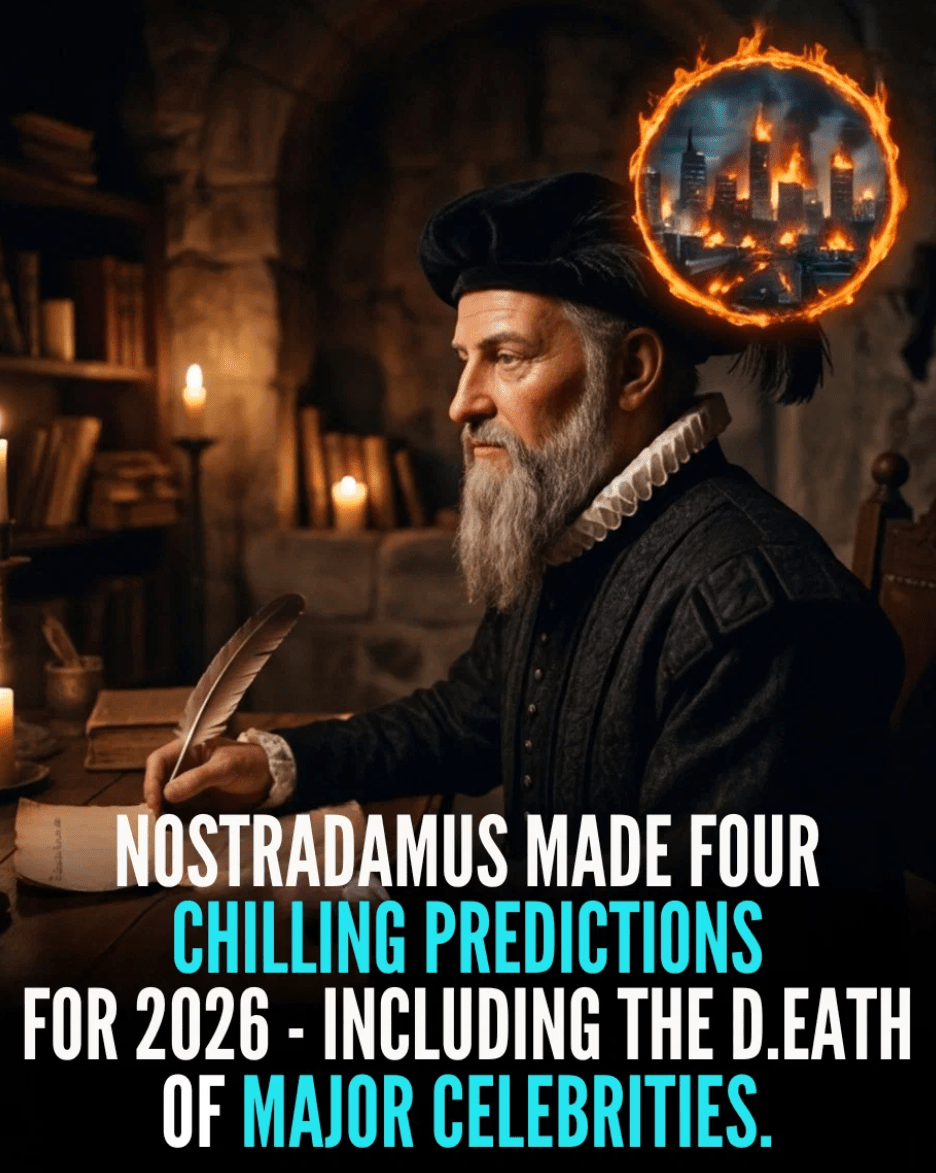
A new year often brings hope, goals, and fresh beginnings. Yet for some, it also revives interest in predictions about the future. Among the most famous figures linked to prophecy is Nostradamus, whose writings continue to spark debate centuries after his death.
As 2026 approaches, interpretations of his texts are once again circulating, raising questions. Are these predictions meaningful warnings, or simply reflections shaped by modern fears?
Who Was Nostradamus?
Nostradamus, born Michel de Nostredame in 1503, was a French physician and astrologer. He became widely known for his book The Prophecies, published in 1555.
This work consists of hundreds of short poems, known as quatrains. They are written in a mixture of old French, Latin, and symbolic language, which makes them difficult to interpret. Because of this ambiguity, readers across generations have found ways to connect his words to different historical events.
A Prediction of Global Instability
Some interpretations suggest that Nostradamus described a period of widespread unrest. His writings mention conflict, tension, and instability across different regions.
Supporters of these interpretations link such passages to modern geopolitical rivalries, economic uncertainty, or technological competition. Others argue that these descriptions are too general and could apply to almost any period in history.
This highlights the central challenge with Nostradamus: his words are open enough to fit many different scenarios.
The Symbolism of the “Swarm of Bees”
One of the more unusual references in his writings describes a “swarm of bees” connected to sudden events.
Interpretations vary widely. Some believe the bees represent powerful leaders, alliances, or organized groups. Others see them as symbols of mass movements, social unrest, or even environmental changes.
Without a clear context, the meaning remains speculative, which is part of what keeps interest in these texts alive.
A Focus on Europe
Another commonly discussed passage refers to serious events affecting a European region.
Some readers interpret this as a prediction of political or military tension within Europe. However, historians point out that Europe has experienced repeated conflicts over centuries, making it easy to draw connections after the fact.
This retrospective interpretation is one of the main criticisms of Nostradamus-related predictions.
The Idea of a Sudden Loss
Another widely shared interpretation involves the unexpected death of an important figure. The description is vague, referring only to a prominent individual struck down suddenly.
Because public figures pass away every year, this type of prediction can be linked to many real-world events. This reinforces skepticism among experts, who argue that such statements lack specific, verifiable detail.
Should These Predictions Be Taken Seriously?
What keeps Nostradamus relevant is not necessarily accuracy, but ambiguity. His writings invite interpretation, and each generation tends to project its own concerns onto his words.
Some people see his quatrains as genuine glimpses into the future. Others view them as symbolic texts that gain meaning only after events occur.
In reality, the fascination with Nostradamus may say more about human psychology than about prophecy itself. People naturally seek patterns, especially in uncertain times.
The enduring appeal of Nostradamus lies in mystery rather than certainty. His writings continue to inspire curiosity, debate, and speculation more than 400 years after they were written.
Whether seen as prophecy or poetry, they remind us of one thing: the future is not fixed. While it can be intriguing to explore predictions, the most reliable way to shape what lies ahead is through our own choices and actions.