
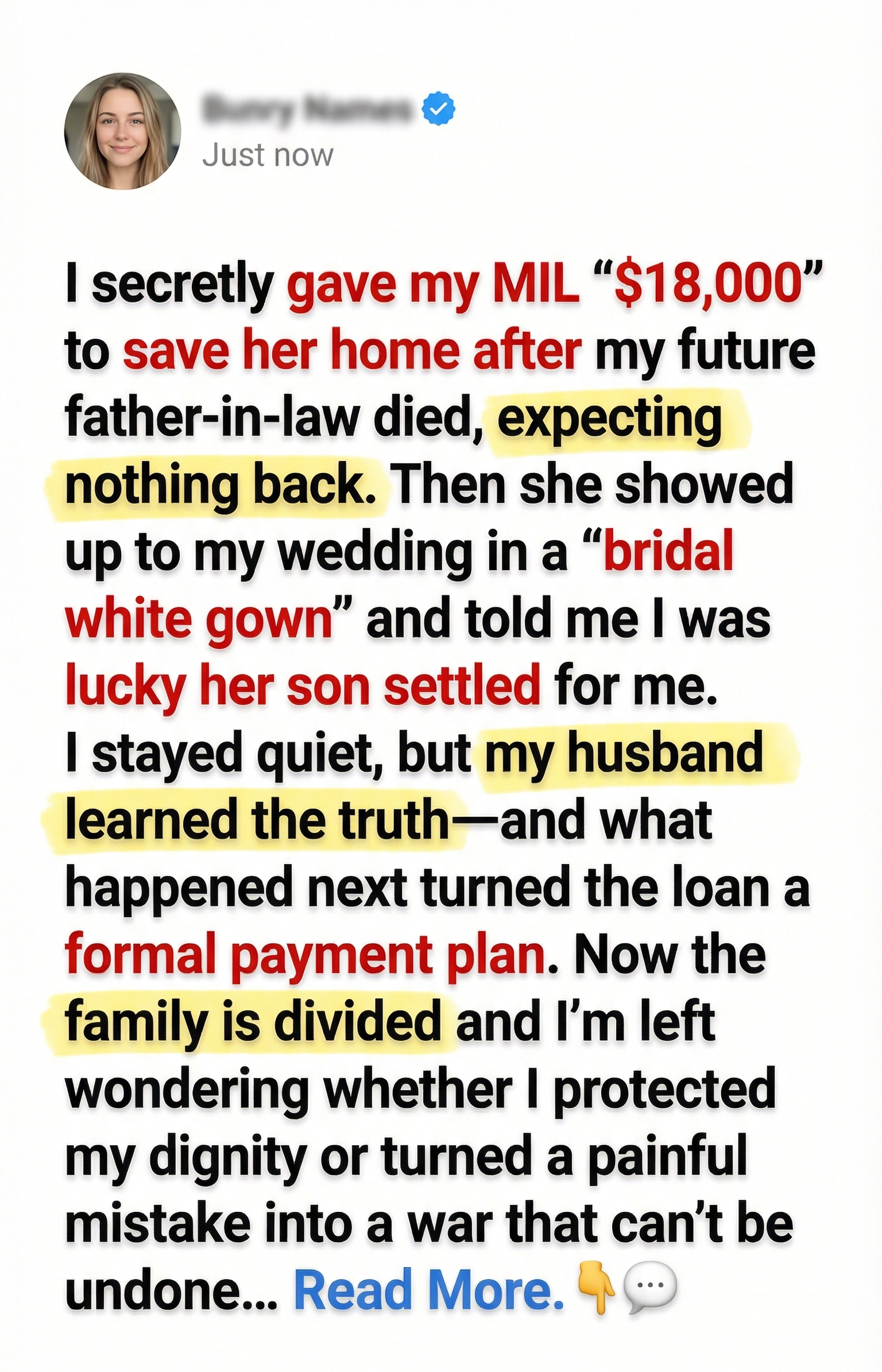
There are some betrayals that arrive with shouting, and others that arrive dressed in silence. Mine came in white.
When I first met my future mother-in-law, I didn’t think of her as a difficult woman. I thought of her as a widow trying to survive a life that had changed too quickly. She had lost her husband unexpectedly, and with that loss came the kind of stress that sinks into everything—financial pressure, emotional strain, the constant fear of not having enough. At the time, I was still on the outside of the family, looking in. My fiancé and I loved each other, and while our future was not yet officially mapped out, I already knew I wanted to stand beside him for the rest of my life.
When I learned that she was struggling to keep her home, it didn’t feel complicated to me. It felt human.
I had savings. Not a fortune, but enough to make a difference. Enough to breathe a little life into someone else’s crisis. And because I loved her son, because I could see the pain he carried after losing his father, I decided to help her quietly. No announcements. No speeches. No expectation of gratitude. I never wanted the family to think of me as some kind of savior, and I definitely never wanted her to feel shame in accepting help.
So I lent her $18,000.
It wasn’t a wild gesture. It was practical, and gentle, and, in my mind, deeply temporary. She signed a simple acknowledgment. Nothing dramatic. Nothing legalistic. It was just a written understanding that she would repay me when she was able. No deadline. No threat. No pressure. I trusted her. More importantly, I trusted the idea that family should mean something.
Back then, I believed quiet generosity would be enough to create trust.
I was wrong.
By the time the wedding arrived, I had already spent months planning a day that felt like the beginning of something sacred. Not because I believed weddings solve problems—they do not—but because I believed they reveal character. The guest list, the food, the music, the seating, the small details that seem decorative but actually shape the memory of a day: all of it mattered to me. I wanted peace. Warmth. A sense that everyone in the room understood they were witnessing the joining of two lives, not the staging of a performance.
And then she walked in wearing white.
Not ivory. Not cream. Not some soft variation that could be brushed off as a misunderstanding. It was bridal white. Floor-length. Obvious. Bright enough to announce itself before she ever spoke a word.
I noticed immediately. So did everyone else.
The room shifted in that invisible way rooms do when people sense something inappropriate but do not yet know whether they are allowed to react. Whispers started quietly and then multiplied. I heard someone ask whether we had made the wedding a “double bride” theme, and I wanted to disappear. My cheeks burned. My stomach tightened. I felt every eye and every quiet opinion pressing in at once.
But I didn’t react.
I had already learned something long before that day: when a person wants to provoke you publicly, they are often waiting for your embarrassment to become their entertainment.
So I smiled.
I thanked her for coming.
I kept moving through the room, greeting guests, accepting congratulations, pretending the moment had not cracked something inside me.
Then came the comment.
“You are lucky my son settled for you.”
The words landed with a cruelty that was almost elegant. There was no raised voice. No dramatic scene. Just a sentence meant to shrink me in front of everyone who heard it. And for one second, I felt the old instinct to defend myself, to explain, to match her tone with my own outrage.
But I didn’t.
Instead, I stored the pain away where women often store humiliation when they are determined not to let anyone ruin their day.
I had been on her side.
That was the part that hurt most. I had quietly protected her dignity when she needed help. I had not told my fiancé because I didn’t want her to feel ashamed. I had not told relatives because I knew what pride can do to a person already grieving and already frightened. I had acted out of compassion, not leverage. And somehow, that compassion had been repaid with a public insult.
What she didn’t know was that I had already told my husband about the loan before the wedding.
It happened during a practical conversation about merging finances. We were discussing accounts, future planning, and the reality that marriage isn’t only romance—it is also structure. At some point, I finally told him the truth. I explained everything: the house, the mortgage danger, the loan, the written acknowledgment, the fact that I had done it quietly and with no intention of making a scene.
He was stunned.
Not because he doubted me, but because he had no idea the support his mother had received had come from me. He had been grieving his father, navigating his own life, and trusting that his mother had found a way through her crisis. When I told him, he looked at me with a mixture of disbelief and gratitude that I will never forget. He understood instantly what it meant: I had protected his mother’s home at a time when no one else stepped in.
He also understood something else.
Kindness should not be exploited.
He told me that she should begin paying me back now that she was on her feet. I remember dismissing the idea at the time, saying she was family. I did not want money to become the center of our relationship. I had helped because I wanted to help, not because I was waiting for repayment like a creditor.
But he had been watching more closely than I realized.
And after the wedding, once he saw how little she thought of me, something in him hardened—not out of revenge, but out of clarity.
He confronted her privately the next morning.
He told her her behavior had embarrassed him. He told her he would not tolerate disrespect toward his wife. He was calm, but firm, and that firmness was something I had never seen from him toward his mother before. She, of course, brushed it off. She said I was too sensitive. She said white was fashionable. She said the whole thing was being exaggerated.
That response, more than anything, was the moment the last thread of ambiguity snapped.
Because if a person can look you in the eye, accept your help, humiliate you in public, and then wave off your hurt as oversensitivity, then the issue is no longer one misunderstanding. It is a pattern.
So he did what had to be done.
He had the lawyer send the formal payment plan.
No cruelty. No threats. No theatrics. Just structure.
Because structure was the only language left that she could not twist into sentiment.
And suddenly, all the warmth and informality she had once leaned on became something else entirely: accountable, documented, specific. That, more than the wedding, made her furious.
I think that is what truly bothered her. Not the repayment itself, but the fact that my generosity no longer allowed her to act entitled. She had been comfortable when the money lived in the blurry space of family obligation, where favors are remembered selectively and gratitude is optional. Formalizing it exposed the reality that she had received something valuable from me and then treated me with contempt.
That kind of exposure can be unbearable for some people.
So yes, she was furious.
She accused me of weaponizing the wedding. She claimed I had turned a personal moment into a financial attack. But I did not raise my voice when I answered her. I told her the same thing I believe now: respect and generosity cannot exist in only one direction.
That sentence changed everything.
Not because it silenced her, but because it clarified me.
I did not loan the money so she could humble me later. I did not support her so she could reclaim power over me in a white gown in front of my family and friends. I did not protect her home so I could be dismissed like an afterthought at my own wedding. My kindness was real. My hurt was real too.
And now everyone has an opinion, as families always do when a hidden imbalance suddenly becomes visible.
Some people say she brought the white dress on purpose, as a power move. Others say formal repayment was too far, too cold, too punitive. Some believe I should have swallowed the insult and preserved the peace. But peace built on silence is not peace. It is pressure waiting to burst.
What I know is this: I do not need the $18,000 immediately. I did not do this because I was desperate. I did it because I wanted the truth to exist in daylight. I wanted my husband, his siblings, and even his mother to understand that there is a difference between love and submission.
A person can be generous and still expect respect.
A person can be kind and still set boundaries.
A person can help family and still refuse to be humiliated.
In the weeks since, the dinners have changed. Conversation feels smaller. People choose words more carefully. Some avoid my eyes, while others seem relieved that someone finally named what had been festering for years. My husband stands beside me more firmly now. Not loudly. Not in some dramatic declaration. Just consistently. And sometimes consistency matters more than speeches.
I still think about the wedding. The bright lights. The whispers. The look on her face when she realized the old dynamic was ending. I think about how quickly a moment meant to honor a union can reveal the hidden math of a family system. And I think about how easy it is for some people to confuse patience with weakness.
I was patient.
I was not weak.
Maybe that is the real answer here.
Maybe the payment plan was not punishment at all, but the first time the truth had been made formal. Maybe the white dress was not just a bad choice but a final test of what I would tolerate. And maybe what happened afterward was not me going too far, but me finally going far enough to protect my dignity.
I still care about my mother-in-law. That is the complicated part. Resentment does not always erase affection. But caring about someone does not mean surrendering to them. It means seeing them clearly, even when clarity is painful.
And I see her clearly now.
I see a woman who mistook my kindness for weakness, my silence for permission, and my generosity for something she could pocket without consequence.
She was wrong.
And I think, deep down, she knows it.