
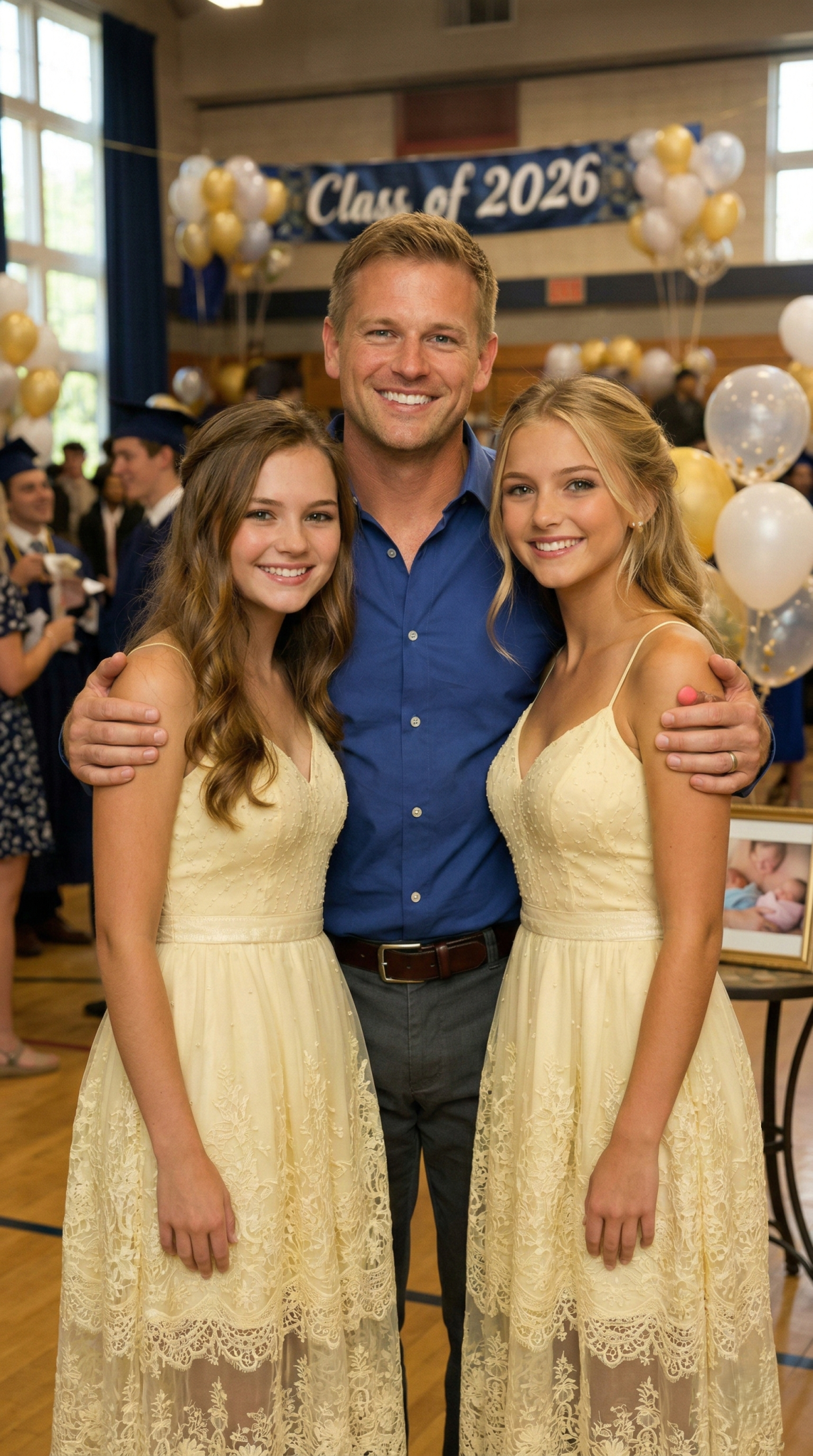
Eighteen years ago, my wife walked out on me and our blind newborn twins to chase fame, leaving behind two fragile lives and a husband who had no idea how to carry the weight she dropped without warning.
I raised them alone, teaching them to sew and building a life from scraps, from sleepless nights and secondhand furniture and courage I didn’t know I possessed until I had no choice.
Last week, she returned with designer gowns, cash, and one cruel condition that made my blood boil, because it proved she still saw love as a transaction instead of a commitment.
My name’s Mark, and I’m 42 years old, older in spirit than in years because responsibility has a way of aging a man quickly.
Last Thursday changed everything I thought I knew about second chances and the people who don’t deserve them, about forgiveness and the difference between regret and convenience.
Eighteen years ago, my wife, Lauren, left me with our newborn twin daughters, Emma and Clara, at a time when I could barely hold myself together, let alone hold two infants who depended on me for everything.
Both were born blind, entering a world that would constantly underestimate them before they ever had a chance to prove otherwise.
The doctors delivered the news gently, as if they were apologizing for something they couldn’t control, their voices soft and careful like they feared the truth might shatter us.
Eighteen years ago, my wife, Lauren, made a decision that would define all of our futures in a single selfish breath.
She saw it as a life sentence she hadn’t signed up for, as though motherhood were a contract she could simply void once the terms felt inconvenient.
Three weeks after we brought the babies home, I woke up to an empty bed and a note on the kitchen counter, the kind of quiet that feels wrong before you even understand why.
“I can’t do this. I have dreams. I’m sorry.”
That was it, four sentences scribbled in haste, four sentences that rewrote the rest of my life.
No phone number.
No forwarding address.
Just a woman choosing herself over two helpless babies who needed their mother more than she needed applause.
Life became a blur of bottles, diapers, and learning how to navigate a world designed for people who could see, while my daughters would have to feel their way through it inch by inch.
She saw it as a life sentence she hadn’t signed up for, but I saw it as a calling I refused to abandon.
I had no idea what I was doing most days, stumbling through parenthood with more fear than confidence.
I read every book I could find about raising children with visual impairments, stacking them beside my bed like sacred texts.
I learned braille before they could even talk, running my fingers over raised dots late into the night until they felt natural beneath my skin.
I rearranged our entire apartment so they could move through it safely, memorizing every corner and edge as if I were mapping a battlefield.
And somehow, we survived, even when survival felt like a thin thread stretched too tight.
But survival isn’t the same as living, and I was determined to give them more than that, to give them joy instead of just endurance.
When the girls were five, I taught them how to sew, sitting between them at a borrowed machine that rattled like it doubted us.
It started as a way to keep their hands busy, to help them develop fine motor skills and spatial awareness in a world that relied so heavily on sight.
But it became so much more than that, growing from therapy into passion before I even realized it was happening.
Emma could feel the texture of fabric and tell you exactly what it was just by running her fingers over it, identifying silk from satin as easily as someone else might recognize colors.
Clara had an instinct for patterns and structure, sensing balance and symmetry without ever seeing a sketch.
She could visualize a garment in her mind and guide her hands to create it without ever seeing a single stitch, trusting her imagination the way others trust mirrors.
Together, we turned our tiny living room into a workshop, transforming scarcity into creativity.
Fabrics covered every surface, draped over chairs and stacked in careful piles.
Thread spools lined the windowsill like colorful soldiers standing guard over our dreams.
Our sewing machine hummed late into the night while we worked on dresses, costumes, and anything we could imagine, its rhythm becoming the soundtrack of our resilience.
We built a world where blindness wasn’t a limitation; it was just part of who they were, neither tragedy nor excuse.
The girls grew up strong, confident, and fiercely independent, carrying themselves with a certainty that silenced doubt before it formed.
They navigated school with canes and determination, memorizing hallways and refusing pity.
They made friends who saw past their disabilities and teachers who learned quickly not to underestimate them.
They laughed, dreamed, and created beautiful things with their hands, proving every day that sight is only one way to perceive the world.
And not once did they ask about their mother, not even in whispers before bed.
I made sure they never felt her absence as a loss… only as her choice, a distinction that protected their hearts.
“Dad, can you help me with this hemline?” Emma called from the sewing table one evening, her voice bright with focus.
I walked over, guiding her hand to feel where the fabric bunched beneath her fingers.
“Right there, sweetheart. Feel that? You need to smooth it out before you pin it.”
She smiled, her fingers working quickly and confidently once she understood. “Got it!”
Clara looked up from her own project. “Dad, do you think we’re good enough to sell these?”
I looked at the gowns they’d created… intricate, beautiful, made with more love than any designer label could ever hold, and my chest swelled.
“You’re more than good enough, dear,” I said softly, meaning every word. “You’re incredible.”
Last Thursday morning started like any other, calm and ordinary in the way routine becomes sacred.
The girls were working on new designs, and I was making coffee when the doorbell rang, sharp and unexpected.
I wasn’t expecting anyone, and something about the sound made my stomach tighten.
When I opened the door, Lauren stood there like a ghost I’d buried 18 years ago, resurrected and polished.
She looked different, refined in a way that screamed money and media training.
Polished and expensive, like someone who’d spent years crafting an image more carefully than she ever crafted a family.
Her hair was styled perfectly, not a strand out of place.
Her clothes probably cost more than our rent combined.
She wore sunglasses even though it was overcast, and when she lowered them to look at me, her expression was pure disdain.
“Mark,” she said, her voice dripping with judgment rather than regret.
I didn’t move or speak, just stood there blocking the doorway like a wall she’d have to acknowledge.
She pushed past me anyway, stepping into our apartment like she owned it, like abandonment gave her rights.
Her eyes swept over our modest living room, our sewing table covered in fabrics, and the life we’d built without her.
Her nose wrinkled like she’d smelled something rotten, as if love and hard work offended her.
“You’ve still remained the same loser,” she said loud enough for the girls to hear, her cruelty intentional.
“Still living in this… hole? You’re supposed to be a man, making big money, building an empire.”
My jaw stiffened, but I refused to give her the satisfaction of a response that would escalate her performance.
Emma and Clara had frozen at their sewing machines, their hands stilling on the fabric mid-stitch.
They couldn’t see her, but they could hear the venom in her voice, and that was more than enough.
“Who’s there, Dad?” Clara asked quietly, tension slipping into her tone.
I took a breath, steadying myself. “It’s your… mother.”
The silence that followed was deafening, thick and heavy with everything unsaid for 18 years.
Lauren walked further into the room, her heels clicking sharply against our worn floor like a metronome of arrogance.
“Girls!” she said, her voice suddenly syrupy sweet. “Look at you. You’re so grown up.”
Emma’s face remained blank, her composure unshaken. “We can’t see, remember? We’re blind. Isn’t that why you left us?”
The bluntness made Lauren falter for just a second, her mask slipping.
“Of course,” she recovered quickly. “I meant… you’ve grown so much. I’ve thought about you every single day.”
“Funny,” Clara said, her voice ice-cold and steady. “We haven’t thought about you at all.”
I’d never been prouder of my daughters.
Lauren cleared her throat, clearly thrown off by their strength. “I came back for a reason. I have something for you.”
She pulled two garment bags from behind her and laid them carefully on our couch like props in a show.
Then she produced a thick envelope, the kind that makes a heavy sound when it hits a surface.
“These are designer gowns,” she said, unzipping one bag to reveal expensive fabric. “The kind you girls could never afford. And there’s cash here too. Enough to change your lives.”
“Why now? After 18 years?” I asked, my voice rough with disbelief.
Lauren smiled, but it didn’t reach her eyes. “Because I want my daughters back. I want to give them the life they deserve.”
She pulled out a folded document and placed it on top of the envelope with deliberate care. “But there’s one condition.”
“It’s simple, darling,” she said smoothly. “You can have all of this… the gowns, the money, everything. But you have to choose ME over your father.”
“You have to acknowledge publicly that he failed you,” she added. “That he kept you in poverty while I was out working to build a better future. That you’re choosing to come live with me because I can ACTUALLY provide for you.”
Emma stood up slowly, her hand finding the envelope of cash.
“This is a lot of money,” she said softly, weighing it in her palm.
“But you know what’s funny?” she continued, her voice strengthening. “We’ve never needed it. We’ve had everything that actually matters.”
Clara stood beside her. “We’ve had a father who stayed. Who taught us. Who loved us when we were hard to love.”
“Who made sure we never felt broken,” Emma added firmly.
“We don’t want your money,” Clara said. “We don’t want your gowns. And we don’t want YOU.”
Emma tore the envelope open and threw the bills into the air, letting them rain down like meaningless paper. “We’re not for sale.”
Lauren’s composure shattered. “I wanted the world to see I’m a good mother!” she shouted desperately.
“You stayed away because you’re selfish,” Emma replied calmly.
Clara opened the door. “Please leave.”
The door closed behind her with a satisfying click, sealing 18 years of abandonment on the outside where it belonged.
The story hit social media within hours, spreading faster than any narrative Lauren could control.
Her attempt at a redemption arc backfired so spectacularly that she became a cautionary tale instead, a lesson in how image cannot replace integrity.
Meanwhile, my daughters were offered something real.
A prestigious short film company reached out, offering them full scholarships to their costume design program because talent doesn’t need pity to shine.
I stood on set yesterday, watching Emma adjust an actress’s collar while Clara pinned a hemline with steady hands.
“Your daughters are incredibly talented. We’re lucky to have them,” the director told me sincerely.
“I’m the lucky one,” I replied, my voice thick with emotion.
Last night, we sat in our apartment, the same cramped space Lauren had mocked, eating takeout and laughing.
This was wealth and success. This was everything that mattered.
Lauren had chosen fame and found emptiness. We’d chosen each other and found everything.
My daughters didn’t need designer gowns or stacks of cash.
They needed someone who would stay.
And 18 years later, when their mother tried to buy them back, they already knew the difference between a price tag and priceless.