
Weddings are supposed to begin with joy, laughter, and the quiet thrill of forever.
Mine began with a stain that felt like betrayal.
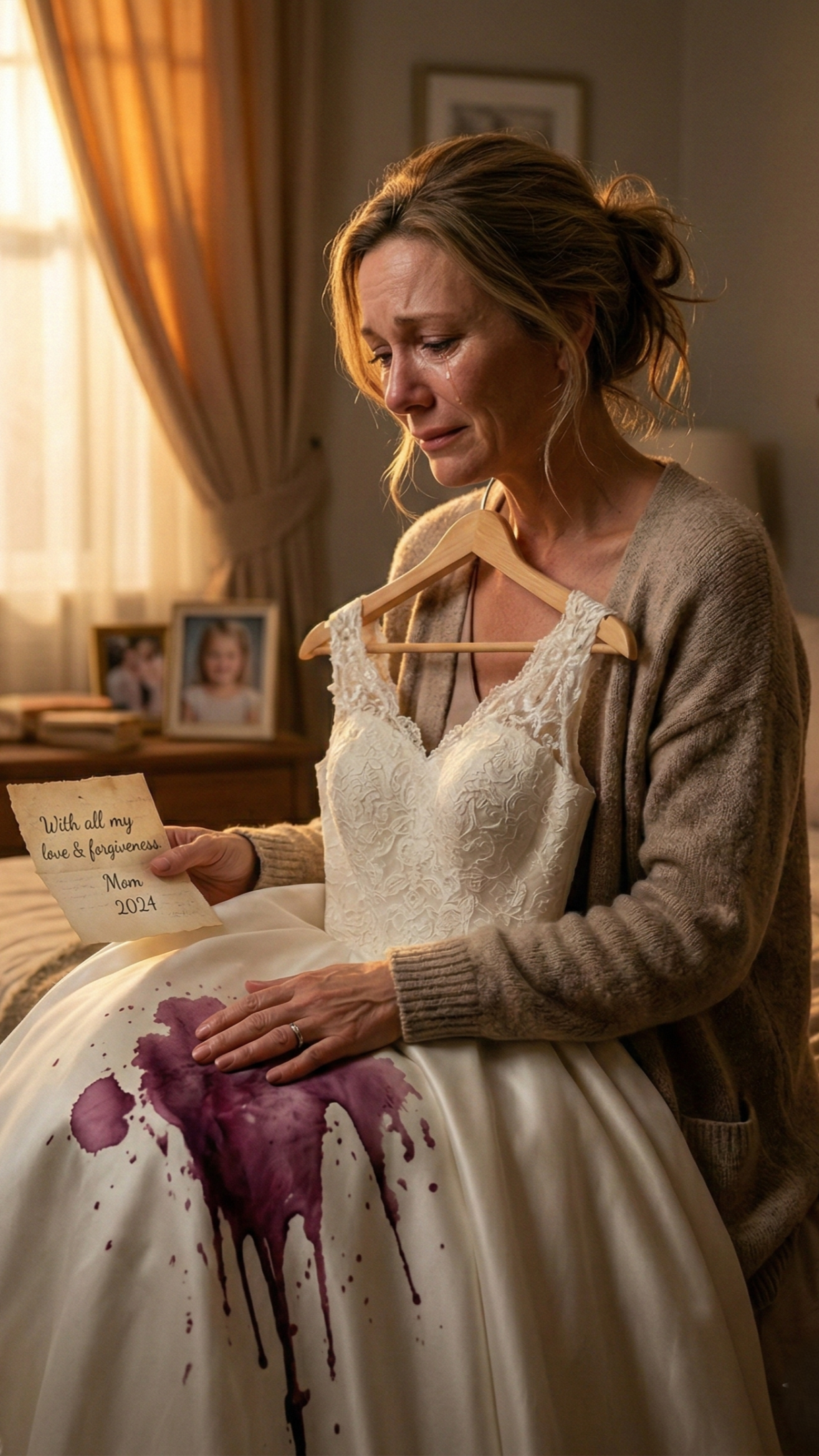
My mother-in-law “accidentally” ruined my wedding dress the morning of my wedding—she spilled an entire cup of juice on it while helping me get ready. I was devastated, she barely apologized, and I got married in my backup dress, feeling like she’d done it on purpose. I hated her for years over it.
It happened so quickly that I didn’t even process it at first. One second she was adjusting the fabric at my waist, smiling politely for photos. The next, bright red juice spread across the bodice of the gown I had dreamed about since I was a little girl.
The room went silent. My bridesmaids gasped. Someone rushed for towels. I remember staring down at the stain, unable to breathe, feeling as though something sacred had just been destroyed.
That dress wasn’t just fabric and lace. It was months of planning, saving, imagining. It was the dress I had tried on and cried in. The dress my mother had hugged me in. The dress that made everything feel real.
And in a single careless motion, it was ruined.
My mother-in-law muttered a quick apology, but it felt thin, almost rehearsed. There was no panic in her voice, no desperate scrambling to fix what had happened. Just a shrug, a tight smile, and a quiet step back as the chaos unfolded around us.
In that moment, something shifted inside me.
I changed into my backup dress—pretty, but not the one. I walked down the aisle smiling for guests, posing for photos, saying my vows. Everyone told me I looked beautiful.
But I felt robbed.
Every time I saw my mother-in-law during the reception, a wave of resentment crashed over me. I watched her laugh with relatives and sip champagne, and I became convinced it hadn’t been an accident at all.
Why would someone be so careless on a morning like that?
Over the years, that question hardened into a quiet certainty. She had done it on purpose. I couldn’t prove it, but my heart believed it. And that belief built a wall between us.
Family dinners were polite but cold. Holidays felt tense. I kept my distance, offering civility but never warmth. I told myself I was justified. After all, who ruins a bride’s dress and simply moves on?
I carried that anger for years.
Then everything changed.
Then she was diagnosed with early-onset dementia, and while going through her things to move her into care, I found my original dress in her closet, perfectly preserved and professionally cleaned.
I stood there frozen, the garment bag trembling in my hands. I slowly unzipped it, half afraid of what I would find. But there it was—my dress. Pristine. Beautiful. Untouched by the stain that had haunted my memory.
It looked exactly as it had the day I bought it.
Confusion washed over me. Why would she have it? Why would she keep it? And why had she never told me it could be saved?
As I carefully lifted the gown from its hanger, something slipped from inside the lining. A small folded note, yellowed slightly with time, pinned near the heart.
My hands shook as I opened it.
There was a note pinned inside: “For your daughter someday. I’m so sorry about that day. The juice wasn’t an accident—I never got to have a proper wedding or wear a beautiful dress like yours. We were too poor, and I got married at the courthouse in a borrowed skirt.
Watching you in that stunning gown broke something in me, and I just couldn’t handle it. I was selfish and cruel, and I’ve regretted it every single day since.”
I broke down reading it.
The words blurred as tears fell onto the very fabric she had once stained. The anger I had carried for so long suddenly felt heavy, misplaced, almost fragile.
She’d grown up with nothing and never had the wedding she dreamed of as a girl. I forgave her that same day, and we actually became close during her final years.
In that quiet bedroom, surrounded by boxes and memories, I saw her differently for the first time. Not as the woman who had sabotaged my wedding, but as a young bride who never got her moment. A girl who had stood in a courthouse wearing someone else’s skirt, pretending it was enough.
Jealousy is an ugly emotion. It doesn’t excuse what she did. But for the first time, I understood it.
She hadn’t ruined my dress out of cruelty alone. She had done it out of grief for something she never had.
And she had carried that shame silently for years.
As her dementia progressed, pieces of her memory faded. She would forget names, dates, conversations we had just finished. But sometimes, in rare lucid moments, she would look at me with an expression that felt like apology.
I never mentioned the note.
Instead, I chose kindness.
I started visiting her regularly. We would sit together, flipping through old photo albums. I showed her pictures from my wedding—the backup dress and all. She would smile and tell me I looked beautiful.
And this time, I believed her.
There was a softness between us that hadn’t existed before. Walls dissolved. Resentment gave way to compassion. The years we lost to misunderstanding could never be recovered, but the years we had left became something tender.
Near the end of her life, she reached for my hand more often. Sometimes she mistook me for someone else—a sister, a friend from childhood. But sometimes she knew exactly who I was.
And in those moments, there was peace.
Forgiveness didn’t erase what happened that morning. It didn’t give me back the walk down the aisle in my dream dress. But it gave me something far greater: understanding.
I learned that people carry invisible wounds. That bitterness can grow in the cracks of unmet dreams. That sometimes the worst actions come from the deepest pain.
Most of all, I learned that holding onto anger can steal more from us than the original hurt ever did.
The dress now hangs in my own closet. Preserved. Protected. Waiting, just as she intended.
If I ever have a daughter, I’ll tell her the whole story. Not just about the stain, but about the note. About jealousy and regret. About how easy it is to misjudge someone when you don’t know their history.
And about forgiveness.
Because sometimes the people who hurt us the most are the ones who needed healing all along.
And sometimes, the most beautiful part of a wedding story isn’t the dress—it’s the grace that comes long after the vows.