After Lorna ended our conversation, I sat at my desk trying to understand why she had reacted so aggressively to the nurse’s phone call. If someone had mistakenly identified our mother at a nursing home, I would have expected my sister to be confused or concerned rather than furious.
I had spent years working with official records, and I knew that a person’s death normally left a clear administrative trail. Instead of arguing with Lorna again, I decided to examine the documents that should have existed if Mom had truly died.
I began by searching the Illinois death index for Evelyn Mulligan, using her date of birth, March 2, 1949. I checked the identifying information carefully, expecting to find a record confirming the heart attack Lorna had described.
There was no matching death certificate. I also found no funeral home record or cremation permit connected to my mother’s supposed death.
I knew that a lawful cremation in Illinois required appropriate death documentation and authorization. The complete absence of those records made Lorna’s explanation increasingly difficult to believe.
Next, I examined the publicly available property records for Mom’s house in Rockford. According to the documents, the property had been sold in May, approximately one month after Lorna claimed our mother had died.
The transaction identified Lorna Mulligan as the seller acting under power of attorney for Evelyn Mulligan. That detail was especially important because a power of attorney ordinarily ends when the person granting it dies.
If Mom had truly died in April, Lorna couldn’t have continued exercising that authority in May. The documents strongly suggested that my sister had known our mother was alive when she sold the house.
I thought about the wooden box Lorna had photographed and the way she’d discouraged me from visiting Rockford. I also remembered her insistence that Mom’s debts had consumed everything, leaving neither daughter with any inheritance.
For the first time, I considered the possibility that my sister had deliberately hidden our mother from me. The thought was horrifying, but the evidence pointed toward something far more serious than a misunderstanding.
I contacted Willow Bend Care Center again and confirmed the information Femi had provided. Once I was satisfied that the facility was legitimate, I booked a flight to Illinois that same evening.
During the journey, I kept imagining what I might find when I arrived. I wanted desperately to believe Mom was alive, but I was terrified that six months of grief had left me vulnerable to another devastating disappointment.
At Willow Bend, Femi greeted me and led me through the hallway toward my mother’s room. He explained that Evelyn had been unusually withdrawn and frequently spoke about the daughter she missed.
When we reached the room, I saw an elderly woman sitting beside the window in a blue sweater. She was thinner than I remembered, and her hair had grown grayer, but I recognized her immediately.
A half-finished scarf rested in her lap, with knitting needles lying across the soft blue yarn. She slowly lifted her head when she heard us enter.
“Tracy?”
Her eyes filled with tears as she stared at me. I moved toward her, overwhelmed by the realization that the woman I’d mourned for six months was sitting directly in front of me.
“Oh, my girl. Lorna told me you died.”
I stopped beside her wheelchair, struggling to comprehend what she’d just said. My sister hadn’t merely convinced me that our mother was dead; she’d apparently told Mom that I was gone too.
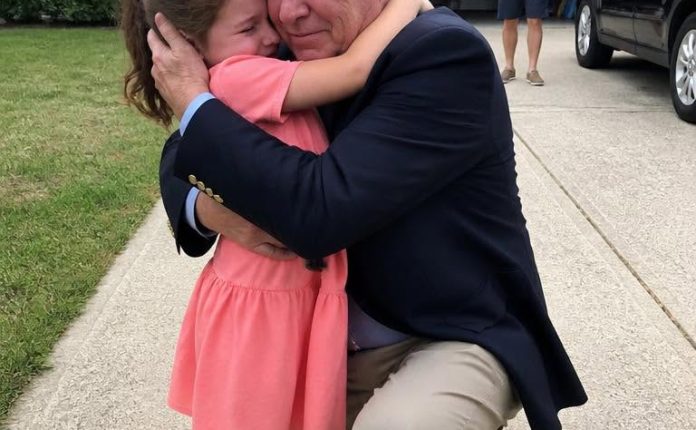
As I knelt in front of her, Mom reached toward my face with trembling hands. She touched my cheeks gently, as though she needed to make certain that I was real.
Neither of us could understand why Lorna had done this. But in that moment, I realized that my sister had stolen something far more precious than money: six months in which my mother and I could have been together.
Part 3: The Daughter Who Was Supposed to Be Dead
I fell to my knees beside my mother’s wheelchair, unable to believe that she was alive after six months of mourning. She held my face between her trembling hands, studying me carefully as though she feared I might disappear if she looked away.
Mom began crying as she explained what Lorna had told her. According to my sister, I had died in a car accident in Denver the previous April, and there had been no funeral she could attend because the city was too far away.