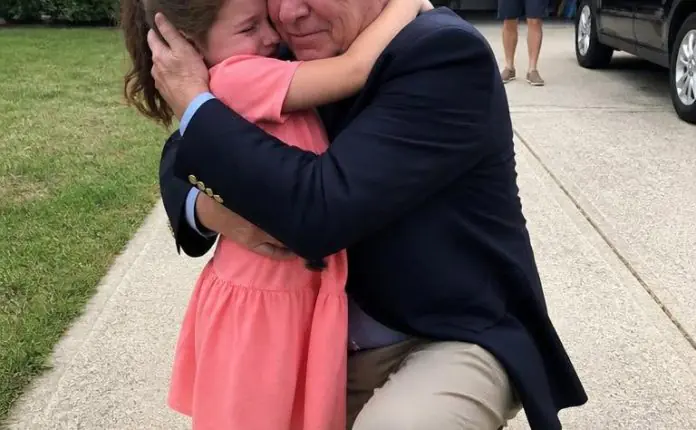
A month later, I returned to Oliver’s school for a community safety presentation. I noticed him laughing with another student, wearing newer sneakers and carrying a backpack decorated with colorful stickers.
When he recognized me, he excitedly raised his hand and announced that his grandmother was improving. He also proudly explained that his father had started listening whenever he expressed concern.
After the presentation, Oliver approached me in the hallway with another piece of good news. He smiled and explained that he no longer needed to save food from his school lunches.
I watched him run outside to join his friends, grateful that he finally looked like an ordinary seven-year-old. His experience reinforced something I’d learned throughout my career: children don’t always need adults to provide immediate answers, but they do need their concerns to be taken seriously.
Six months after our first encounter, Grant unexpectedly called the police station. He reassured me that Margaret was doing much better and explained that Oliver wanted to invite me to her seventy-eighth birthday celebration.
“Officer Hayes, Oliver has been preparing something special for weeks. He says you’re the one person outside our family who absolutely needs to be there.”
I accepted the invitation, curious about what the boy had planned. The following Saturday, I drove to a community center outside Cedar Falls, where colorful balloons and a handmade birthday banner decorated the entrance.
Approximately thirty guests had gathered around tables filled with flowers, homemade desserts, and family photographs. Grant greeted me warmly, looking far more relaxed than the exhausted man I’d met at the hospital months earlier.
Margaret sat near the birthday cake, wearing a lavender cardigan over a floral dress. Her hair was neatly styled, and she was laughing with relatives, appearing healthier and more comfortable than when I’d first found her.
Oliver stood beside her, proudly displaying a drawing of a yellow house surrounded by flowers. When he spotted me, he hurried across the room and eagerly led me toward his grandmother.
Margaret recognized me immediately and warmly thanked me for helping her family. She admitted that she couldn’t remember everything from the difficult weeks before her hospitalization, but she remembered Oliver promising to find someone who could help.
After the birthday cake was served, Grant announced that Oliver had prepared something he wanted to share. The boy approached the front of the room carrying a large blue folder filled with drawings.
His pictures showed Margaret’s old house, his grandmother sitting beside a window, and a small boy holding a police officer’s hand. Oliver explained that he’d been frightened when Margaret became ill because he believed it was his responsibility to make her better.
“Officer Rebecca told me something important. She said taking care of Grandma wasn’t supposed to be my job.”
Grant nodded in agreement, and Oliver reached into the folder for another sheet of paper. Across the top, he’d written three large words in colorful letters: THE LISTENING PROMISE.
What he’d written underneath was about to change much more than his own family.
PART 4: THE PROMISE THAT SPREAD THROUGH THE COMMUNITY
Oliver held up his colorful paper so everyone at Margaret’s birthday celebration could see it. Beneath the title, he’d written three promises about listening to children, finding trustworthy adults when someone needed help, and apologizing when mistakes were made.
He explained that he wanted every grown-up at the party to sign the document. For several moments, the room remained quiet as everyone considered what his request meant.
Grant was the first to approach, but before signing, he knelt beside his son. He apologized for dismissing Oliver’s warnings about Margaret and acknowledged that a child should never have been left carrying such a frightening responsibility alone.
“I’m sorry I didn’t listen when you told me Grandma needed help. You were right, and I promise I’ll do better.”
Oliver accepted his father’s apology, and Grant embraced him before signing the paper. One by one, Patricia, Oliver’s teacher, neighbors, and other relatives added their names, including Margaret herself.
When Oliver brought the document to me, I gladly signed it. He quietly explained that he didn’t want other children to experience the loneliness of asking for help and being ignored.