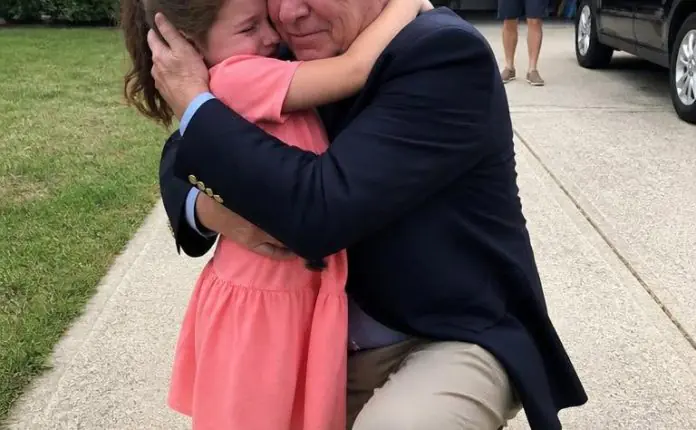
One evening, he admitted that he’d received a C on a mathematics test and had been afraid I’d become angry. Instead of criticizing him, I thanked him for being honest and assured him that a disappointing grade wouldn’t change how I felt about him.
“Are you really not mad at me?”
“No, sweetheart. I’m glad you trusted me enough to tell me.”
Eli smiled with genuine relief before announcing that telling me the truth was his highlight for the day. I realized how much progress he’d made because he could finally discuss something disappointing without expecting rejection.
That autumn, Whitman Elementary prepared for its annual fall fair, complete with orange decorations, carnival games, and enormous cookies. Morgan had moved on to middle school, but he asked to return as a volunteer while Eli attended fifth grade in Mrs. Quinn’s classroom.
The night before the fair, I discovered both boys sitting on Eli’s bedroom floor counting money they’d saved for two months. Their earnings included birthday gifts, returned cans, money from Morgan mowing neighbors’ lawns, and Eli walking Mrs. Patterson’s dog for two dollars per walk.
Together, they’d collected seventy-three dollars and fifteen cents. Morgan explained that they wanted enough money to help every child who couldn’t afford the fair, especially because Mrs. Quinn expected more students to need assistance that year.
Eli added that they wanted each child to receive two cookies rather than just one. Their determination made me smile, and I reached into my wallet for another fifty-dollar bill.
“You’re our favorite mom,” Morgan announced.
“I’m also your only mom.”
Eli smiled and repeated the familiar answer that had become part of our family.
“That still counts.”
The following morning, I volunteered at the cookie table while Morgan and Eli purchased approximately $123 worth of tickets. Instead of heading toward the games, they walked directly to the bleachers where eighteen children were sitting without money to participate.
The boys joined the group rather than standing over them, then began distributing tickets and helping everyone enjoy the activities. They treated the children as friends instead of making them feel like recipients of charity.
At the far end of the bleachers sat a girl of about seven, wearing a jacket too thin for October. Her hair was braided untidily, and she watched the festivities with her knees pulled close to her chest.
Eli noticed her and approached my cookie table carrying six dollars. He purchased two enormous M&M cookies, each wrapped in plastic with a red ribbon, before returning to sit beside the girl.
For a while, he simply kept her company without demanding conversation. Eventually, he offered her one of the cookies, and after a hesitant exchange, she accepted it with a small smile.
From across the gym, I couldn’t hear their conversation, but I recognized what Eli was doing. He was giving another child the same patient kindness that Morgan had once offered him.
That evening, I asked Eli what he’d said to the girl. He explained that she’d wanted to know why a stranger would buy her a cookie, and he’d answered by telling her about his brother.
“Someone sat beside Morgan when he was little, and later Morgan sat beside me. I told her that’s how it works. Someone helps you, and then you pass that kindness along.”
Morgan looked at Eli proudly before turning toward me with a familiar request. He wanted permission to share two highlights at dinner, even though our family had already changed that rule long ago.
“Mom, can I have two highlights tonight?”
“Everyone gets two highlights now, sweetheart. That’s our rule.”
Morgan smiled and admitted that he simply enjoyed hearing me say it. Looking at my two sons across the table, I understood that the fifty dollars I’d given Morgan years earlier had become something far more valuable than a day of entertainment.
It had helped bring Eli into our family and taught both boys that kindness could create opportunities for people who felt forgotten. The cookies themselves were temporary, but the feeling of being noticed and welcomed had stayed with them.
Years earlier, Morgan had sat alone at a holiday party until I joined him. He later offered that same companionship to Eli, who was now passing it along to another child.
Our family had grown because someone had chosen to sit beside a lonely boy instead of walking past him. And as I watched Morgan and Eli laughing together, I knew the greatest lesson they’d learned was one they would continue sharing.
Sometimes changing someone’s life begins with nothing more complicated than noticing they’re alone, sitting beside them, and making sure they know there’s room.
THE END
Disclaimer: This fictional story was created with AI assistance for entertainment. Names, characters, dialogue, and events are fictional. Any resemblance to actual people or events is coincidental.